

Candies, gum drops, no sugar or low calorie (sorbitol)
Whole food · Sweets

Photo: Wikipedia
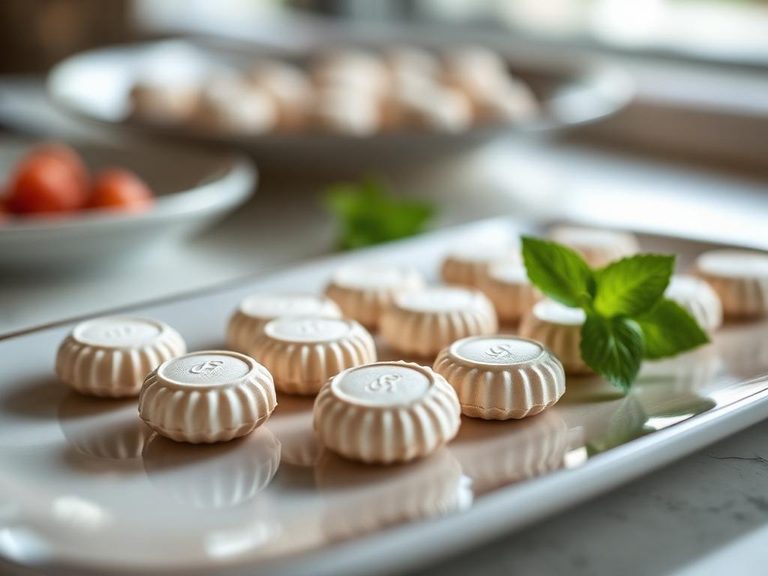
These are small, dome-shaped candies made with sorbitol, a sugar alcohol, instead of traditional sugar. They offer a firm, slightly chewy texture and a burst of sweet, often fruity or minty flavor without the high sugar content. Nutritionally, they provide a significant carbohydrate load (88.1g per 100g) primarily from the sugar alcohol, which the body metabolizes differently than sucrose.
Calorie split: 0% protein · 99% carbs · 1% fat
↓ Full nutrition💚 Why it's loved
People love them for delivering a satisfying, nostalgic candy experience—a sweet, flavorful burst—without the immediate guilt or dental impact of regular sugar. Their portability and variety of flavors make them a convenient, on-the-go treat.
⚠️ Watch-outs & how to enjoy it better
The primary downside is the laxative effect sorbitol can have when consumed in excess (typically over 20-50g per day), causing digestive discomfort. Those with irritable bowel syndrome (IBS) or fructose malabsorption should be particularly cautious. To counteract this, practice strict portion control (stick to a small handful) and consume them slowly, not on an empty stomach.
Key benefits
- Provides a sugar-free sweet treat option.
- Sorbitol is lower in calories than sugar (2.6 kcal/g vs 4 kcal/g).
- Does not promote tooth decay as strongly as sugar.
- Offers a consistent, shelf-stable texture without crystallization.
🍽️ Popular dishes
🌍 Where it's eaten
💡 Did you know?
Sorbitol, the key sweetener, was first isolated from the berries of the mountain ash tree (genus Sorbus) in 1872, which is how it got its name.
Full nutrition (USDA data · scales with serving)
| Water | 11.7 g |
| Energy | 354 kcal |
| Energy | 1482 kj |
| Protein | 0.00 g |
| Total lipid (fat) | 0.20 g |
| Ash | 0.00 g |
| Carbohydrate, by difference | 88.1 g |
| Fiber, total dietary | 0.00 g |
| Total Sugars | 70.0 g |
| Calcium, Ca | 0.00 mg |
| Iron, Fe | 0.00 mg |
| Magnesium, Mg | 0.00 mg |
| Phosphorus, P | 0.00 mg |
| Potassium, K | 0.00 mg |
| Sodium, Na | 7.0 mg |
| Zinc, Zn | 0.00 mg |
| Copper, Cu | 0.00 mg |
| Selenium, Se | 0.50 ug |
| Vitamin C, total ascorbic acid | 0.00 mg |
| Thiamin | 0.00 mg |
| Riboflavin | 0.00 mg |
| Niacin | 0.00 mg |
| Vitamin B-6 | 0.00 mg |
| Folate, total | 0.00 ug |
| Folic acid | 0.00 ug |
| Folate, food | 0.00 ug |
| Folate, DFE | 0.00 ug |
| Choline, total | 0.00 mg |
| Vitamin B-12 | 0.00 ug |
| Vitamin B-12, added | 0.00 ug |
| Vitamin A, RAE | 0.00 ug |
| Retinol | 0.00 ug |
| Carotene, beta | 0.00 ug |
| Carotene, alpha | 0.00 ug |
| Cryptoxanthin, beta | 0.00 ug |
| Vitamin A, IU | 0.00 iu |
| Lycopene | 0.00 ug |
| Lutein + zeaxanthin | 0.00 ug |
| Vitamin E (alpha-tocopherol) | 0.00 mg |
| Vitamin E, added | 0.00 mg |
| Vitamin D (D2 + D3), International Units | 0.00 iu |
| Vitamin D (D2 + D3) | 0.00 ug |
| Vitamin K (phylloquinone) | 0.00 ug |
| Alcohol, ethyl | 0.00 g |
| Caffeine | 0.00 mg |
| Theobromine | 0.00 mg |
Fat & fatty acid profile (per 100g)
| Fatty acids, total saturated | 0.03 g |
| SFA 4:0 | 0.00 g |
| SFA 6:0 | 0.00 g |
| SFA 8:0 | 0.00 g |
| SFA 10:0 | 0.00 g |
| SFA 12:0 | 0.00 g |
| SFA 14:0 | 0.00 g |
| SFA 16:0 | 0.02 g |
| SFA 18:0 | 0.00 g |
| Fatty acids, total monounsaturated | 0.09 g |
| MUFA 16:1 | 0.00 g |
| MUFA 18:1 | 0.09 g |
| MUFA 20:1 | 0.00 g |
| MUFA 22:1 | 0.00 g |
| Fatty acids, total polyunsaturated | 0.06 g |
| PUFA 18:2 | 0.06 g |
| PUFA 18:3 | 0.00 g |
| PUFA 18:4 | 0.00 g |
| PUFA 20:4 | 0.00 g |
| PUFA 20:5 n-3 (EPA) | 0.00 g |
| PUFA 22:5 n-3 (DPA) | 0.00 g |
| PUFA 22:6 n-3 (DHA) | 0.00 g |
| Cholesterol | 0.00 mg |
Amino acid profile (per 100g)
Estimated from Candies, honey-combed, with peanut butter — USDA does not publish this profile for Candies.
| Tryptophan | 0.09 g |
| Threonine | 0.21 g |
| Isoleucine | 0.24 g |
| Leucine | 0.61 g |
| Lysine | 0.27 g |
| Methionine | 0.10 g |
| Cystine | 0.09 g |
| Phenylalanine | 0.47 g |
| Tyrosine | 0.33 g |
| Valine | 0.31 g |
| Arginine | 1.1 g |
| Histidine | 0.22 g |
| Alanine | 0.36 g |
| Aspartic acid | 1.2 g |
| Glutamic acid | 2.0 g |
| Glycine | 0.56 g |
| Proline | 0.55 g |
| Serine | 0.58 g |
FAQ
Are these completely sugar-free?
They are labeled 'no sugar' because they use sorbitol, a sugar alcohol, instead of sucrose. However, sorbitol is a carbohydrate and still contributes to the total carb count.
Can diabetics eat these?
Sorbitol has a lower glycemic index than sugar, but it still affects blood glucose levels. Diabetics should account for the carbohydrates and consult their healthcare provider, as individual responses vary.
Why do they sometimes have a 'cooling' sensation?
Sorbitol has an endothermic (heat-absorbing) heat of solution. As it dissolves in saliva, it draws a small amount of heat from the mouth, creating a mild cooling feeling.
Nutrient density (calculated · NRF9.3)
Nutrient Rich Foods index: beneficial nutrients (protein, fiber, vitamins, minerals) minus saturated fat, added sugar & sodium, per 100 kcal.
NRF9.3 index — Fulgoni, Keast & Drewnowski, 2009. Computed from USDA nutrients.
Weight-loss friendliness (composite index)
Energy density 3.54 kcal/g · 0% calories from protein · 0.0 g fiber · 70.0 g sugar per 100 g.
Composite of energy density (Rolls et al., 1999), protein & fiber satiety, minus sugar. A calculated heuristic — ranks satiety-per-calorie, not a clinical measure.
Dietary load (calculated from USDA values)
Potential renal acid load. Positive = acid-forming, negative = alkaline-forming.
Sodium:potassium per WHO potassium guidance. Computed from USDA nutrients.