

Cake, fruit cake
Common food

Photo: Wikipedia
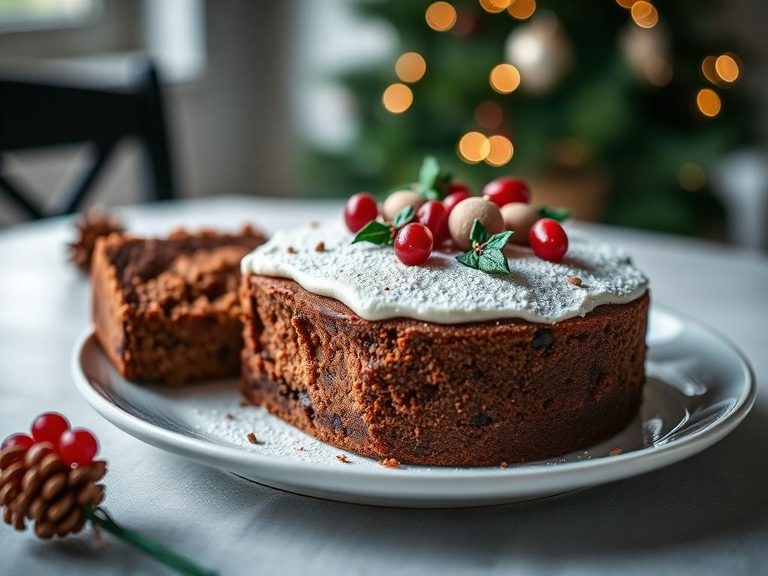
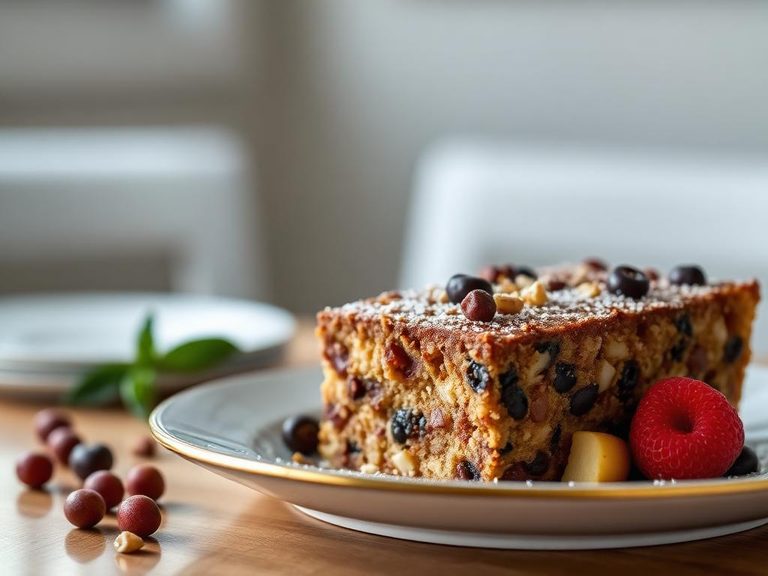
A dense, richly spiced cake packed with candied and dried fruits, often soaked in spirits, offering a chewy, moist texture with a deep, sweet, and complex flavor profile. Its substantial carbohydrate content, primarily from sugars and refined flour, makes it a high-energy treat, while the fruit pieces provide small bursts of natural sweetness and texture.
Calorie split: 3% protein · 72% carbs · 24% fat
↓ Full nutrition💚 Why it's loved
People cherish fruit cake for its luxurious, festive taste and its deep-rooted association with holidays like Christmas and weddings, symbolizing celebration and tradition. Its versatility allows it to be enjoyed plain, toasted, or paired with cheeses and spirits, making it a centerpiece for gatherings.
⚠️ Watch-outs & how to enjoy it better
Its high sugar and refined carbohydrate content can cause rapid blood-sugar spikes, making it unsuitable for those managing diabetes or insulin resistance. The dense, calorie-rich nature requires portion control, and common allergens like wheat (gluten), eggs, and sometimes nuts are often present. To counteract, pair a small slice with a source of protein or fat (like a handful of nuts or cheese) to slow sugar absorption, and choose versions with more whole fruits and less added sugar.
Key benefits
- Provides quick energy from carbohydrates and sugars
- Contains small amounts of dietary fiber from dried fruits
- Offers a concentrated source of calories for energy needs
- The spices (like cinnamon, nutmeg) may have antioxidant properties
- Long shelf life due to high sugar content and alcohol soaking
🍽️ Popular dishes
🌍 Where it's eaten
💡 Did you know?
Traditional British Christmas cakes were originally 'plumb cakes' and were so dense and rich they were often aged for months, sometimes wrapped in cloth and fed with brandy or rum to preserve and enhance flavor.
Full nutrition (USDA data · scales with serving)
| Water | 25.3 g |
| Energy | 324 kcal |
| Protein | 2.9 g |
| Total lipid (fat) | 9.1 g |
| Carbohydrate, by difference | 61.6 g |
| Fiber, total dietary | 3.7 g |
| Total Sugars | 27.4 g |
| Calcium, Ca | 33.0 mg |
| Iron, Fe | 2.1 mg |
| Magnesium, Mg | 16.0 mg |
| Phosphorus, P | 52.0 mg |
| Potassium, K | 153 mg |
| Sodium, Na | 101 mg |
| Zinc, Zn | 0.27 mg |
| Copper, Cu | 0.05 mg |
| Selenium, Se | 2.0 ug |
| Vitamin C, total ascorbic acid | 0.50 mg |
| Thiamin | 0.05 mg |
| Riboflavin | 0.10 mg |
| Niacin | 0.79 mg |
| Vitamin B-6 | 0.05 mg |
| Folate, total | 20.0 ug |
| Folic acid | 17.0 ug |
| Folate, food | 3.0 ug |
| Folate, DFE | 32.0 ug |
| Choline, total | 8.9 mg |
| Vitamin B-12 | 0.01 ug |
| Vitamin B-12, added | 0.00 ug |
| Vitamin A, RAE | 7.0 ug |
| Retinol | 7.0 ug |
| Carotene, beta | 3.0 ug |
| Carotene, alpha | 1.0 ug |
| Cryptoxanthin, beta | 1.0 ug |
| Lycopene | 0.00 ug |
| Lutein + zeaxanthin | 21.0 ug |
| Vitamin E (alpha-tocopherol) | 0.90 mg |
| Vitamin E, added | 0.00 mg |
| Vitamin D (D2 + D3) | 0.00 ug |
| Vitamin K (phylloquinone) | 1.5 ug |
| Alcohol, ethyl | 0.00 g |
| Caffeine | 0.00 mg |
| Theobromine | 0.00 mg |
Fat & fatty acid profile (per 100g)
| Fatty acids, total saturated | 1.0 g |
| SFA 4:0 | 0.00 g |
| SFA 6:0 | 0.00 g |
| SFA 8:0 | 0.00 g |
| SFA 10:0 | 0.00 g |
| SFA 12:0 | 0.00 g |
| SFA 14:0 | 0.02 g |
| SFA 16:0 | 0.74 g |
| SFA 18:0 | 0.27 g |
| Fatty acids, total monounsaturated | 4.2 g |
| MUFA 16:1 | 0.04 g |
| MUFA 18:1 | 4.1 g |
| MUFA 20:1 | 0.03 g |
| MUFA 22:1 | 0.00 g |
| Fatty acids, total polyunsaturated | 3.3 g |
| PUFA 18:2 | 3.0 g |
| PUFA 18:3 | 0.34 g |
| PUFA 18:4 | 0.00 g |
| PUFA 20:4 | 0.00 g |
| PUFA 20:5 n-3 (EPA) | 0.00 g |
| PUFA 22:5 n-3 (DPA) | 0.00 g |
| PUFA 22:6 n-3 (DHA) | 0.00 g |
| Cholesterol | 5.0 mg |
Amino acid profile (per 100g)
Estimated from Bread, pound cake type, pan de torta salvadoran — USDA does not publish this profile for Cake.
| Tryptophan | 0.09 g |
| Threonine | 0.16 g |
| Isoleucine | 0.24 g |
| Leucine | 0.54 g |
| Lysine | 0.15 g |
| Methionine | 0.18 g |
| Cystine | 0.06 g |
| Phenylalanine | 0.35 g |
| Tyrosine | 0.17 g |
| Valine | 0.33 g |
| Arginine | 0.18 g |
| Histidine | 0.10 g |
| Alanine | 0.29 g |
| Aspartic acid | 0.39 g |
| Glutamic acid | 2.2 g |
| Glycine | 0.23 g |
| Proline | 1.1 g |
| Serine | 0.38 g |
| Hydroxyproline | 0.00 g |
FAQ
Why is fruit cake so dense and heavy?
Its density comes from a high ratio of dried fruits and nuts to flour, and the batter is often mixed to a thick consistency. The soaking process in alcohol or syrup also adds moisture and weight, creating a compact, moist texture.
Can fruit cake be made without alcohol?
Yes, many modern and traditional recipes use fruit juices, tea, or syrups (like simple syrup or molasses) to soak the fruits and add moisture, making it suitable for those who avoid alcohol.
How long does fruit cake last?
When properly stored in a cool, dark place and periodically 'fed' with alcohol or syrup, a traditional fruit cake can last for months or even over a year. Its high sugar and alcohol content act as natural preservatives.
Nutrient density (calculated · NRF9.3)
Nutrient Rich Foods index: beneficial nutrients (protein, fiber, vitamins, minerals) minus saturated fat, added sugar & sodium, per 100 kcal.
NRF9.3 index — Fulgoni, Keast & Drewnowski, 2009. Computed from USDA nutrients.
Weight-loss friendliness (composite index)
Energy density 3.24 kcal/g · 4% calories from protein · 3.7 g fiber · 27.4 g sugar per 100 g.
Composite of energy density (Rolls et al., 1999), protein & fiber satiety, minus sugar. A calculated heuristic — ranks satiety-per-calorie, not a clinical measure.
Dietary load (calculated from USDA values)
Potential renal acid load. Positive = acid-forming, negative = alkaline-forming.
Sodium-to-potassium ratio: 0.66 (lower is better — aim for ≤ 1)
Sodium:potassium per WHO potassium guidance. Computed from USDA nutrients.