

Coffee cake, crumb or quick-bread type, with fruit
Common food
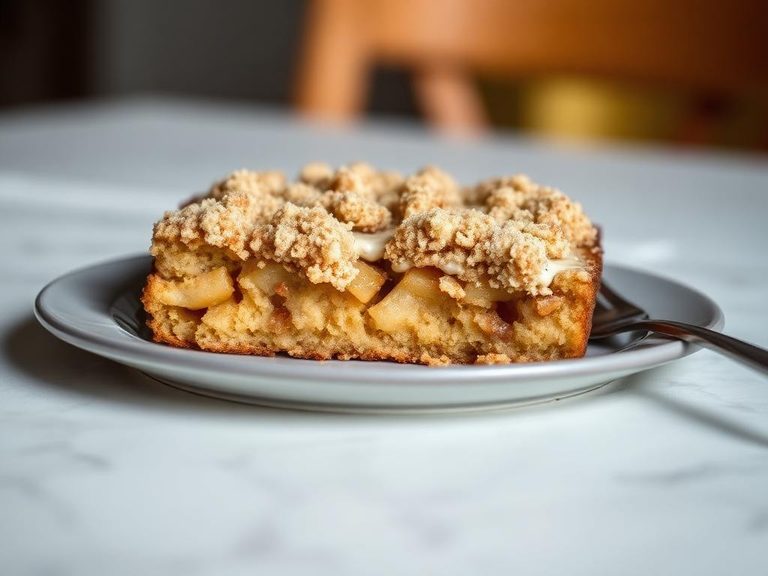
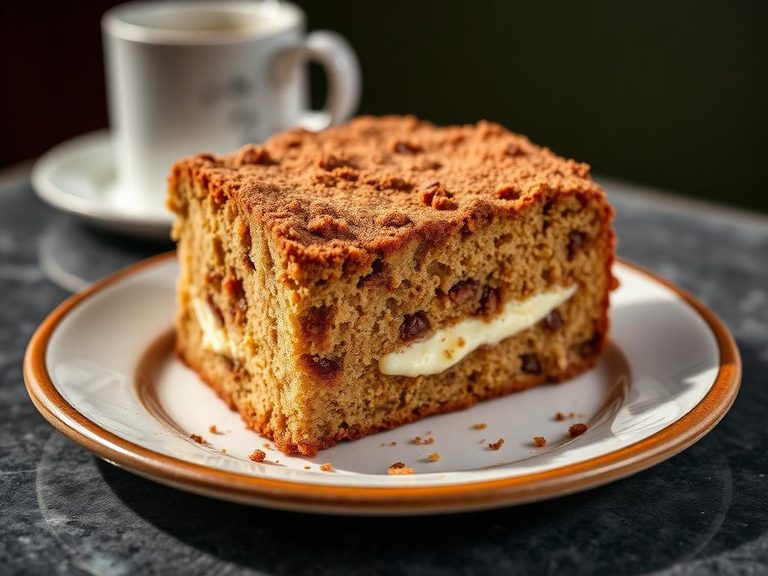
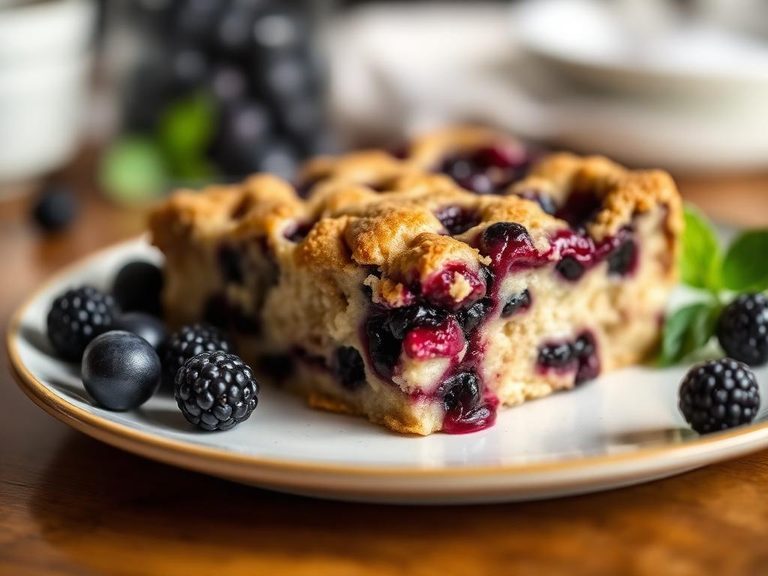
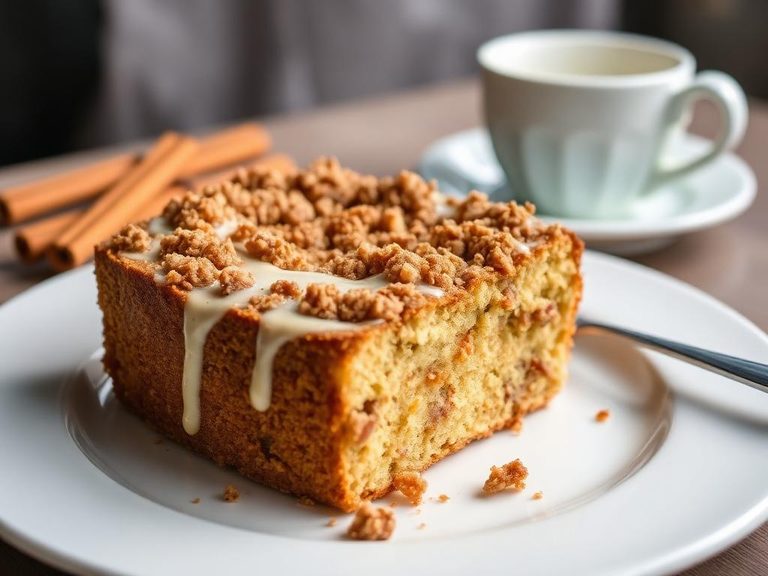
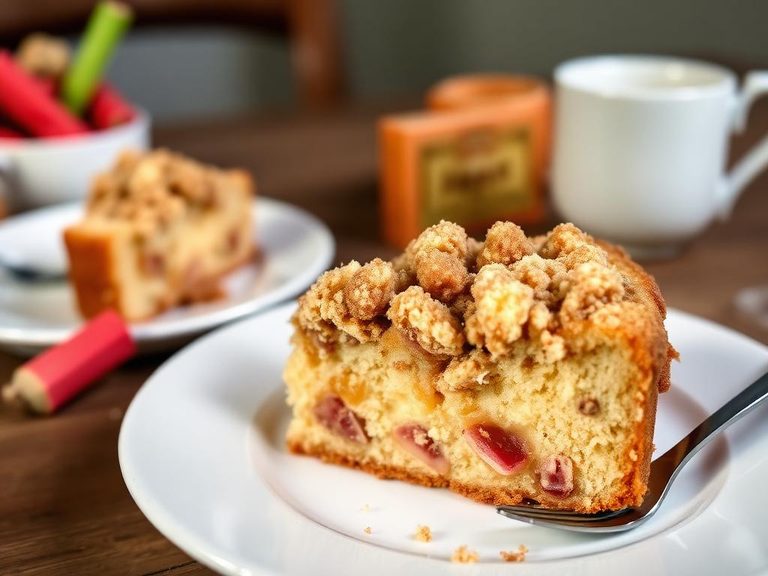
A moist, tender quick bread or cake, distinguished by a sweet, buttery streusel crumb topping and often studded with fruit like apples, berries, or cinnamon-swirled raisins. Its texture is a delightful contrast between the soft, cakey base and the crunchy, sugary topping. Nutritionally, it's a significant source of carbohydrates and added sugars, providing quick energy but little protein or fiber.
Calorie split: 5% protein · 62% carbs · 33% fat
↓ Full nutrition💚 Why it's loved
People adore it for the irresistible contrast between the soft, moist cake and the sweet, crunchy crumb topping, often paired with a hot beverage. It's a beloved staple of coffee breaks, brunches, and holiday mornings, evoking a sense of comfort and nostalgia.
⚠️ Watch-outs & how to enjoy it better
Its high sugar and refined carbohydrate content can lead to blood sugar spikes and crashes, and it's calorie-dense with low satiety. Those monitoring blood sugar or calorie intake should practice strict portion control and pair a small slice with protein (like Greek yogurt) or healthy fat (like nuts) to slow sugar absorption.
Key benefits
- Provides quick energy from carbohydrates
- Can be a comforting, mood-boosting treat
- Fruit additions offer small amounts of vitamins and antioxidants
- Versatile base for various fruit and spice combinations
- Often enjoyed as a social or cultural staple at gatherings
🍽️ Popular dishes
🌍 Where it's eaten
💡 Did you know?
The term 'coffee cake' is a misnomer; it traditionally refers to a cake meant to be *eaten with* coffee, not one that contains coffee as an ingredient.
Full nutrition (USDA data · scales with serving)
| Water | 32.6 g |
| Energy | 322 kcal |
| Protein | 4.2 g |
| Total lipid (fat) | 11.8 g |
| Carbohydrate, by difference | 50.2 g |
| Fiber, total dietary | 1.2 g |
| Total Sugars | 33.8 g |
| Calcium, Ca | 87.0 mg |
| Iron, Fe | 1.4 mg |
| Magnesium, Mg | 17.0 mg |
| Phosphorus, P | 90.0 mg |
| Potassium, K | 105 mg |
| Sodium, Na | 203 mg |
| Zinc, Zn | 0.45 mg |
| Copper, Cu | 0.11 mg |
| Selenium, Se | 5.3 ug |
| Vitamin C, total ascorbic acid | 0.90 mg |
| Thiamin | 0.17 mg |
| Riboflavin | 0.14 mg |
| Niacin | 1.3 mg |
| Vitamin B-6 | 0.07 mg |
| Folate, total | 30.0 ug |
| Folic acid | 19.0 ug |
| Folate, food | 12.0 ug |
| Folate, DFE | 43.0 ug |
| Choline, total | 21.4 mg |
| Vitamin B-12 | 0.09 ug |
| Vitamin B-12, added | 0.00 ug |
| Vitamin A, RAE | 79.0 ug |
| Retinol | 77.0 ug |
| Carotene, beta | 19.0 ug |
| Carotene, alpha | 0.00 ug |
| Cryptoxanthin, beta | 4.0 ug |
| Lycopene | 0.00 ug |
| Lutein + zeaxanthin | 32.0 ug |
| Vitamin E (alpha-tocopherol) | 0.12 mg |
| Vitamin E, added | 0.00 mg |
| Vitamin D (D2 + D3) | 0.30 ug |
| Vitamin K (phylloquinone) | 1.0 ug |
| Alcohol, ethyl | 0.00 g |
| Caffeine | 0.00 mg |
| Theobromine | 0.00 mg |
Fat & fatty acid profile (per 100g)
| Fatty acids, total saturated | 4.4 g |
| SFA 4:0 | 0.17 g |
| SFA 6:0 | 0.12 g |
| SFA 8:0 | 0.07 g |
| SFA 10:0 | 0.16 g |
| SFA 12:0 | 0.19 g |
| SFA 14:0 | 0.61 g |
| SFA 16:0 | 2.2 g |
| SFA 18:0 | 0.76 g |
| Fatty acids, total monounsaturated | 2.2 g |
| MUFA 16:1 | 0.10 g |
| MUFA 18:1 | 2.0 g |
| MUFA 20:1 | 0.02 g |
| MUFA 22:1 | 0.00 g |
| Fatty acids, total polyunsaturated | 3.2 g |
| PUFA 18:2 | 2.5 g |
| PUFA 18:3 | 0.55 g |
| PUFA 18:4 | 0.00 g |
| PUFA 20:4 | 0.01 g |
| PUFA 20:5 n-3 (EPA) | 0.00 g |
| PUFA 22:5 n-3 (DPA) | 0.00 g |
| PUFA 22:6 n-3 (DHA) | 0.00 g |
| Cholesterol | 40.0 mg |
Amino acid profile (per 100g)
Estimated from Cake, coffeecake, cheese — USDA does not publish this profile for Coffee cake.
| Tryptophan | 0.08 g |
| Threonine | 0.26 g |
| Isoleucine | 0.33 g |
| Leucine | 0.57 g |
| Lysine | 0.40 g |
| Methionine | 0.14 g |
| Cystine | 0.11 g |
| Phenylalanine | 0.35 g |
| Tyrosine | 0.26 g |
| Valine | 0.36 g |
| Arginine | 0.30 g |
| Histidine | 0.19 g |
| Alanine | 0.26 g |
| Aspartic acid | 0.47 g |
| Glutamic acid | 1.8 g |
| Glycine | 0.21 g |
| Proline | 0.63 g |
| Serine | 0.37 g |
FAQ
Is coffee cake the same as crumb cake?
They are very similar and often used interchangeably. The main distinction is that crumb cake has a much thicker, more pronounced streusel topping, sometimes equal in thickness to the cake layer itself, while coffee cake's topping is typically thinner.
Can I make it healthier?
Yes. You can reduce sugar in both the cake and topping, use whole-wheat flour for part of the flour, increase fruit content, and add nuts or seeds for fiber and protein. Using Greek yogurt or applesauce can also reduce fat.
Why did my coffee cake sink in the middle?
This is often due to underbaking, too much leavening (baking powder/soda), or opening the oven door too early. Ensure your oven is properly calibrated, follow the recipe precisely, and avoid peeking during the first 3/4 of the baking time.
Nutrient density (calculated · NRF9.3)
Nutrient Rich Foods index: beneficial nutrients (protein, fiber, vitamins, minerals) minus saturated fat, added sugar & sodium, per 100 kcal.
NRF9.3 index — Fulgoni, Keast & Drewnowski, 2009. Computed from USDA nutrients.
Weight-loss friendliness (composite index)
Energy density 3.22 kcal/g · 5% calories from protein · 1.2 g fiber · 33.8 g sugar per 100 g.
Composite of energy density (Rolls et al., 1999), protein & fiber satiety, minus sugar. A calculated heuristic — ranks satiety-per-calorie, not a clinical measure.
Dietary load (calculated from USDA values)
Potential renal acid load. Positive = acid-forming, negative = alkaline-forming.
Sodium-to-potassium ratio: 1.93 (lower is better — aim for ≤ 1)
Sodium:potassium per WHO potassium guidance. Computed from USDA nutrients.