

Coffee cake, crumb or quick-bread type
Common food
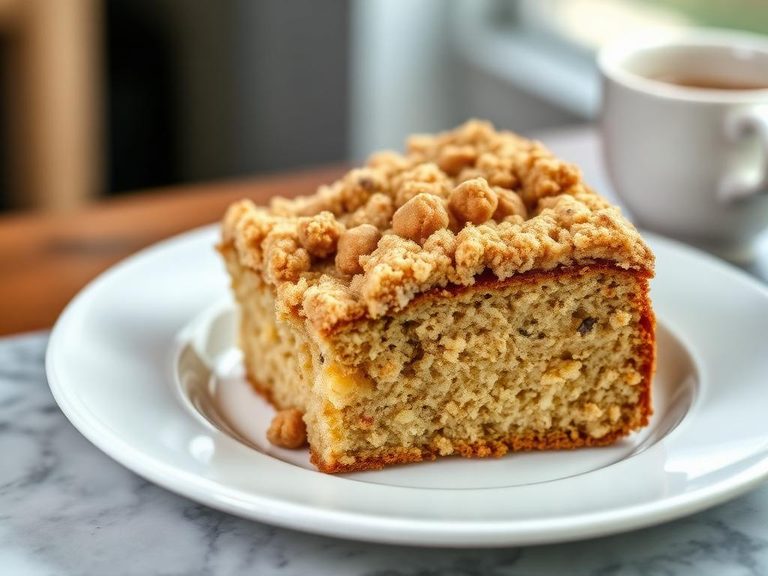
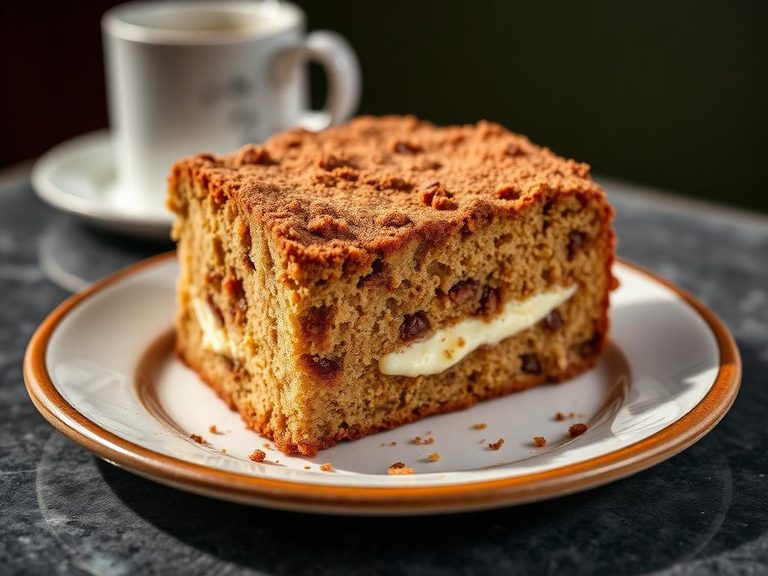
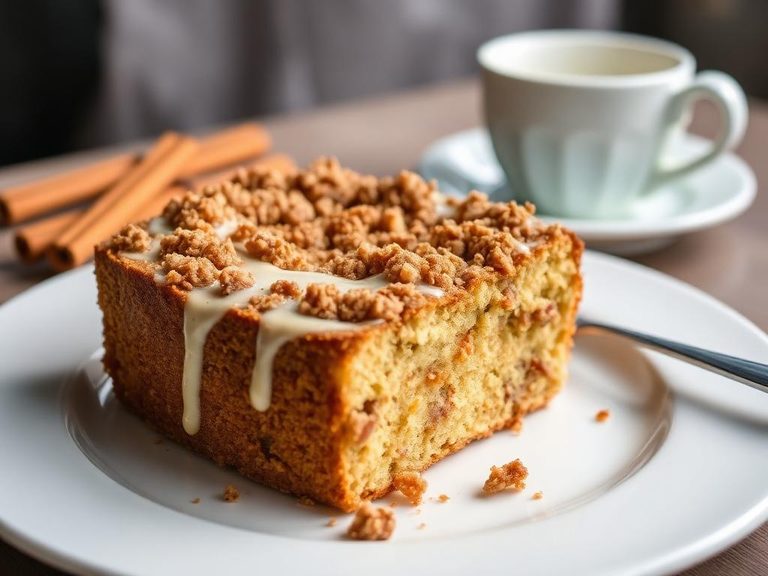
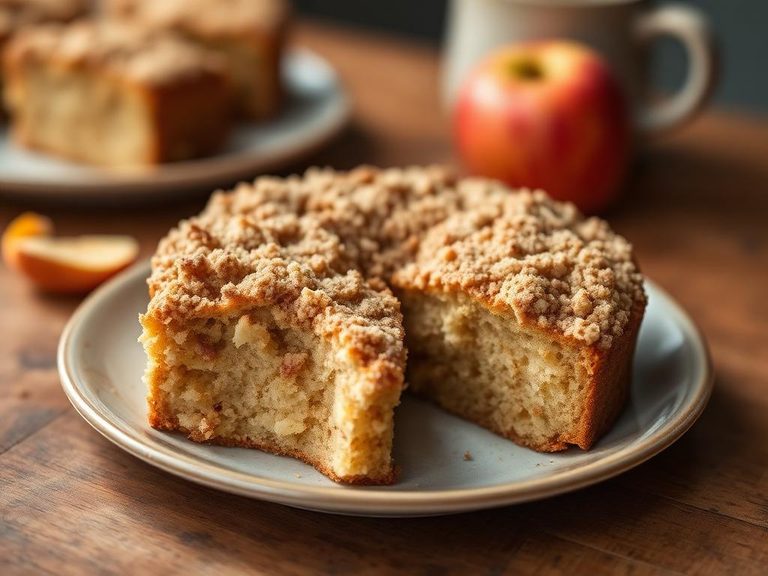
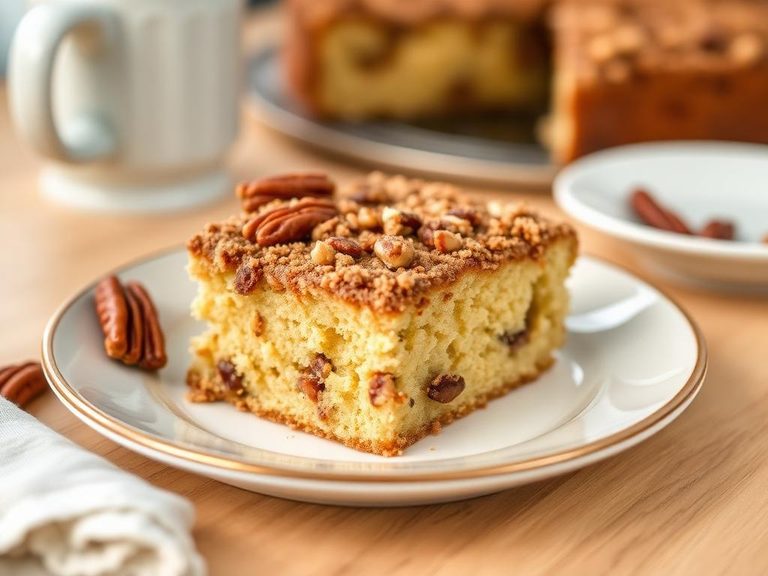
A dense, moist cake with a buttery, cinnamon-spiced crumb topping, often baked in a single layer. Its texture is tender yet substantial, with a sweet, buttery flavor profile and a crunchy, sugary streusel. Nutritionally, it's a high-energy treat, delivering significant calories and sugar from its refined carbs and added fats.
Calorie split: 7% protein · 52% carbs · 42% fat
↓ Full nutrition💚 Why it's loved
People adore it for its comforting, nostalgic flavor—a perfect balance of sweet, buttery cake and crunchy, spiced topping. It's a beloved staple at coffee breaks, brunches, and potlucks, symbolizing casual, home-style baking.
⚠️ Watch-outs & how to enjoy it better
Its high sugar and refined carbohydrate content can lead to rapid blood-sugar spikes and subsequent crashes. To mitigate this, enjoy a modest portion alongside a source of protein (like Greek yogurt) or healthy fat (like nuts) to slow sugar absorption. Those monitoring calorie intake should be mindful, as a standard slice can easily exceed 400 calories.
Key benefits
- Quick to prepare, often requiring no special equipment
- Provides a quick source of energy from carbohydrates
- The crumb topping adds textural contrast and flavor depth
- A versatile base for additions like nuts, fruit, or chocolate chips
🍽️ Popular dishes
🌍 Where it's eaten
💡 Did you know?
Despite its name, traditional coffee cake contains no coffee; it's meant to be served *with* coffee, though some modern recipes do incorporate coffee into the batter or glaze for added depth.
Full nutrition (USDA data · scales with serving)
| Water | 21.9 g |
| Energy | 396 kcal |
| Protein | 6.5 g |
| Total lipid (fat) | 18.4 g |
| Carbohydrate, by difference | 51.3 g |
| Fiber, total dietary | 1.4 g |
| Total Sugars | 26.6 g |
| Calcium, Ca | 134 mg |
| Iron, Fe | 2.2 mg |
| Magnesium, Mg | 26.0 mg |
| Phosphorus, P | 138 mg |
| Potassium, K | 132 mg |
| Sodium, Na | 319 mg |
| Zinc, Zn | 0.68 mg |
| Copper, Cu | 0.16 mg |
| Selenium, Se | 8.2 ug |
| Vitamin C, total ascorbic acid | 0.10 mg |
| Thiamin | 0.27 mg |
| Riboflavin | 0.20 mg |
| Niacin | 2.0 mg |
| Vitamin B-6 | 0.09 mg |
| Folate, total | 48.0 ug |
| Folic acid | 29.0 ug |
| Folate, food | 19.0 ug |
| Folate, DFE | 68.0 ug |
| Choline, total | 32.3 mg |
| Vitamin B-12 | 0.14 ug |
| Vitamin B-12, added | 0.00 ug |
| Vitamin A, RAE | 123 ug |
| Retinol | 121 ug |
| Carotene, beta | 24.0 ug |
| Carotene, alpha | 0.00 ug |
| Cryptoxanthin, beta | 2.0 ug |
| Lycopene | 0.00 ug |
| Lutein + zeaxanthin | 44.0 ug |
| Vitamin E (alpha-tocopherol) | 0.17 mg |
| Vitamin E, added | 0.00 mg |
| Vitamin D (D2 + D3) | 0.50 ug |
| Vitamin K (phylloquinone) | 1.3 ug |
| Alcohol, ethyl | 0.00 g |
| Caffeine | 0.00 mg |
| Theobromine | 0.00 mg |
Fat & fatty acid profile (per 100g)
| Fatty acids, total saturated | 6.9 g |
| SFA 4:0 | 0.27 g |
| SFA 6:0 | 0.19 g |
| SFA 8:0 | 0.11 g |
| SFA 10:0 | 0.26 g |
| SFA 12:0 | 0.29 g |
| SFA 14:0 | 0.95 g |
| SFA 16:0 | 3.4 g |
| SFA 18:0 | 1.2 g |
| Fatty acids, total monounsaturated | 3.4 g |
| MUFA 16:1 | 0.15 g |
| MUFA 18:1 | 3.1 g |
| MUFA 20:1 | 0.03 g |
| MUFA 22:1 | 0.00 g |
| Fatty acids, total polyunsaturated | 5.0 g |
| PUFA 18:2 | 4.0 g |
| PUFA 18:3 | 0.87 g |
| PUFA 18:4 | 0.00 g |
| PUFA 20:4 | 0.01 g |
| PUFA 20:5 n-3 (EPA) | 0.00 g |
| PUFA 22:5 n-3 (DPA) | 0.01 g |
| PUFA 22:6 n-3 (DHA) | 0.00 g |
| Cholesterol | 63.0 mg |
Amino acid profile (per 100g)
Estimated from Cake, coffeecake, cheese — USDA does not publish this profile for Coffee cake.
| Tryptophan | 0.08 g |
| Threonine | 0.26 g |
| Isoleucine | 0.33 g |
| Leucine | 0.57 g |
| Lysine | 0.40 g |
| Methionine | 0.14 g |
| Cystine | 0.11 g |
| Phenylalanine | 0.35 g |
| Tyrosine | 0.26 g |
| Valine | 0.36 g |
| Arginine | 0.30 g |
| Histidine | 0.19 g |
| Alanine | 0.26 g |
| Aspartic acid | 0.47 g |
| Glutamic acid | 1.8 g |
| Glycine | 0.21 g |
| Proline | 0.63 g |
| Serine | 0.37 g |
FAQ
What's the difference between coffee cake and crumb cake?
Crumb cake is a subtype of coffee cake defined by its exceptionally thick, streusel-like crumb topping, which should be as thick as the cake layer itself. Regular coffee cake may have a lighter streusel, a glaze, or no topping at all.
Can coffee cake be made ahead?
Yes. The batter can often be refrigerated overnight before baking. Baked cake can be wrapped tightly and stored at room temperature for 2-3 days, or frozen for up to 3 months. The crumb topping is best added just before baking for maximum crunch.
Why is it called 'quick-bread type'?
This refers to cakes leavened with chemical agents like baking powder or baking soda instead of yeast. They are 'quick' because they require no rising time and are mixed and baked in one session, resulting in a tender, cake-like crumb.
Nutrient density (calculated · NRF9.3)
Nutrient Rich Foods index: beneficial nutrients (protein, fiber, vitamins, minerals) minus saturated fat, added sugar & sodium, per 100 kcal.
NRF9.3 index — Fulgoni, Keast & Drewnowski, 2009. Computed from USDA nutrients.
Weight-loss friendliness (composite index)
Energy density 3.96 kcal/g · 7% calories from protein · 1.4 g fiber · 26.6 g sugar per 100 g.
Composite of energy density (Rolls et al., 1999), protein & fiber satiety, minus sugar. A calculated heuristic — ranks satiety-per-calorie, not a clinical measure.
Dietary load (calculated from USDA values)
Potential renal acid load. Positive = acid-forming, negative = alkaline-forming.
Sodium-to-potassium ratio: 2.42 (lower is better — aim for ≤ 1)
Sodium:potassium per WHO potassium guidance. Computed from USDA nutrients.