

Cake, coffeecake, fruit
Whole food · Baked Products
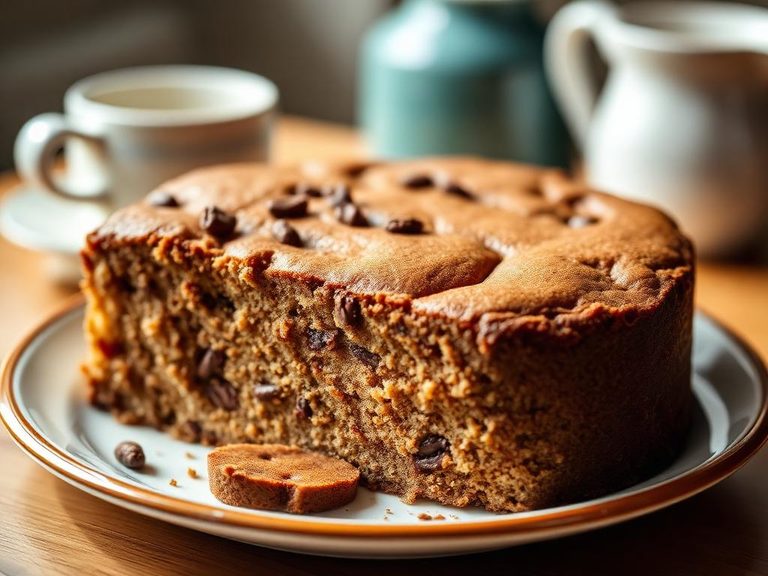
A moist, tender cake studded with juicy fruit pieces, offering a delightful contrast between soft crumb and sweet-tart bursts of flavor. Its golden-brown crust gives way to a light, airy interior, making it a comforting treat for any time of day. Nutritionally, it provides a moderate energy boost with a balance of carbohydrates and fats, though its fiber content is modest.
Calorie split: 7% protein · 65% carbs · 29% fat
↓ Full nutrition💚 Why it's loved
People adore its comforting, nostalgic flavor and the way the fruit adds natural sweetness and moisture, making each bite a pleasant surprise. It's a beloved staple in coffee shops and home kitchens, often enjoyed with coffee or tea for a simple, satisfying moment.
⚠️ Watch-outs & how to enjoy it better
Its high carbohydrate content can lead to blood sugar spikes, especially for those with insulin sensitivity or diabetes. To counteract this, pair a small slice with a source of protein or healthy fat (like Greek yogurt or nuts) to slow sugar absorption, and practice portion control by sticking to a single, modest serving.
Key benefits
- Provides quick energy from carbohydrates
- Contains some dietary fiber from fruit pieces
- Offers a small amount of protein
- Can be a source of antioxidants if made with berries
- Versatile for breakfast, dessert, or snack
🍽️ Popular dishes


🌍 Where it's eaten
💡 Did you know?
The term 'coffeecake' doesn't necessarily mean it contains coffee; it originally referred to a cake meant to be eaten alongside a cup of coffee.
Full nutrition (USDA data · scales with serving)
| Water | 31.7 g |
| Energy | 311 kcal |
| Energy | 1301 kj |
| Protein | 5.2 g |
| Total lipid (fat) | 10.2 g |
| Ash | 1.2 g |
| Carbohydrate, by difference | 51.5 g |
| Fiber, total dietary | 2.5 g |
| Calcium, Ca | 45.0 mg |
| Iron, Fe | 2.4 mg |
| Magnesium, Mg | 17.0 mg |
| Phosphorus, P | 118 mg |
| Potassium, K | 90.0 mg |
| Sodium, Na | 385 mg |
| Zinc, Zn | 0.65 mg |
| Copper, Cu | 0.03 mg |
| Manganese, Mn | 0.24 mg |
| Selenium, Se | 16.5 ug |
| Vitamin C, total ascorbic acid | 0.80 mg |
| Thiamin | 0.04 mg |
| Riboflavin | 0.19 mg |
| Niacin | 2.6 mg |
| Pantothenic acid | 0.66 mg |
| Vitamin B-6 | 0.04 mg |
| Folate, total | 47.0 ug |
| Folic acid | 28.0 ug |
| Folate, food | 19.0 ug |
| Folate, DFE | 67.0 ug |
| Vitamin B-12 | 0.02 ug |
| Vitamin A, RAE | 7.0 ug |
| Retinol | 0.00 ug |
| Vitamin A, IU | 140 iu |
| Alcohol, ethyl | 0.00 g |
Fat & fatty acid profile (per 100g)
| Fatty acids, total saturated | 2.5 g |
| SFA 4:0 | 0.00 g |
| SFA 6:0 | 0.00 g |
| SFA 8:0 | 0.00 g |
| SFA 10:0 | 0.00 g |
| SFA 12:0 | 0.00 g |
| SFA 14:0 | 0.05 g |
| SFA 16:0 | 1.3 g |
| SFA 18:0 | 1.1 g |
| Fatty acids, total monounsaturated | 5.6 g |
| MUFA 16:1 | 0.01 g |
| MUFA 18:1 | 5.5 g |
| MUFA 20:1 | 0.00 g |
| MUFA 22:1 | 0.00 g |
| Fatty acids, total polyunsaturated | 1.5 g |
| PUFA 18:2 | 1.4 g |
| PUFA 18:3 | 0.08 g |
| PUFA 18:4 | 0.00 g |
| PUFA 20:4 | 0.00 g |
| PUFA 20:5 n-3 (EPA) | 0.00 g |
| PUFA 22:5 n-3 (DPA) | 0.00 g |
| PUFA 22:6 n-3 (DHA) | 0.00 g |
| Cholesterol | 7.0 mg |
Amino acid profile (per 100g)
| Tryptophan | 0.06 g |
| Threonine | 0.17 g |
| Isoleucine | 0.21 g |
| Leucine | 0.36 g |
| Lysine | 0.19 g |
| Methionine | 0.09 g |
| Cystine | 0.10 g |
| Phenylalanine | 0.25 g |
| Tyrosine | 0.15 g |
| Valine | 0.24 g |
| Arginine | 0.25 g |
| Histidine | 0.11 g |
| Alanine | 0.23 g |
| Aspartic acid | 0.33 g |
| Glutamic acid | 1.4 g |
| Glycine | 0.27 g |
| Proline | 0.52 g |
| Serine | 0.26 g |
FAQ
Is coffeecake the same as coffee cake?
Not exactly. 'Coffeecake' is a specific type of cake, often with a streusel topping, designed to be served with coffee. 'Coffee cake' can sometimes refer to any cake flavored with coffee.
Can I make this cake healthier?
Yes, you can reduce sugar, use whole-grain flour, and increase the fruit content. Adding nuts or seeds can boost fiber and protein.
What fruits work best in this cake?
Sturdier fruits like apples, pears, blueberries, or cranberries hold up well during baking. Softer fruits like strawberries may release too much moisture.
Nutrient density (calculated · NRF9.3)
Nutrient Rich Foods index: beneficial nutrients (protein, fiber, vitamins, minerals) minus saturated fat, added sugar & sodium, per 100 kcal.
NRF9.3 index — Fulgoni, Keast & Drewnowski, 2009. Computed from USDA nutrients.
Weight-loss friendliness (composite index)
Energy density 3.11 kcal/g · 7% calories from protein · 2.5 g fiber · 0.0 g sugar per 100 g.
Composite of energy density (Rolls et al., 1999), protein & fiber satiety, minus sugar. A calculated heuristic — ranks satiety-per-calorie, not a clinical measure.
Dietary load (calculated from USDA values)
Potential renal acid load. Positive = acid-forming, negative = alkaline-forming.
Sodium-to-potassium ratio: 4.28 (lower is better — aim for ≤ 1)
Sodium:potassium per WHO potassium guidance. Computed from USDA nutrients.