

Beverages, Orange-flavor drink, breakfast type, with pulp, frozen concentrate, prepared with water
Whole food · Beverages

Photo: Wikipedia
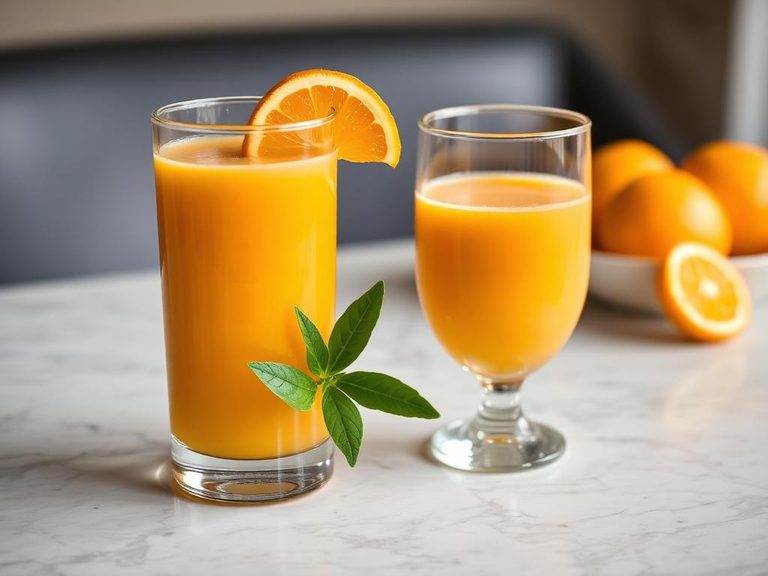
This is a sweet, tangy orange-flavored drink made by reconstituting a frozen concentrate with water, resulting in a bright, pulpy beverage with a classic breakfast-table appeal. It delivers a quick, sugary energy boost with minimal fat or protein, making it a light, refreshing choice for a morning pick-me-up.
Calorie split: 0% protein · 97% carbs · 3% fat
↓ Full nutrition💚 Why it's loved
People love it for its nostalgic, sweet-tart flavor that instantly evokes a classic breakfast setting. Its versatility allows it to be served chilled as a standalone drink, used as a base for smoothies, or even as a quick flavoring for marinades and desserts.
⚠️ Watch-outs & how to enjoy it better
The high sugar content (nearly 12g per 100g) can cause rapid blood-sugar spikes, making it a poor choice for those managing diabetes or seeking sustained energy. To counteract this, pair it with a source of protein or healthy fat (like eggs or nuts) to slow sugar absorption, and practice strict portion control by diluting it further with water or using a smaller glass.
Key benefits
- Provides a quick source of energy from carbohydrates
- Contains some vitamin C from orange flavoring
- Convenient and easy to prepare from frozen concentrate
- Offers a familiar, comforting taste for many
- Hydrating when mixed with water
🍽️ Popular dishes
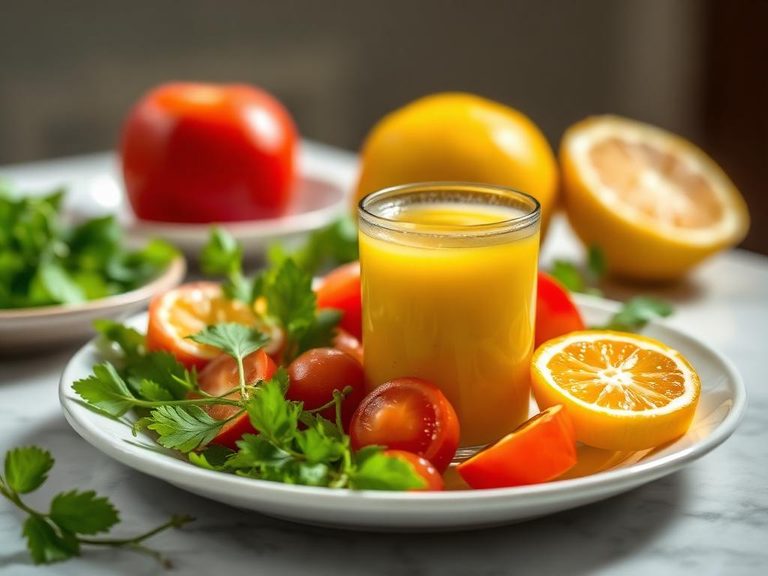
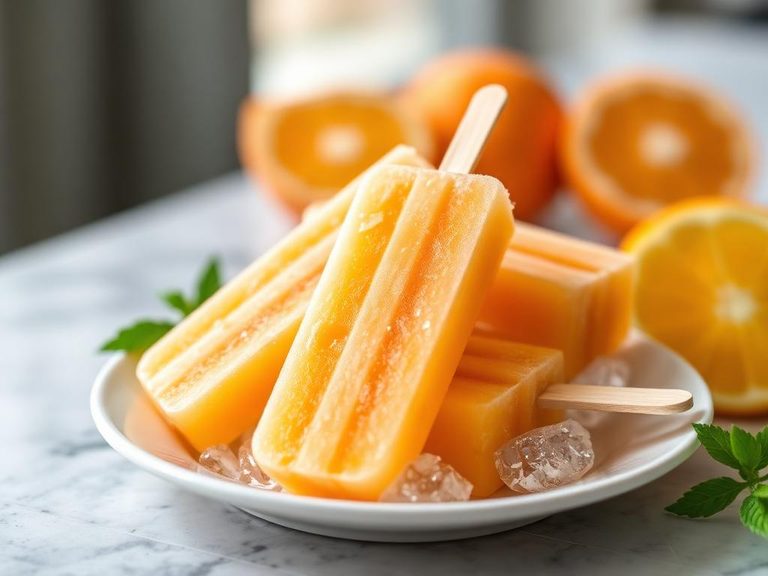
🌍 Where it's eaten
💡 Did you know?
The frozen orange juice concentrate industry was revolutionized in the 1940s by the development of the 'Not From Concentrate' (NFC) process, which was ironically developed to solve the problem of having too much surplus juice that needed to be preserved.
Full nutrition (USDA data · scales with serving)
| Water | 87.2 g |
| Energy | 49.0 kcal |
| Energy | 205 kj |
| Protein | 0.03 g |
| Total lipid (fat) | 0.14 g |
| Ash | 0.44 g |
| Carbohydrate, by difference | 12.2 g |
| Fiber, total dietary | 0.00 g |
| Total Sugars | 11.9 g |
| Calcium, Ca | 39.0 mg |
| Iron, Fe | 0.08 mg |
| Magnesium, Mg | 1.0 mg |
| Phosphorus, P | 22.0 mg |
| Potassium, K | 124 mg |
| Sodium, Na | 10.0 mg |
| Zinc, Zn | 0.02 mg |
| Copper, Cu | 0.02 mg |
| Manganese, Mn | 0.01 mg |
| Selenium, Se | 0.10 ug |
| Fluoride, F | 50.9 ug |
| Vitamin C, total ascorbic acid | 69.2 mg |
| Thiamin | 0.12 mg |
| Riboflavin | 0.04 mg |
| Niacin | 0.00 mg |
| Pantothenic acid | 0.01 mg |
| Vitamin B-6 | 0.00 mg |
| Folate, total | 9.0 ug |
| Folic acid | 0.00 ug |
| Folate, food | 9.0 ug |
| Folate, DFE | 9.0 ug |
| Vitamin B-12 | 0.00 ug |
| Vitamin B-12, added | 0.00 ug |
| Vitamin A, RAE | 0.00 ug |
| Retinol | 0.00 ug |
| Carotene, beta | 0.00 ug |
| Carotene, alpha | 0.00 ug |
| Cryptoxanthin, beta | 0.00 ug |
| Vitamin A, IU | 0.00 iu |
| Lycopene | 0.00 ug |
| Lutein + zeaxanthin | 0.00 ug |
| Alcohol, ethyl | 0.00 g |
| Caffeine | 0.00 mg |
| Theobromine | 0.00 mg |
Fat & fatty acid profile (per 100g)
| Fatty acids, total saturated | 0.02 g |
| SFA 4:0 | 0.00 g |
| SFA 6:0 | 0.00 g |
| SFA 8:0 | 0.00 g |
| SFA 10:0 | 0.00 g |
| SFA 12:0 | 0.00 g |
| SFA 14:0 | 0.00 g |
| SFA 16:0 | 0.01 g |
| SFA 18:0 | 0.01 g |
| Fatty acids, total monounsaturated | 0.06 g |
| MUFA 16:1 | 0.00 g |
| MUFA 18:1 | 0.06 g |
| MUFA 20:1 | 0.00 g |
| MUFA 22:1 | 0.00 g |
| Fatty acids, total polyunsaturated | 0.06 g |
| PUFA 18:2 | 0.05 g |
| PUFA 18:3 | 0.00 g |
| PUFA 18:4 | 0.00 g |
| PUFA 20:4 | 0.00 g |
| PUFA 20:5 n-3 (EPA) | 0.00 g |
| PUFA 22:5 n-3 (DPA) | 0.00 g |
| PUFA 22:6 n-3 (DHA) | 0.00 g |
| Fatty acids, total trans | 0.00 g |
| Cholesterol | 0.00 mg |
Amino acid profile (per 100g)
Estimated from Beverages, carbonated, tonic water — USDA does not publish this profile for Beverages.
| Tryptophan | 0.00 g |
| Threonine | 0.00 g |
| Isoleucine | 0.00 g |
| Leucine | 0.00 g |
| Lysine | 0.00 g |
| Methionine | 0.00 g |
| Cystine | 0.00 g |
| Phenylalanine | 0.00 g |
| Tyrosine | 0.00 g |
| Valine | 0.00 g |
| Arginine | 0.00 g |
| Histidine | 0.00 g |
| Alanine | 0.00 g |
| Aspartic acid | 0.00 g |
| Glutamic acid | 0.00 g |
| Glycine | 0.00 g |
| Proline | 0.00 g |
| Serine | 0.00 g |
FAQ
Is this the same as 100% orange juice?
No. This is a 'flavored drink' or 'beverage' made from concentrate with added sugar and pulp, whereas 100% orange juice is pure squeezed juice with no added sugars or water.
Why is it frozen?
Freezing the concentrate preserves it for long-term storage and transport. Adding water at home reconstitutes it to a drinkable strength, making it a convenient and shelf-stable product.
Does the pulp add nutritional value?
The pulp adds some dietary fiber and a textural element, but in this product, the amount is minimal (0g fiber per 100g is listed), so its nutritional impact is negligible.
Nutrient density (calculated · NRF9.3)
Nutrient Rich Foods index: beneficial nutrients (protein, fiber, vitamins, minerals) minus saturated fat, added sugar & sodium, per 100 kcal.
NRF9.3 index — Fulgoni, Keast & Drewnowski, 2009. Computed from USDA nutrients.
Weight-loss friendliness (composite index)
Energy density 0.49 kcal/g · 0% calories from protein · 0.0 g fiber · 11.9 g sugar per 100 g.
Composite of energy density (Rolls et al., 1999), protein & fiber satiety, minus sugar. A calculated heuristic — ranks satiety-per-calorie, not a clinical measure.
Dietary load (calculated from USDA values)
Potential renal acid load. Positive = acid-forming, negative = alkaline-forming.
Sodium-to-potassium ratio: 0.08 (lower is better — aim for ≤ 1)
Sodium:potassium per WHO potassium guidance. Computed from USDA nutrients.