

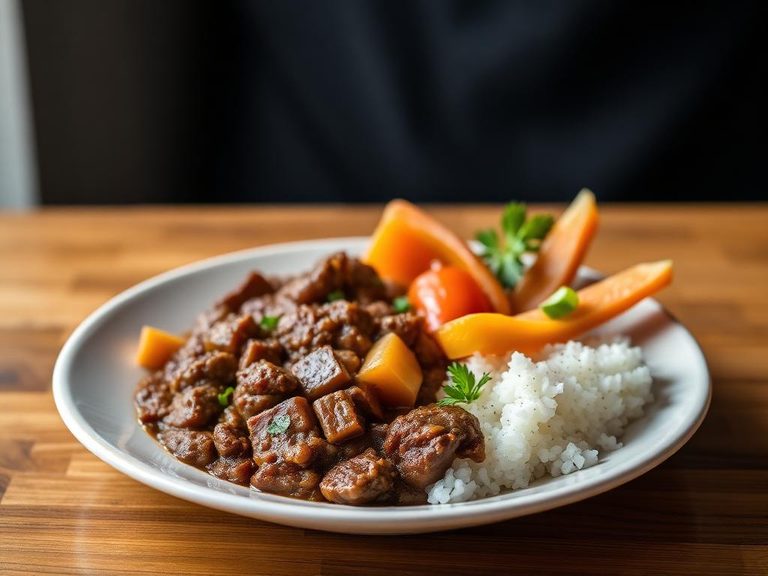
Beef, potatoes, and vegetables including carrots, broccoli, and/or dark-green leafy; tomato-based sauce
Common food

Photo: Wikipedia
A hearty, savory stew where tender beef and soft potatoes mingle with bright carrots and earthy greens in a rich, tangy tomato sauce. Each spoonful offers a comforting mix of textures—from the yielding potato to the slight bite of broccoli—balanced by the sauce's gentle acidity. Despite its substantial feel, it's surprisingly light at just 126 calories per 100g, packing a solid 5.33g of protein alongside a spectrum of vitamins from the mixed vegetables.
Calorie split: 17% protein · 35% carbs · 49% fat
↓ Full nutrition💚 Why it's loved
People adore this dish for its comforting, home-cooked warmth and the way it brings together familiar, satisfying flavors in one pot. It's a versatile crowd-pleaser that feels both nourishing and indulgent, often evoking memories of family meals or traditional Sunday dinners.
⚠️ Watch-outs & how to enjoy it better
The tomato-based sauce can be acidic for those with sensitive stomachs or acid reflux, and the sodium content in pre-made sauces may be a concern for blood pressure management. To counteract, choose low-sodium broth or sauce, pair with a small portion of whole grains to buffer acidity, and ensure vegetables are well-cooked to reduce oxalates if using spinach or kale.
Key benefits
- High-quality protein from beef supports muscle maintenance
- Rich in vitamin A from carrots and dark greens for eye health
- Provides iron and B vitamins for energy metabolism
- Fiber from vegetables aids digestive health
- Low-calorie density makes it suitable for weight management
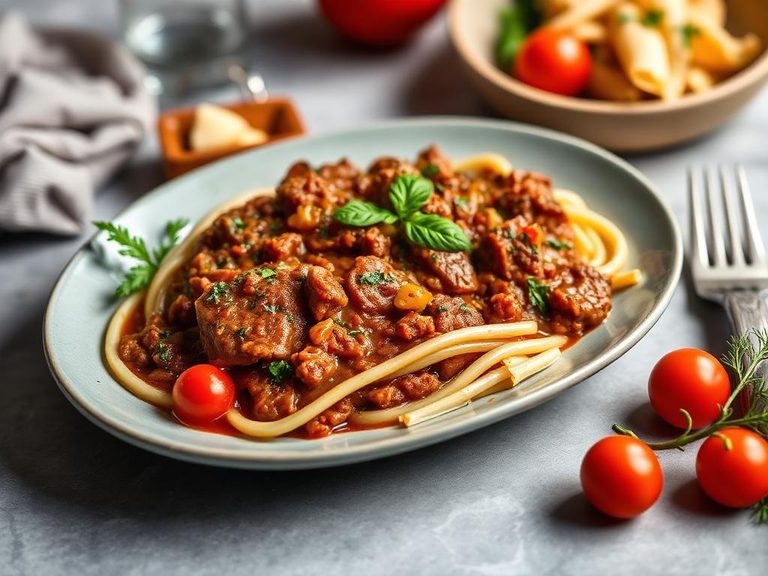
🍽️ Popular dishes
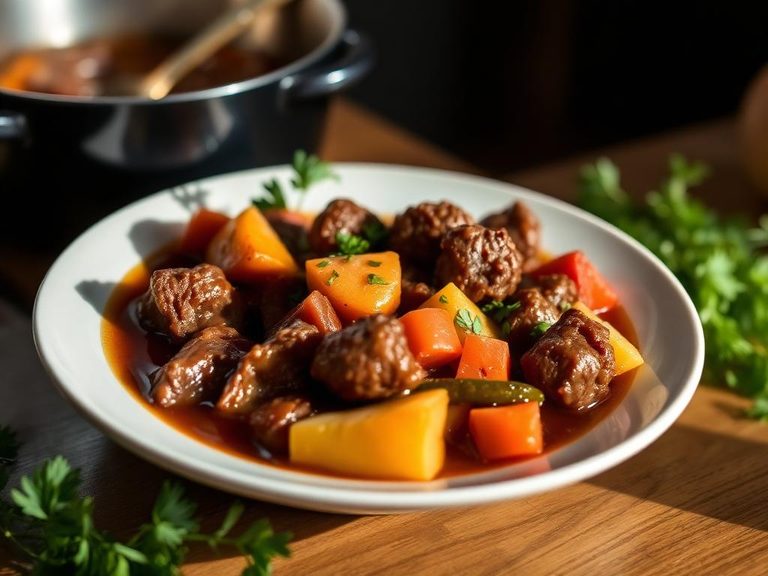
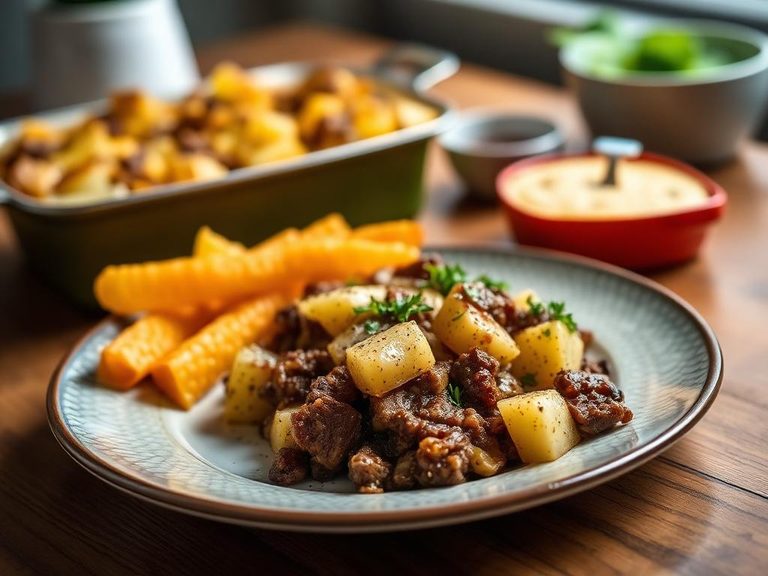
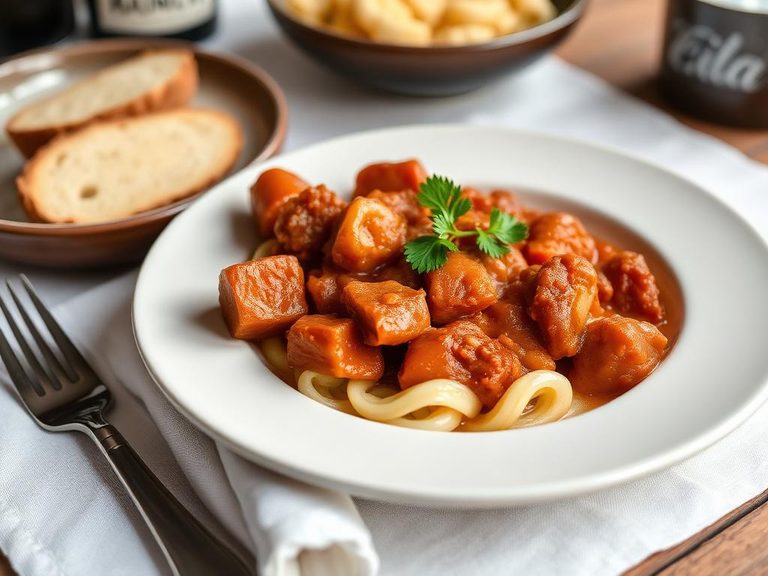
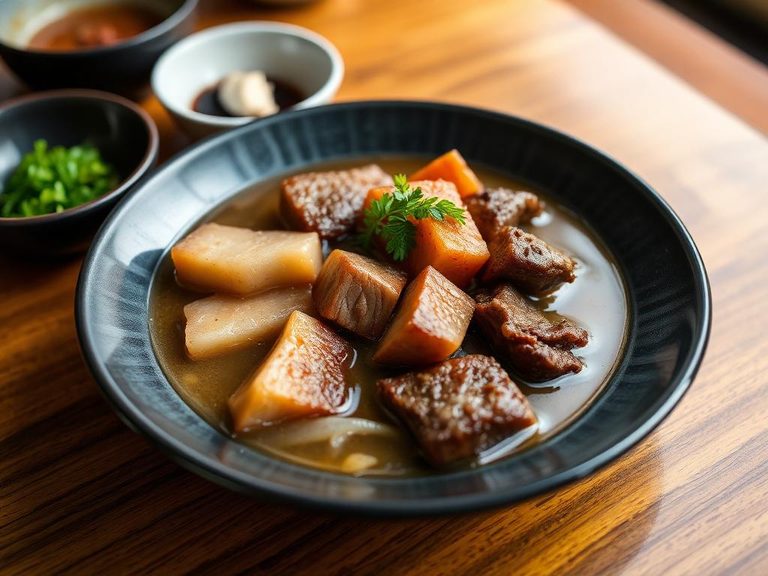
🌍 Where it's eaten
💡 Did you know?
In Japan, a similar dish called 'nikujaga' (meat and potatoes) was reportedly created by a navy chef in the late 19th century to mimic Western stews, but it quickly became a beloved national comfort food.
Full nutrition (USDA data · scales with serving)
| Water | 75.1 g |
| Energy | 126 kcal |
| Protein | 5.3 g |
| Total lipid (fat) | 7.0 g |
| Carbohydrate, by difference | 11.1 g |
| Fiber, total dietary | 1.7 g |
| Total Sugars | 1.8 g |
| Calcium, Ca | 14.0 mg |
| Iron, Fe | 0.82 mg |
| Magnesium, Mg | 17.0 mg |
| Phosphorus, P | 56.0 mg |
| Potassium, K | 280 mg |
| Sodium, Na | 310 mg |
| Zinc, Zn | 0.90 mg |
| Copper, Cu | 0.12 mg |
| Selenium, Se | 4.5 ug |
| Vitamin C, total ascorbic acid | 8.7 mg |
| Thiamin | 0.07 mg |
| Riboflavin | 0.06 mg |
| Niacin | 1.6 mg |
| Vitamin B-6 | 0.21 mg |
| Folate, total | 13.0 ug |
| Folic acid | 0.00 ug |
| Folate, food | 13.0 ug |
| Folate, DFE | 13.0 ug |
| Choline, total | 25.5 mg |
| Vitamin B-12 | 0.22 ug |
| Vitamin B-12, added | 0.00 ug |
| Vitamin A, RAE | 83.0 ug |
| Retinol | 0.00 ug |
| Carotene, beta | 826 ug |
| Carotene, alpha | 322 ug |
| Cryptoxanthin, beta | 1.0 ug |
| Lycopene | 3596 ug |
| Lutein + zeaxanthin | 163 ug |
| Vitamin E (alpha-tocopherol) | 1.7 mg |
| Vitamin E, added | 0.00 mg |
| Vitamin D (D2 + D3) | 0.00 ug |
| Vitamin K (phylloquinone) | 16.3 ug |
| Alcohol, ethyl | 0.00 g |
| Caffeine | 0.00 mg |
| Theobromine | 0.00 mg |
Fat & fatty acid profile (per 100g)
| Fatty acids, total saturated | 1.2 g |
| SFA 4:0 | 0.00 g |
| SFA 6:0 | 0.00 g |
| SFA 8:0 | 0.00 g |
| SFA 10:0 | 0.00 g |
| SFA 12:0 | 0.00 g |
| SFA 14:0 | 0.04 g |
| SFA 16:0 | 0.84 g |
| SFA 18:0 | 0.29 g |
| Fatty acids, total monounsaturated | 2.9 g |
| MUFA 16:1 | 0.07 g |
| MUFA 18:1 | 2.8 g |
| MUFA 20:1 | 0.04 g |
| MUFA 22:1 | 0.00 g |
| Fatty acids, total polyunsaturated | 2.3 g |
| PUFA 18:2 | 2.0 g |
| PUFA 18:3 | 0.27 g |
| PUFA 18:4 | 0.00 g |
| PUFA 20:4 | 0.00 g |
| PUFA 20:5 n-3 (EPA) | 0.00 g |
| PUFA 22:5 n-3 (DPA) | 0.00 g |
| PUFA 22:6 n-3 (DHA) | 0.00 g |
| Cholesterol | 12.0 mg |
Amino acid profile (per 100g)
Estimated from Beef, variety meats and by-products, mechanically separated beef, raw — USDA does not publish this profile for Beef.
| Tryptophan | 0.17 g |
| Threonine | 0.47 g |
| Isoleucine | 0.58 g |
| Leucine | 1.2 g |
| Lysine | 1.2 g |
| Methionine | 0.43 g |
| Cystine | 0.23 g |
| Phenylalanine | 0.64 g |
| Tyrosine | 0.38 g |
| Valine | 0.92 g |
| Arginine | 1.2 g |
| Histidine | 0.44 g |
| Alanine | 1.0 g |
| Aspartic acid | 1.3 g |
| Glutamic acid | 2.1 g |
| Glycine | 1.2 g |
| Proline | 0.92 g |
| Serine | 0.57 g |
FAQ
Is this dish suitable for a low-carb diet?
It contains potatoes and carrots, which are higher in carbs, but the overall carb content is moderate at 11.13g per 100g. You can reduce potatoes or replace them with lower-carb vegetables like cauliflower to make it more keto-friendly.
Can I make this dish ahead of time?
Yes, it stores well in the refrigerator for 3-4 days and freezes for up to 3 months. The flavors often deepen when reheated, making it ideal for meal prep.
What are the best vegetables to include for maximum nutrition?
Dark-green leafy vegetables like spinach or kale add iron and calcium, while carrots provide beta-carotene. Broccoli offers vitamin C and fiber. A mix ensures a broad nutrient profile.
Nutrient density (calculated · NRF9.3)
Nutrient Rich Foods index: beneficial nutrients (protein, fiber, vitamins, minerals) minus saturated fat, added sugar & sodium, per 100 kcal.
NRF9.3 index — Fulgoni, Keast & Drewnowski, 2009. Computed from USDA nutrients.
Weight-loss friendliness (composite index)
Energy density 1.26 kcal/g · 17% calories from protein · 1.7 g fiber · 1.8 g sugar per 100 g.
Composite of energy density (Rolls et al., 1999), protein & fiber satiety, minus sugar. A calculated heuristic — ranks satiety-per-calorie, not a clinical measure.
Dietary load (calculated from USDA values)
Potential renal acid load. Positive = acid-forming, negative = alkaline-forming.
Sodium-to-potassium ratio: 1.11 (lower is better — aim for ≤ 1)
Sodium:potassium per WHO potassium guidance. Computed from USDA nutrients.