

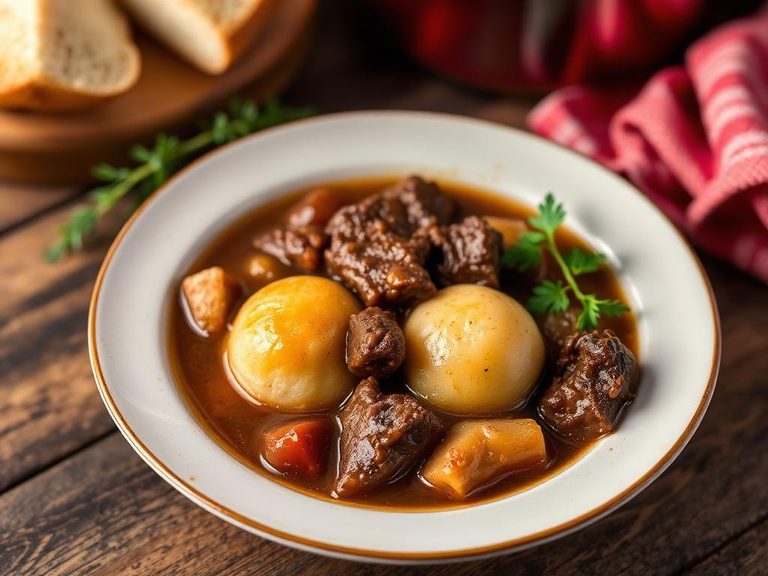
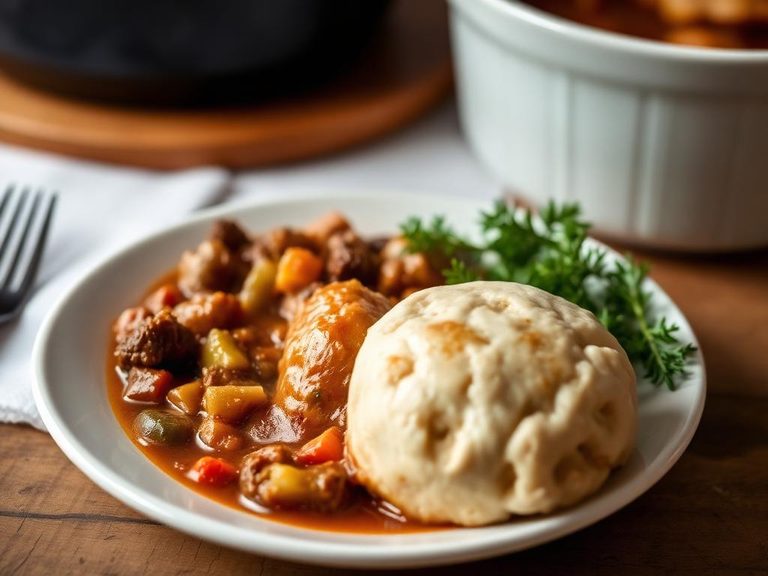
Beef, dumplings, and vegetables including carrots, broccoli, and/or dark-green leafy; gravy
Common food
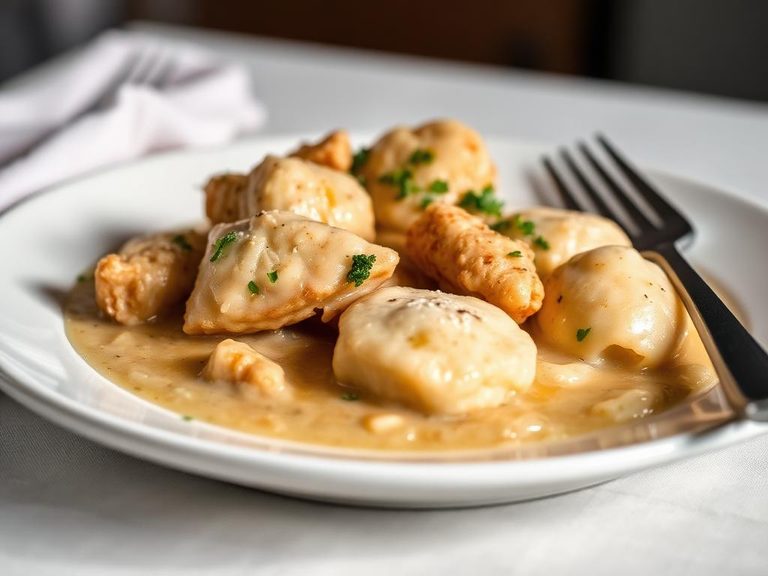
This is a classic comfort food dish, typically a savory stew or pie filling where tender chunks of beef and soft, pillowy dumplings are simmered with a medley of vegetables like carrots and broccoli in a rich, brown gravy. The flavor is deeply savory and meaty, with the dumplings providing a satisfying, doughy contrast to the tender vegetables and meat. Nutritionally, it offers a balanced mix of protein and carbohydrates, though it is relatively low in fiber and sugar.
Calorie split: 19% protein · 36% carbs · 44% fat
↓ Full nutrition💚 Why it's loved
People love this dish for its hearty, comforting nature and the satisfying combination of tender meat, soft dumplings, and savory gravy. It's a staple of home cooking and family meals, evoking a sense of warmth and tradition.
⚠️ Watch-outs & how to enjoy it better
The dish can be high in sodium from the gravy and may cause blood sugar spikes due to the refined carbohydrates in the dumplings. To counteract this, pair it with a side of extra steamed greens for fiber, use low-sodium broth for the gravy, and consider whole-grain flour for the dumplings.
Key benefits
- Provides a balanced source of protein and carbohydrates for energy.
- Contains vegetables like carrots and broccoli, offering vitamins A and C.
- The gravy and dumplings provide a satisfying, hearty texture and mouthfeel.
- A versatile dish that can incorporate a variety of seasonal vegetables.
🍽️ Popular dishes


🌍 Where it's eaten
💡 Did you know?
The word 'dumpling' likely originated in the 17th century from the German word 'Knödel' or 'Dumpling', and early versions were often just dough boiled in water or broth, not necessarily filled with meat.
Full nutrition (USDA data · scales with serving)
| Water | 74.3 g |
| Energy | 127 kcal |
| Protein | 6.2 g |
| Total lipid (fat) | 6.4 g |
| Carbohydrate, by difference | 11.7 g |
| Fiber, total dietary | 0.90 g |
| Total Sugars | 1.1 g |
| Calcium, Ca | 73.0 mg |
| Iron, Fe | 1.2 mg |
| Magnesium, Mg | 10.0 mg |
| Phosphorus, P | 78.0 mg |
| Potassium, K | 106 mg |
| Sodium, Na | 306 mg |
| Zinc, Zn | 0.90 mg |
| Copper, Cu | 0.04 mg |
| Selenium, Se | 6.4 ug |
| Vitamin C, total ascorbic acid | 3.8 mg |
| Thiamin | 0.11 mg |
| Riboflavin | 0.10 mg |
| Niacin | 1.5 mg |
| Vitamin B-6 | 0.09 mg |
| Folate, total | 20.0 ug |
| Folic acid | 10.0 ug |
| Folate, food | 10.0 ug |
| Folate, DFE | 27.0 ug |
| Choline, total | 21.6 mg |
| Vitamin B-12 | 0.28 ug |
| Vitamin B-12, added | 0.00 ug |
| Vitamin A, RAE | 86.0 ug |
| Retinol | 6.0 ug |
| Carotene, beta | 783 ug |
| Carotene, alpha | 332 ug |
| Cryptoxanthin, beta | 0.00 ug |
| Lycopene | 0.00 ug |
| Lutein + zeaxanthin | 160 ug |
| Vitamin E (alpha-tocopherol) | 0.92 mg |
| Vitamin E, added | 0.00 mg |
| Vitamin D (D2 + D3) | 0.10 ug |
| Vitamin K (phylloquinone) | 13.0 ug |
| Alcohol, ethyl | 0.00 g |
| Caffeine | 0.00 mg |
| Theobromine | 0.00 mg |
Fat & fatty acid profile (per 100g)
| Fatty acids, total saturated | 1.5 g |
| SFA 4:0 | 0.01 g |
| SFA 6:0 | 0.00 g |
| SFA 8:0 | 0.00 g |
| SFA 10:0 | 0.01 g |
| SFA 12:0 | 0.01 g |
| SFA 14:0 | 0.07 g |
| SFA 16:0 | 0.92 g |
| SFA 18:0 | 0.40 g |
| Fatty acids, total monounsaturated | 2.5 g |
| MUFA 16:1 | 0.10 g |
| MUFA 18:1 | 2.4 g |
| MUFA 20:1 | 0.03 g |
| MUFA 22:1 | 0.00 g |
| Fatty acids, total polyunsaturated | 1.7 g |
| PUFA 18:2 | 1.5 g |
| PUFA 18:3 | 0.17 g |
| PUFA 18:4 | 0.00 g |
| PUFA 20:4 | 0.01 g |
| PUFA 20:5 n-3 (EPA) | 0.00 g |
| PUFA 22:5 n-3 (DPA) | 0.00 g |
| PUFA 22:6 n-3 (DHA) | 0.00 g |
| Cholesterol | 14.0 mg |
Amino acid profile (per 100g)
Estimated from Beef, variety meats and by-products, mechanically separated beef, raw — USDA does not publish this profile for Beef.
| Tryptophan | 0.17 g |
| Threonine | 0.47 g |
| Isoleucine | 0.58 g |
| Leucine | 1.2 g |
| Lysine | 1.2 g |
| Methionine | 0.43 g |
| Cystine | 0.23 g |
| Phenylalanine | 0.64 g |
| Tyrosine | 0.38 g |
| Valine | 0.92 g |
| Arginine | 1.2 g |
| Histidine | 0.44 g |
| Alanine | 1.0 g |
| Aspartic acid | 1.3 g |
| Glutamic acid | 2.1 g |
| Glycine | 1.2 g |
| Proline | 0.92 g |
| Serine | 0.57 g |
FAQ
What is the typical calorie content of beef, dumplings, and vegetables with gravy?
Per 100 grams, this dish contains approximately 127 calories, making it a moderately calorie-dense meal.
Is this dish suitable for a low-carb diet?
Not typically, as the dumplings and gravy contribute significantly to the carbohydrate content, with about 11.7g of carbs per 100g.
How can I make this dish healthier?
You can increase the vegetable content, use whole-grain flour for dumplings, opt for leaner cuts of beef, and prepare the gravy with low-sodium broth and minimal added salt.
Nutrient density (calculated · NRF9.3)
Nutrient Rich Foods index: beneficial nutrients (protein, fiber, vitamins, minerals) minus saturated fat, added sugar & sodium, per 100 kcal.
NRF9.3 index — Fulgoni, Keast & Drewnowski, 2009. Computed from USDA nutrients.
Weight-loss friendliness (composite index)
Energy density 1.27 kcal/g · 19% calories from protein · 0.9 g fiber · 1.1 g sugar per 100 g.
Composite of energy density (Rolls et al., 1999), protein & fiber satiety, minus sugar. A calculated heuristic — ranks satiety-per-calorie, not a clinical measure.
Dietary load (calculated from USDA values)
Potential renal acid load. Positive = acid-forming, negative = alkaline-forming.
Sodium-to-potassium ratio: 2.89 (lower is better — aim for ≤ 1)
Sodium:potassium per WHO potassium guidance. Computed from USDA nutrients.