

Chicken or turkey, dumplings, and vegetables excluding carrots, broccoli, and dark green leafy; gravy
Common food

Photo: Wikipedia
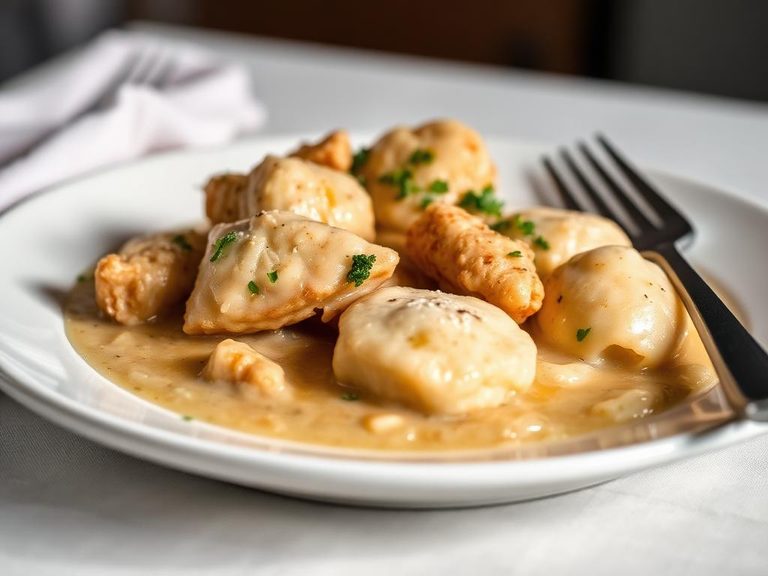
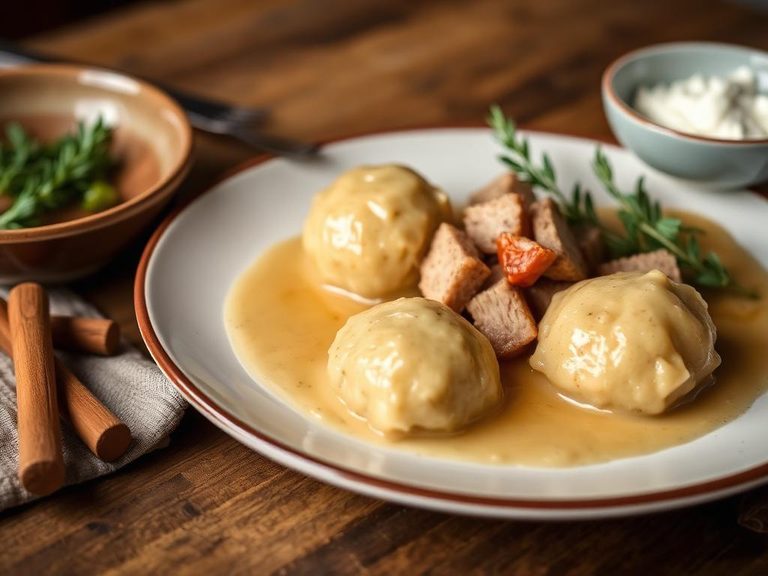
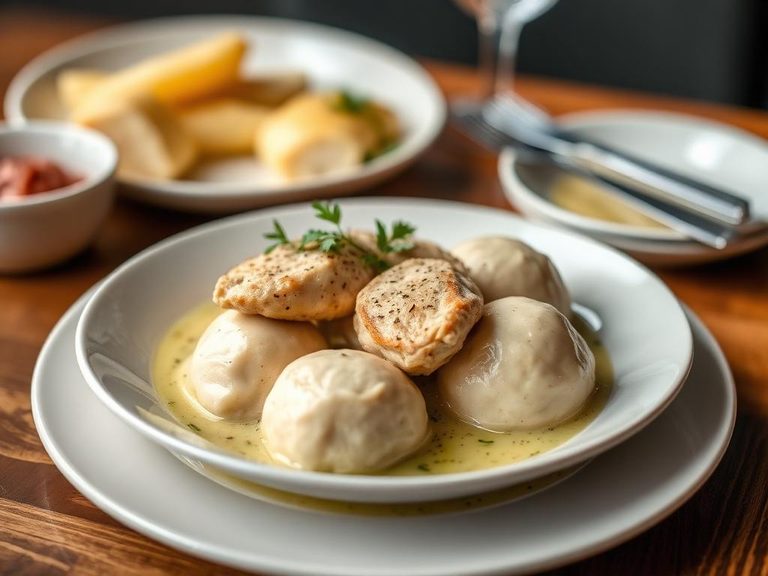
This is a classic comfort food medley: tender shreds of poultry and soft, pillowy dumplings simmered in a savory, vegetable-studded gravy. The texture is a delightful contrast between the fluffy, doughy dumplings and the tender meat and vegetables, all coated in a rich, savory sauce. Nutritionally, it provides a balanced mix of protein and carbs, with the fat content coming primarily from the gravy and poultry.
Calorie split: 17% protein · 39% carbs · 43% fat
↓ Full nutrition💚 Why it's loved
People love it for its profound comfort factor—the warm, savory, and cohesive flavors evoke a sense of home and nostalgia. It's also prized as a versatile, all-in-one meal that can be easily adapted with seasonal vegetables or different herbs.
⚠️ Watch-outs & how to enjoy it better
The dish can be high in sodium from the gravy and processed poultry, and the refined flour in dumplings may cause blood-sugar spikes. To counteract this, opt for low-sodium broth, use whole-wheat flour for dumplings, and increase the proportion of non-starchy vegetables in the mix.
Key benefits
- Good source of lean protein from poultry
- Provides quick energy from carbohydrate-rich dumplings
- Contains a mix of vitamins and minerals from mixed vegetables
- Highly satiating due to combined protein, carbs, and fat
- A complete, one-pot meal offering comfort and sustenance
🍽️ Popular dishes
🌍 Where it's eaten
💡 Did you know?
Traditional dumplings were originally a frugal way to stretch a meal, using simple flour and fat to create a filling addition to a stew, rather than a separate baked bread.
Full nutrition (USDA data · scales with serving)
| Water | 73.9 g |
| Energy | 128 kcal |
| Protein | 5.7 g |
| Total lipid (fat) | 6.2 g |
| Carbohydrate, by difference | 12.8 g |
| Fiber, total dietary | 0.80 g |
| Total Sugars | 1.1 g |
| Calcium, Ca | 71.0 mg |
| Iron, Fe | 0.92 mg |
| Magnesium, Mg | 13.0 mg |
| Phosphorus, P | 87.0 mg |
| Potassium, K | 115 mg |
| Sodium, Na | 340 mg |
| Zinc, Zn | 0.44 mg |
| Copper, Cu | 0.04 mg |
| Selenium, Se | 5.3 ug |
| Vitamin C, total ascorbic acid | 0.70 mg |
| Thiamin | 0.11 mg |
| Riboflavin | 0.11 mg |
| Niacin | 1.9 mg |
| Vitamin B-6 | 0.07 mg |
| Folate, total | 19.0 ug |
| Folic acid | 10.0 ug |
| Folate, food | 9.0 ug |
| Folate, DFE | 26.0 ug |
| Choline, total | 15.8 mg |
| Vitamin B-12 | 0.10 ug |
| Vitamin B-12, added | 0.00 ug |
| Vitamin A, RAE | 10.0 ug |
| Retinol | 7.0 ug |
| Carotene, beta | 25.0 ug |
| Carotene, alpha | 6.0 ug |
| Cryptoxanthin, beta | 11.0 ug |
| Lycopene | 0.00 ug |
| Lutein + zeaxanthin | 108 ug |
| Vitamin E (alpha-tocopherol) | 0.76 mg |
| Vitamin E, added | 0.00 mg |
| Vitamin D (D2 + D3) | 0.10 ug |
| Vitamin K (phylloquinone) | 7.3 ug |
| Alcohol, ethyl | 0.00 g |
| Caffeine | 0.00 mg |
| Theobromine | 0.00 mg |
Fat & fatty acid profile (per 100g)
| Fatty acids, total saturated | 1.2 g |
| SFA 4:0 | 0.01 g |
| SFA 6:0 | 0.00 g |
| SFA 8:0 | 0.00 g |
| SFA 10:0 | 0.01 g |
| SFA 12:0 | 0.01 g |
| SFA 14:0 | 0.03 g |
| SFA 16:0 | 0.82 g |
| SFA 18:0 | 0.31 g |
| Fatty acids, total monounsaturated | 2.5 g |
| MUFA 16:1 | 0.11 g |
| MUFA 18:1 | 2.4 g |
| MUFA 20:1 | 0.03 g |
| MUFA 22:1 | 0.00 g |
| Fatty acids, total polyunsaturated | 1.8 g |
| PUFA 18:2 | 1.6 g |
| PUFA 18:3 | 0.18 g |
| PUFA 18:4 | 0.00 g |
| PUFA 20:4 | 0.00 g |
| PUFA 20:5 n-3 (EPA) | 0.00 g |
| PUFA 22:5 n-3 (DPA) | 0.00 g |
| PUFA 22:6 n-3 (DHA) | 0.00 g |
| Cholesterol | 17.0 mg |
Amino acid profile (per 100g)
Estimated from Turnover, chicken- or turkey-, and vegetable-filled, reduced fat, frozen — USDA does not publish this profile for Chicken or turkey.
| Tryptophan | 0.16 g |
| Threonine | 0.41 g |
| Isoleucine | 0.47 g |
| Leucine | 0.80 g |
| Lysine | 0.61 g |
| Methionine | 0.23 g |
| Cystine | 0.13 g |
| Phenylalanine | 0.47 g |
| Tyrosine | 0.37 g |
| Valine | 0.53 g |
| Arginine | 0.51 g |
| Histidine | 0.30 g |
| Alanine | 0.45 g |
| Aspartic acid | 0.80 g |
| Glutamic acid | 2.2 g |
| Glycine | 0.38 g |
| Proline | 0.87 g |
| Serine | 0.42 g |
| Hydroxyproline | 0.00 g |
FAQ
What's the difference between dumplings and noodles in this dish?
Dumplings are typically soft, thick, and doughy, often dropped as spoonfuls into the stew to steam, while noodles are thinner, rolled, and cut, with a chewier texture.
Can I make this dish healthier?
Yes. Use skinless poultry, low-sodium broth, whole-grain dumplings, and load it with extra vegetables like peas, corn, or celery to boost fiber and nutrients.
Is the gravy essential?
The gravy is the key component that binds the dish, providing moisture and flavor. A lighter version can be made with a broth-based roux or by blending some cooked vegetables.
Nutrient density (calculated · NRF9.3)
Nutrient Rich Foods index: beneficial nutrients (protein, fiber, vitamins, minerals) minus saturated fat, added sugar & sodium, per 100 kcal.
NRF9.3 index — Fulgoni, Keast & Drewnowski, 2009. Computed from USDA nutrients.
Weight-loss friendliness (composite index)
Energy density 1.28 kcal/g · 18% calories from protein · 0.8 g fiber · 1.1 g sugar per 100 g.
Composite of energy density (Rolls et al., 1999), protein & fiber satiety, minus sugar. A calculated heuristic — ranks satiety-per-calorie, not a clinical measure.
Dietary load (calculated from USDA values)
Potential renal acid load. Positive = acid-forming, negative = alkaline-forming.
Sodium-to-potassium ratio: 2.96 (lower is better — aim for ≤ 1)
Sodium:potassium per WHO potassium guidance. Computed from USDA nutrients.