

Beans and white rice
Common food
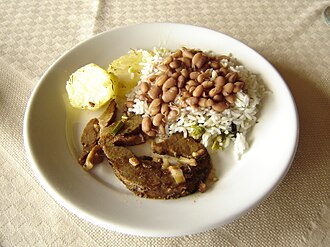
Photo: Wikipedia
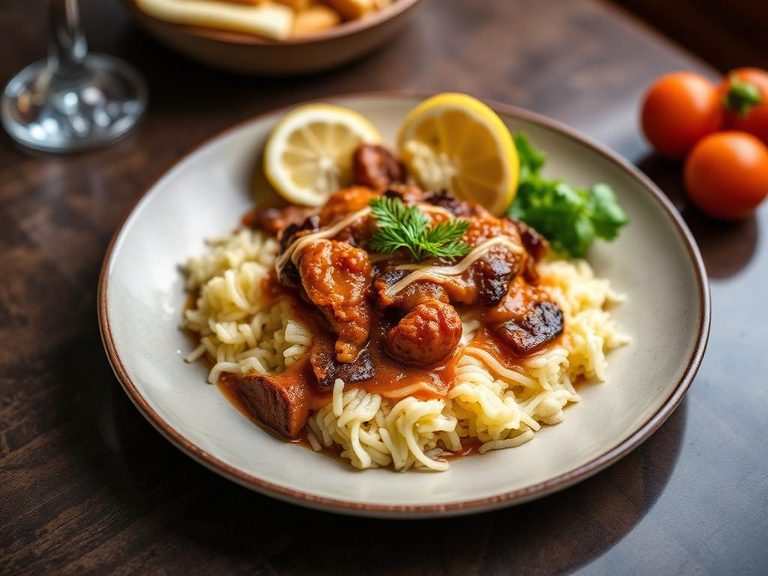
Beans and white rice is a hearty, comforting staple where tender, creamy beans mingle with fluffy, mild grains. The combination creates a satisfying, slightly earthy flavor and a soft, cohesive texture that absorbs sauces beautifully. Nutritionally, it's a plant-based powerhouse, offering a complete protein profile and significant fiber for a modest calorie count.
Calorie split: 16% protein · 61% carbs · 23% fat
↓ Full nutrition💚 Why it's loved
People love this dish for its deeply comforting, home-cooked appeal and its incredible versatility as a blank canvas for spices, meats, or vegetables. It's a beloved, economical comfort food woven into the culinary fabric of countless cultures worldwide.
⚠️ Watch-outs & how to enjoy it better
The primary concern is its high glycemic index, which can cause blood sugar spikes, especially when made with long-grain white rice. To counteract this, pair it with a source of fat or protein (like avocado, cheese, or a fried egg), add non-starchy vegetables, or consider using brown rice or a mix of beans for a lower-glycemic version. Some may also experience digestive gas from the beans; rinsing canned beans and gradual introduction can help.
Key benefits
- Provides a complete plant-based protein when combined
- Excellent source of dietary fiber for digestive health
- Naturally low in fat and contains no cholesterol
- A cost-effective and shelf-stable pantry staple
- Offers sustained energy from complex carbohydrates
🍽️ Popular dishes


🌍 Where it's eaten
💡 Did you know?
The phrase 'not worth a hill of beans' is an idiom meaning something is worthless, yet nutritionally and economically, beans and rice together have been considered priceless sustenance for billions of people throughout history.
Full nutrition (USDA data · scales with serving)
| Water | 62.4 g |
| Energy | 164 kcal |
| Protein | 6.5 g |
| Total lipid (fat) | 4.2 g |
| Carbohydrate, by difference | 25.2 g |
| Fiber, total dietary | 3.7 g |
| Total Sugars | 0.21 g |
| Calcium, Ca | 54.0 mg |
| Iron, Fe | 2.5 mg |
| Magnesium, Mg | 40.0 mg |
| Phosphorus, P | 80.0 mg |
| Potassium, K | 327 mg |
| Sodium, Na | 231 mg |
| Zinc, Zn | 0.96 mg |
| Copper, Cu | 0.19 mg |
| Selenium, Se | 3.7 ug |
| Vitamin C, total ascorbic acid | 0.00 mg |
| Thiamin | 0.13 mg |
| Riboflavin | 0.03 mg |
| Niacin | 0.66 mg |
| Vitamin B-6 | 0.09 mg |
| Folate, total | 66.0 ug |
| Folic acid | 22.0 ug |
| Folate, food | 44.0 ug |
| Folate, DFE | 81.0 ug |
| Choline, total | 20.4 mg |
| Vitamin B-12 | 0.00 ug |
| Vitamin B-12, added | 0.00 ug |
| Vitamin A, RAE | 0.00 ug |
| Retinol | 0.00 ug |
| Carotene, beta | 0.00 ug |
| Carotene, alpha | 0.00 ug |
| Cryptoxanthin, beta | 0.00 ug |
| Lycopene | 0.00 ug |
| Lutein + zeaxanthin | 0.00 ug |
| Vitamin E (alpha-tocopherol) | 1.3 mg |
| Vitamin E, added | 0.00 mg |
| Vitamin D (D2 + D3) | 0.00 ug |
| Vitamin K (phylloquinone) | 5.9 ug |
| Alcohol, ethyl | 0.00 g |
| Caffeine | 0.00 mg |
| Theobromine | 0.00 mg |
Fat & fatty acid profile (per 100g)
| Fatty acids, total saturated | 0.60 g |
| SFA 4:0 | 0.00 g |
| SFA 6:0 | 0.00 g |
| SFA 8:0 | 0.00 g |
| SFA 10:0 | 0.00 g |
| SFA 12:0 | 0.00 g |
| SFA 14:0 | 0.00 g |
| SFA 16:0 | 0.45 g |
| SFA 18:0 | 0.12 g |
| Fatty acids, total monounsaturated | 1.7 g |
| MUFA 16:1 | 0.01 g |
| MUFA 18:1 | 1.7 g |
| MUFA 20:1 | 0.03 g |
| MUFA 22:1 | 0.00 g |
| Fatty acids, total polyunsaturated | 1.6 g |
| PUFA 18:2 | 1.4 g |
| PUFA 18:3 | 0.21 g |
| PUFA 18:4 | 0.00 g |
| PUFA 20:4 | 0.00 g |
| PUFA 20:5 n-3 (EPA) | 0.00 g |
| PUFA 22:5 n-3 (DPA) | 0.00 g |
| PUFA 22:6 n-3 (DHA) | 0.00 g |
| Cholesterol | 0.00 mg |
Amino acid profile (per 100g)
Estimated from Beans, small white, mature seeds, cooked, boiled, without salt — USDA does not publish this profile for Beans and white rice.
| Tryptophan | 0.11 g |
| Threonine | 0.38 g |
| Isoleucine | 0.40 g |
| Leucine | 0.72 g |
| Lysine | 0.62 g |
| Methionine | 0.14 g |
| Cystine | 0.10 g |
| Phenylalanine | 0.48 g |
| Tyrosine | 0.25 g |
| Valine | 0.47 g |
| Arginine | 0.56 g |
| Histidine | 0.25 g |
| Alanine | 0.38 g |
| Aspartic acid | 1.1 g |
| Glutamic acid | 1.4 g |
| Glycine | 0.35 g |
| Proline | 0.38 g |
| Serine | 0.49 g |
FAQ
Why are beans and rice eaten together?
Together, they form a complete protein, providing all nine essential amino acids the body needs. Rice is low in lysine but high in methionine, while beans are the opposite, making them a perfect nutritional pair.
Is this dish good for weight loss?
It can be, due to its high fiber and protein content which promote fullness. However, portion control is key, as rice is calorie-dense. Loading the bowl with extra vegetables and using a moderate portion of rice can make it very weight-loss friendly.
How do I prevent the beans from getting mushy?
If using canned beans, add them at the very end of cooking just to heat through. If cooking dried beans, simmer them separately until tender but still intact, then fold them into the cooked rice.
Nutrient density (calculated · NRF9.3)
Nutrient Rich Foods index: beneficial nutrients (protein, fiber, vitamins, minerals) minus saturated fat, added sugar & sodium, per 100 kcal.
NRF9.3 index — Fulgoni, Keast & Drewnowski, 2009. Computed from USDA nutrients.
Weight-loss friendliness (composite index)
Energy density 1.64 kcal/g · 16% calories from protein · 3.7 g fiber · 0.2 g sugar per 100 g.
Composite of energy density (Rolls et al., 1999), protein & fiber satiety, minus sugar. A calculated heuristic — ranks satiety-per-calorie, not a clinical measure.
Dietary load (calculated from USDA values)
Potential renal acid load. Positive = acid-forming, negative = alkaline-forming.
Sodium-to-potassium ratio: 0.71 (lower is better — aim for ≤ 1)
Sodium:potassium per WHO potassium guidance. Computed from USDA nutrients.