

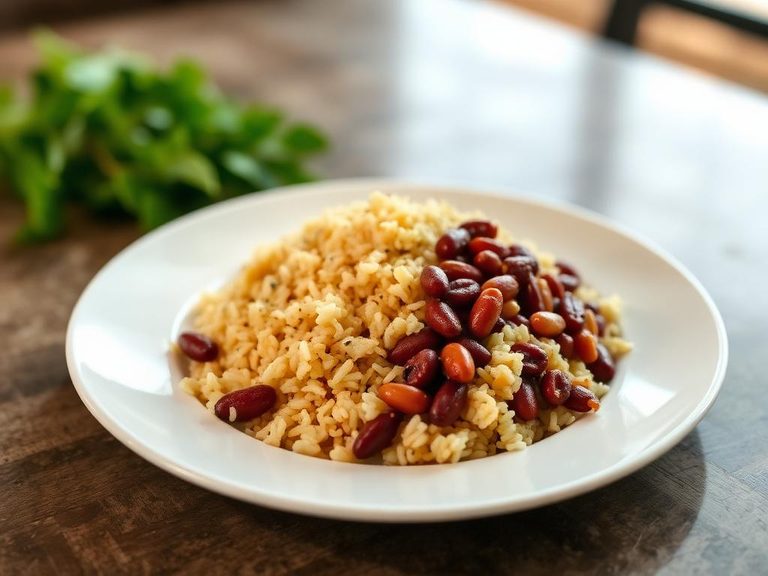
Kidney beans and white rice
Common food

Photo: Wikipedia
A staple comfort food of creamy, starchy white rice and earthy, tender kidney beans, creating a satisfying, hearty texture. Nutritionally, it's a plant-based powerhouse, delivering a complete protein profile and a solid dose of fiber for sustained energy.
Calorie split: 15% protein · 61% carbs · 24% fat
↓ Full nutrition💚 Why it's loved
People love it for its deeply satisfying, savory flavor and its incredible versatility as a blank canvas for spices, sauces, and vegetables. It's a beloved, affordable staple in countless cultures, representing comfort and nourishment.
⚠️ Watch-outs & how to enjoy it better
The high carbohydrate content can cause blood sugar spikes for some, and the beans contain oligosaccharides that may cause gas. To counteract this, pair it with non-starchy vegetables and a source of fat or protein, and soak the beans thoroughly before cooking.
Key benefits
- Provides complete plant-based protein
- High in dietary fiber for digestive health
- Excellent source of complex carbohydrates
- Naturally low in sugar and fat
🍽️ Popular dishes
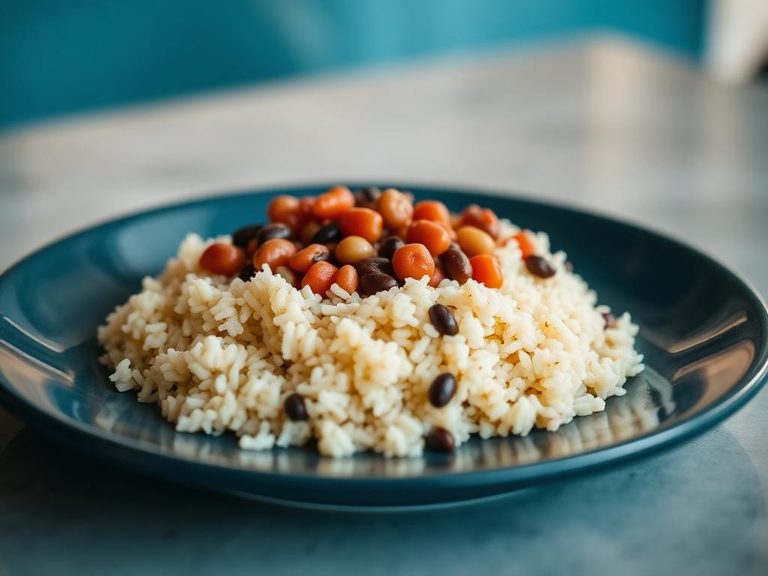
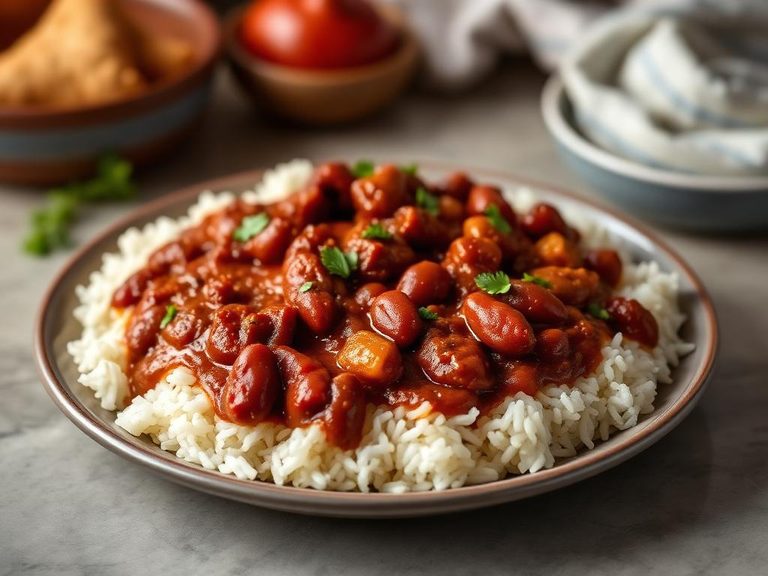
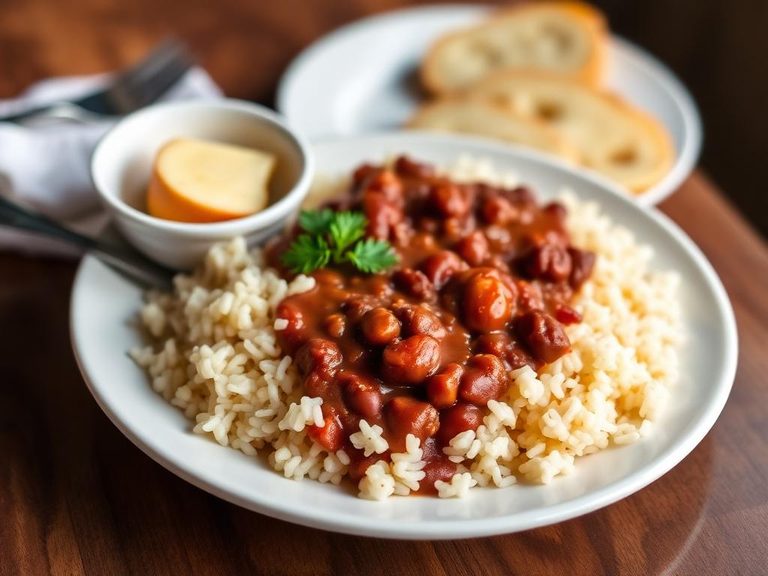
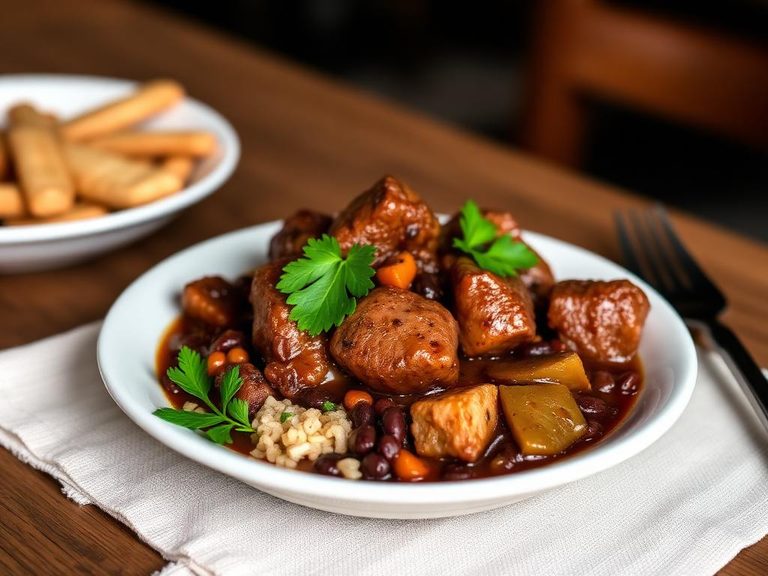
🌍 Where it's eaten
💡 Did you know?
The combination of rice and beans is considered a 'complete protein' because the amino acids missing in one are provided by the other, a nutritional synergy discovered long before modern science.
Full nutrition (USDA data · scales with serving)
| Water | 64.5 g |
| Energy | 158 kcal |
| Protein | 5.9 g |
| Total lipid (fat) | 4.3 g |
| Carbohydrate, by difference | 23.9 g |
| Fiber, total dietary | 4.3 g |
| Total Sugars | 0.20 g |
| Calcium, Ca | 20.0 mg |
| Iron, Fe | 2.1 mg |
| Magnesium, Mg | 30.0 mg |
| Phosphorus, P | 96.0 mg |
| Potassium, K | 239 mg |
| Sodium, Na | 229 mg |
| Zinc, Zn | 0.79 mg |
| Copper, Cu | 0.16 mg |
| Selenium, Se | 3.7 ug |
| Vitamin C, total ascorbic acid | 0.60 mg |
| Thiamin | 0.15 mg |
| Riboflavin | 0.04 mg |
| Niacin | 0.89 mg |
| Vitamin B-6 | 0.10 mg |
| Folate, total | 92.0 ug |
| Folic acid | 22.0 ug |
| Folate, food | 70.0 ug |
| Folate, DFE | 107 ug |
| Choline, total | 17.9 mg |
| Vitamin B-12 | 0.00 ug |
| Vitamin B-12, added | 0.00 ug |
| Vitamin A, RAE | 0.00 ug |
| Retinol | 0.00 ug |
| Carotene, beta | 0.00 ug |
| Carotene, alpha | 0.00 ug |
| Cryptoxanthin, beta | 0.00 ug |
| Lycopene | 0.00 ug |
| Lutein + zeaxanthin | 0.00 ug |
| Vitamin E (alpha-tocopherol) | 0.77 mg |
| Vitamin E, added | 0.00 mg |
| Vitamin D (D2 + D3) | 0.00 ug |
| Vitamin K (phylloquinone) | 8.6 ug |
| Alcohol, ethyl | 0.00 g |
| Caffeine | 0.00 mg |
| Theobromine | 0.00 mg |
Fat & fatty acid profile (per 100g)
| Fatty acids, total saturated | 0.59 g |
| SFA 4:0 | 0.00 g |
| SFA 6:0 | 0.00 g |
| SFA 8:0 | 0.00 g |
| SFA 10:0 | 0.00 g |
| SFA 12:0 | 0.00 g |
| SFA 14:0 | 0.00 g |
| SFA 16:0 | 0.44 g |
| SFA 18:0 | 0.12 g |
| Fatty acids, total monounsaturated | 1.7 g |
| MUFA 16:1 | 0.01 g |
| MUFA 18:1 | 1.7 g |
| MUFA 20:1 | 0.03 g |
| MUFA 22:1 | 0.00 g |
| Fatty acids, total polyunsaturated | 1.7 g |
| PUFA 18:2 | 1.4 g |
| PUFA 18:3 | 0.27 g |
| PUFA 18:4 | 0.00 g |
| PUFA 20:4 | 0.00 g |
| PUFA 20:5 n-3 (EPA) | 0.00 g |
| PUFA 22:5 n-3 (DPA) | 0.00 g |
| PUFA 22:6 n-3 (DHA) | 0.00 g |
| Cholesterol | 0.00 mg |
Amino acid profile (per 100g)
Estimated from Beans, kidney, mature seeds, sprouted, cooked, boiled, drained, without salt — USDA does not publish this profile for Kidney beans and white rice.
| Tryptophan | 0.05 g |
| Threonine | 0.20 g |
| Isoleucine | 0.21 g |
| Leucine | 0.35 g |
| Lysine | 0.28 g |
| Methionine | 0.05 g |
| Cystine | 0.06 g |
| Phenylalanine | 0.24 g |
| Tyrosine | 0.17 g |
| Valine | 0.25 g |
| Arginine | 0.26 g |
| Histidine | 0.14 g |
| Alanine | 0.20 g |
| Aspartic acid | 0.63 g |
| Glutamic acid | 0.59 g |
| Glycine | 0.17 g |
| Proline | 0.20 g |
| Serine | 0.26 g |
FAQ
Why is this combination considered a complete protein?
Rice is low in the amino acid lysine, while beans are low in methionine. Together, they provide all nine essential amino acids the body needs.
How can I reduce the gas caused by kidney beans?
Soak the beans for at least 8 hours, discard the soaking water, and cook them thoroughly. Adding a piece of kombu seaweed or ginger during cooking can also help.
Is this dish suitable for a gluten-free diet?
Yes, both kidney beans and white rice are naturally gluten-free, making this a safe and nutritious choice for those with celiac disease or gluten sensitivity.
Nutrient density (calculated · NRF9.3)
Nutrient Rich Foods index: beneficial nutrients (protein, fiber, vitamins, minerals) minus saturated fat, added sugar & sodium, per 100 kcal.
NRF9.3 index — Fulgoni, Keast & Drewnowski, 2009. Computed from USDA nutrients.
Weight-loss friendliness (composite index)
Energy density 1.58 kcal/g · 15% calories from protein · 4.3 g fiber · 0.2 g sugar per 100 g.
Composite of energy density (Rolls et al., 1999), protein & fiber satiety, minus sugar. A calculated heuristic — ranks satiety-per-calorie, not a clinical measure.
Dietary load (calculated from USDA values)
Potential renal acid load. Positive = acid-forming, negative = alkaline-forming.
Sodium-to-potassium ratio: 0.96 (lower is better — aim for ≤ 1)
Sodium:potassium per WHO potassium guidance. Computed from USDA nutrients.