

Black beans and white rice
Common food

Photo: Wikipedia
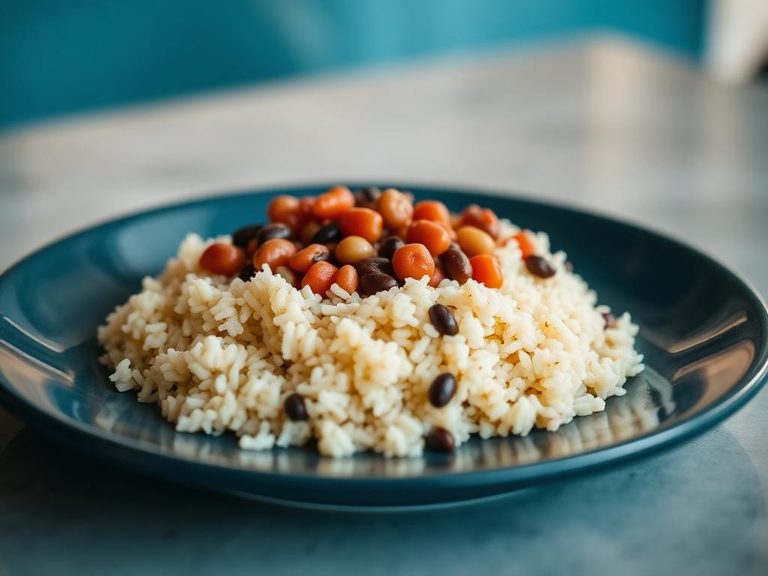
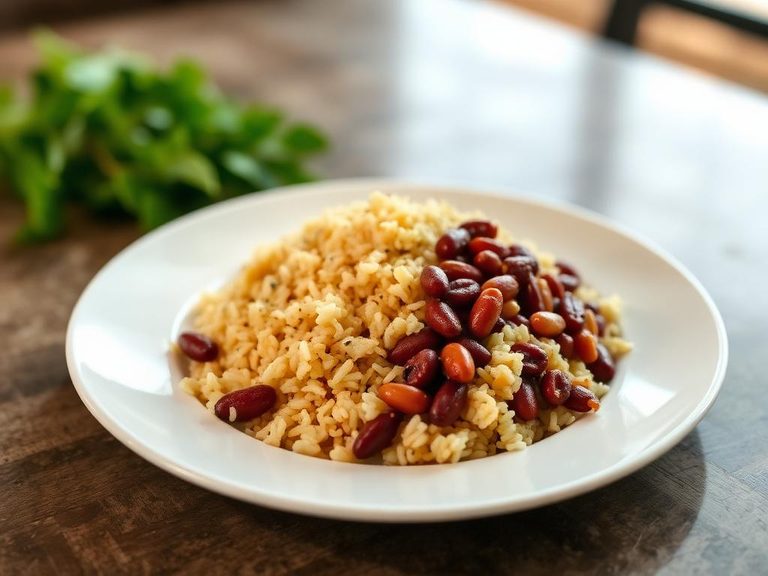
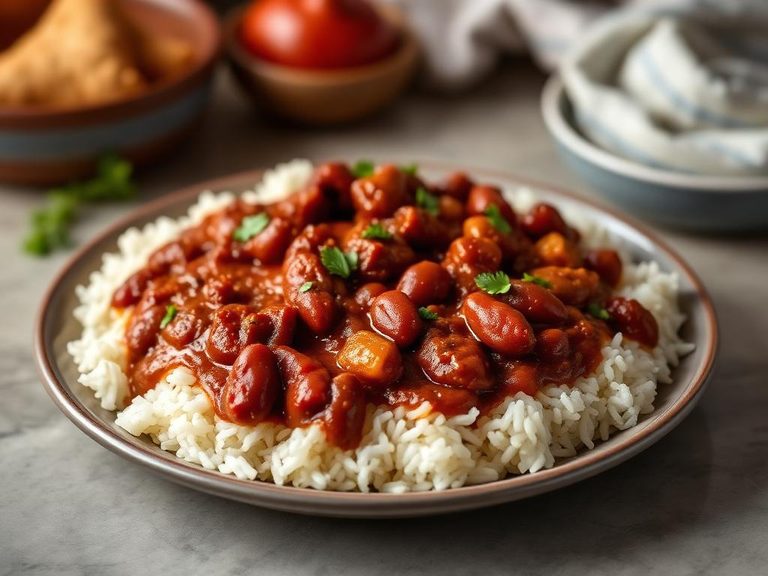
A humble yet hearty staple, this pairing combines the earthy, creamy bite of black beans with the fluffy, neutral canvas of white rice. The contrast in textures—soft beans against tender grains—creates a satisfying, complete protein meal. Nutritionally, it's a balanced powerhouse, offering a solid protein boost alongside complex carbs and filling fiber.
Calorie split: 15% protein · 61% carbs · 24% fat
↓ Full nutrition💚 Why it's loved
People love it for its comforting, savory simplicity and incredible versatility—it absorbs spices and sauces beautifully. It's a cultural cornerstone in countless cuisines, symbolizing sustenance and community.
⚠️ Watch-outs & how to enjoy it better
The high fiber and resistant starch can cause digestive discomfort or gas for some, especially if not accustomed. To counteract this, start with smaller portions, ensure beans are well-cooked, and drink plenty of water. The white rice component has a high glycemic index, which may cause blood sugar spikes; pairing it with the beans' fiber and protein helps mitigate this effect.
Key benefits
- Provides a complete protein profile when combined.
- High in dietary fiber for digestive health.
- Excellent source of plant-based iron and folate.
- Low in sugar and naturally cholesterol-free.
- Offers sustained energy from complex carbohydrates.
🍽️ Popular dishes
🌍 Where it's eaten
💡 Did you know?
The combination is a classic example of 'protein complementation,' where the limiting amino acids in beans (methionine) are supplied by rice, and vice-versa, creating a complete protein.
Full nutrition (USDA data · scales with serving)
| Water | 63.9 g |
| Energy | 160 kcal |
| Protein | 6.0 g |
| Total lipid (fat) | 4.3 g |
| Carbohydrate, by difference | 24.4 g |
| Fiber, total dietary | 5.0 g |
| Total Sugars | 0.20 g |
| Calcium, Ca | 19.0 mg |
| Iron, Fe | 1.6 mg |
| Magnesium, Mg | 44.0 mg |
| Phosphorus, P | 95.0 mg |
| Potassium, K | 212 mg |
| Sodium, Na | 228 mg |
| Zinc, Zn | 0.82 mg |
| Copper, Cu | 0.14 mg |
| Selenium, Se | 3.7 ug |
| Vitamin C, total ascorbic acid | 0.00 mg |
| Thiamin | 0.19 mg |
| Riboflavin | 0.04 mg |
| Niacin | 0.85 mg |
| Vitamin B-6 | 0.07 mg |
| Folate, total | 102 ug |
| Folic acid | 22.0 ug |
| Folate, food | 80.0 ug |
| Folate, DFE | 117 ug |
| Choline, total | 19.0 mg |
| Vitamin B-12 | 0.00 ug |
| Vitamin B-12, added | 0.00 ug |
| Vitamin A, RAE | 0.00 ug |
| Retinol | 0.00 ug |
| Carotene, beta | 0.00 ug |
| Carotene, alpha | 0.00 ug |
| Cryptoxanthin, beta | 0.00 ug |
| Lycopene | 0.00 ug |
| Lutein + zeaxanthin | 0.00 ug |
| Vitamin E (alpha-tocopherol) | 1.2 mg |
| Vitamin E, added | 0.00 mg |
| Vitamin D (D2 + D3) | 0.00 ug |
| Vitamin K (phylloquinone) | 5.8 ug |
| Alcohol, ethyl | 0.00 g |
| Caffeine | 0.00 mg |
| Theobromine | 0.00 mg |
Fat & fatty acid profile (per 100g)
| Fatty acids, total saturated | 0.63 g |
| SFA 4:0 | 0.00 g |
| SFA 6:0 | 0.00 g |
| SFA 8:0 | 0.00 g |
| SFA 10:0 | 0.00 g |
| SFA 12:0 | 0.00 g |
| SFA 14:0 | 0.00 g |
| SFA 16:0 | 0.47 g |
| SFA 18:0 | 0.12 g |
| Fatty acids, total monounsaturated | 1.7 g |
| MUFA 16:1 | 0.01 g |
| MUFA 18:1 | 1.7 g |
| MUFA 20:1 | 0.03 g |
| MUFA 22:1 | 0.00 g |
| Fatty acids, total polyunsaturated | 1.7 g |
| PUFA 18:2 | 1.4 g |
| PUFA 18:3 | 0.23 g |
| PUFA 18:4 | 0.00 g |
| PUFA 20:4 | 0.00 g |
| PUFA 20:5 n-3 (EPA) | 0.00 g |
| PUFA 22:5 n-3 (DPA) | 0.00 g |
| PUFA 22:6 n-3 (DHA) | 0.00 g |
| Cholesterol | 0.00 mg |
Amino acid profile (per 100g)
Estimated from Beans, black, mature seeds, raw — USDA does not publish this profile for Black beans and white rice.
| Tryptophan | 0.26 g |
| Threonine | 0.91 g |
| Isoleucine | 0.95 g |
| Leucine | 1.7 g |
| Lysine | 1.5 g |
| Methionine | 0.33 g |
| Cystine | 0.23 g |
| Phenylalanine | 1.2 g |
| Tyrosine | 0.61 g |
| Valine | 1.1 g |
| Arginine | 1.3 g |
| Histidine | 0.60 g |
| Alanine | 0.91 g |
| Aspartic acid | 2.6 g |
| Glutamic acid | 3.3 g |
| Glycine | 0.84 g |
| Proline | 0.92 g |
| Serine | 1.2 g |
FAQ
Is black beans and rice a complete protein?
Yes, when eaten together in the same meal, they form a complete protein, containing all nine essential amino acids your body needs.
Can I use canned beans?
Absolutely. Rinsing canned black beans thoroughly under water can reduce their sodium content by up to 40%.
How can I add more flavor?
Sauté onions, garlic, and bell peppers as a base, or stir in spices like cumin, smoked paprika, and oregano. A splash of vinegar or lime juice at the end brightens the dish.
Nutrient density (calculated · NRF9.3)
Nutrient Rich Foods index: beneficial nutrients (protein, fiber, vitamins, minerals) minus saturated fat, added sugar & sodium, per 100 kcal.
NRF9.3 index — Fulgoni, Keast & Drewnowski, 2009. Computed from USDA nutrients.
Weight-loss friendliness (composite index)
Energy density 1.60 kcal/g · 15% calories from protein · 5.0 g fiber · 0.2 g sugar per 100 g.
Composite of energy density (Rolls et al., 1999), protein & fiber satiety, minus sugar. A calculated heuristic — ranks satiety-per-calorie, not a clinical measure.
Dietary load (calculated from USDA values)
Potential renal acid load. Positive = acid-forming, negative = alkaline-forming.
Sodium-to-potassium ratio: 1.08 (lower is better — aim for ≤ 1)
Sodium:potassium per WHO potassium guidance. Computed from USDA nutrients.