Bread, pita, whole-wheat
Whole food · Baked Products

Photo: Wikipedia
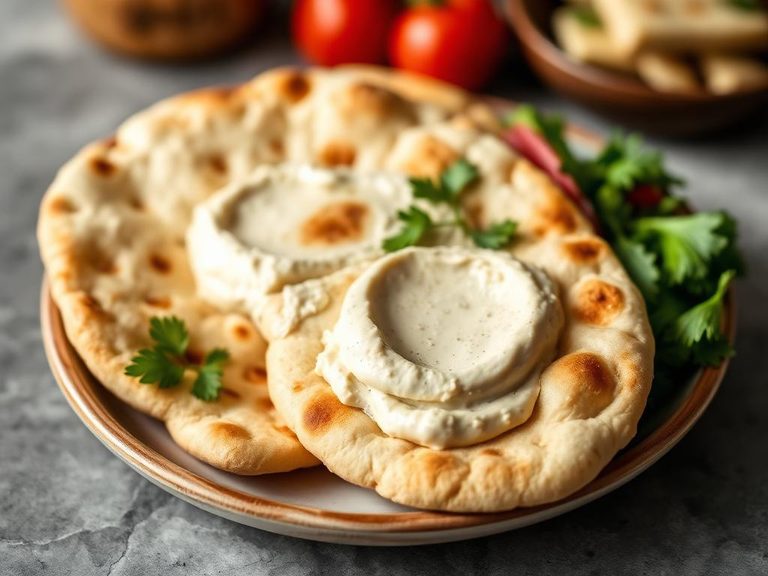
Whole-wheat pita is a soft, pocketed flatbread made from whole-grain flour, offering a nutty, slightly earthy flavor and a satisfying chew. It's a nutritional powerhouse, providing a solid 9.8g of protein and 6.1g of fiber per 100g, making it a more substantial and filling choice than its white-flour counterpart. Its unique pocket is perfect for stuffing with a variety of ingredients, turning a simple bread into a complete meal.
💚 Why it's loved
People love whole-wheat pita for its incredible versatility—it acts as both a plate and an edible utensil, perfect for scooping hummus, tucking in falafel, or holding a hearty salad. Its sturdy yet soft texture and nutty flavor make it a satisfying and wholesome staple in many cuisines, especially Mediterranean and Middle Eastern.
⚠️ Watch-outs & how to enjoy it better
The primary concern is its carbohydrate content (55.89g per 100g), which can cause blood sugar spikes if eaten in large quantities without balance. To counteract this, always pair it with protein (like grilled chicken or chickpeas) and healthy fats (like tahini or avocado) to slow digestion and stabilize blood sugar. Also, check labels for sodium, as some commercial pitas can be surprisingly salty.
Key benefits
- High in dietary fiber (6.1g per 100g) for digestive health and satiety.
- Good source of plant-based protein (9.8g per 100g).
- Made with whole grains, providing more nutrients than refined white pita.
- Low in fat (1.71g per 100g), making it a heart-healthy carbohydrate option.
- Versatile for both hot and cold fillings, from grilled meats to fresh salads.
🍽️ Popular dishes




🌍 Where it's eaten
💡 Did you know?
The pocket in pita bread is created by steam during baking; the intense heat causes the dough to puff up into a balloon, and as it cools, the two layers separate to form the signature pocket.
Full nutrition (scales with serving)
| Water | 30.6 g |
| Energy | 262 kcal |
| Energy | 1096 kj |
| Protein | 9.8 g |
| Total lipid (fat) | 1.7 g |
| Ash | 2.0 g |
| Carbohydrate, by difference | 55.9 g |
| Fiber, total dietary | 6.1 g |
| Total Sugars | 2.9 g |
| Calcium, Ca | 15.0 mg |
| Iron, Fe | 3.1 mg |
| Magnesium, Mg | 69.0 mg |
| Phosphorus, P | 180 mg |
| Potassium, K | 170 mg |
| Sodium, Na | 421 mg |
| Zinc, Zn | 1.5 mg |
| Copper, Cu | 0.29 mg |
| Manganese, Mn | 1.7 mg |
| Selenium, Se | 44.0 ug |
| Vitamin C, total ascorbic acid | 0.00 mg |
| Thiamin | 0.34 mg |
| Riboflavin | 0.08 mg |
| Niacin | 2.8 mg |
| Pantothenic acid | 0.83 mg |
| Vitamin B-6 | 0.27 mg |
| Folate, total | 35.0 ug |
| Folic acid | 0.00 ug |
| Folate, food | 35.0 ug |
| Folate, DFE | 35.0 ug |
| Choline, total | 26.5 mg |
| Vitamin B-12 | 0.00 ug |
| Vitamin B-12, added | 0.00 ug |
| Vitamin A, RAE | 0.00 ug |
| Retinol | 0.00 ug |
| Carotene, beta | 4.0 ug |
| Carotene, alpha | 0.00 ug |
| Cryptoxanthin, beta | 0.00 ug |
| Vitamin A, IU | 0.00 iu |
| Lycopene | 0.00 ug |
| Lutein + zeaxanthin | 53.0 ug |
| Vitamin E (alpha-tocopherol) | 0.61 mg |
| Vitamin E, added | 0.00 mg |
| Vitamin D (D2 + D3), International Units | 0.00 iu |
| Vitamin D (D2 + D3) | 0.00 ug |
| Vitamin K (phylloquinone) | 1.4 ug |
| Alcohol, ethyl | 0.00 g |
| Caffeine | 0.00 mg |
| Theobromine | 0.00 mg |
Fat & fatty acid profile (per 100g)
| Fatty acids, total saturated | 0.21 g |
| SFA 4:0 | 0.00 g |
| SFA 6:0 | 0.00 g |
| SFA 8:0 | 0.00 g |
| SFA 10:0 | 0.00 g |
| SFA 12:0 | 0.00 g |
| SFA 14:0 | 0.00 g |
| SFA 16:0 | 0.37 g |
| SFA 18:0 | 0.02 g |
| Fatty acids, total monounsaturated | 0.35 g |
| MUFA 16:1 | 0.04 g |
| MUFA 18:1 | 0.31 g |
| MUFA 20:1 | 0.00 g |
| MUFA 22:1 | 0.00 g |
| Fatty acids, total polyunsaturated | 1.1 g |
| PUFA 18:2 | 1.0 g |
| PUFA 18:3 | 0.05 g |
| PUFA 18:4 | 0.00 g |
| PUFA 20:4 | 0.00 g |
| PUFA 20:5 n-3 (EPA) | 0.00 g |
| PUFA 22:5 n-3 (DPA) | 0.00 g |
| PUFA 22:6 n-3 (DHA) | 0.00 g |
| Cholesterol | 0.00 mg |
Amino acid profile (per 100g)
| Tryptophan | 0.15 g |
| Threonine | 0.28 g |
| Isoleucine | 0.37 g |
| Leucine | 0.67 g |
| Lysine | 0.27 g |
| Methionine | 0.15 g |
| Cystine | 0.23 g |
| Phenylalanine | 0.47 g |
| Tyrosine | 0.29 g |
| Valine | 0.44 g |
| Arginine | 0.46 g |
| Histidine | 0.23 g |
| Alanine | 0.34 g |
| Aspartic acid | 0.49 g |
| Glutamic acid | 3.2 g |
| Glycine | 0.39 g |
| Proline | 1.0 g |
| Serine | 0.47 g |
FAQ
How is whole-wheat pita different from white pita?
Whole-wheat pita is made from whole-grain flour, retaining the bran and germ, which gives it more fiber, protein, and nutrients. White pita uses refined flour, which has a lighter texture but fewer nutrients.
Can I eat pita on a low-carb diet?
While lower in carbs than some breads, pita is still a significant source of carbohydrates (55.89g per 100g). It's not ideal for strict low-carb diets, but can be included in moderation, especially if paired with protein and fat to manage blood sugar.
What's the best way to store pita bread?
Store pita in an airtight container or zip-top bag at room temperature for up to 2 days, or freeze for up to 3 months. To refresh stale pita, lightly toast it in a pan or oven.