Cassava, raw
Whole food · Vegetables and Vegetable Products
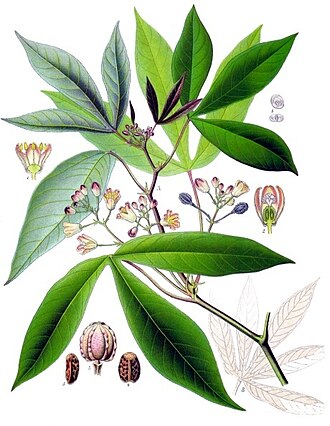
Photo: Wikipedia
Raw cassava is a dense, starchy root with a crisp, slightly waxy texture and a mild, subtly sweet, nutty flavor reminiscent of a potato. Nutritionally, it is a powerhouse of energy-dense carbohydrates, providing a substantial 38 grams per 100 grams, making it a vital calorie source in many tropical diets.
💚 Why it's loved
People love cassava for its incredible versatility and neutral, adaptable flavor that acts as a perfect canvas for both savory and sweet preparations. It holds deep cultural significance as a resilient, staple food security crop in many equatorial regions.
⚠️ Watch-outs & how to enjoy it better
Raw cassava contains cyanogenic glycosides, which can release toxic cyanide if not properly processed (peeled, soaked, and cooked). Its high carbohydrate content can cause significant blood sugar spikes, so individuals managing diabetes should be cautious and pair it with protein, healthy fats, or fiber-rich foods to slow absorption.
Key benefits
- Excellent source of quick energy from complex carbohydrates
- Contains resistant starch which may support gut health
- Naturally gluten-free, suitable for gluten-intolerant diets
- Provides essential minerals like manganese and potassium
- High in dietary fiber for digestive regularity
🍽️ Popular dishes
🌍 Where it's eaten
💡 Did you know?
Cassava is the world's third-largest source of food carbohydrates, after rice and maize, and is a critical survival crop because it can remain in the ground for up to two years without spoiling.
Full nutrition (scales with serving)
| Water | 59.7 g |
| Energy | 160 kcal |
| Energy | 667 kj |
| Protein | 1.4 g |
| Total lipid (fat) | 0.28 g |
| Ash | 0.62 g |
| Carbohydrate, by difference | 38.1 g |
| Fiber, total dietary | 1.8 g |
| Total Sugars | 1.7 g |
| Calcium, Ca | 16.0 mg |
| Iron, Fe | 0.27 mg |
| Magnesium, Mg | 21.0 mg |
| Phosphorus, P | 27.0 mg |
| Potassium, K | 271 mg |
| Sodium, Na | 14.0 mg |
| Zinc, Zn | 0.34 mg |
| Copper, Cu | 0.10 mg |
| Manganese, Mn | 0.38 mg |
| Selenium, Se | 0.70 ug |
| Vitamin C, total ascorbic acid | 20.6 mg |
| Thiamin | 0.09 mg |
| Riboflavin | 0.05 mg |
| Niacin | 0.85 mg |
| Pantothenic acid | 0.11 mg |
| Vitamin B-6 | 0.09 mg |
| Folate, total | 27.0 ug |
| Folic acid | 0.00 ug |
| Folate, food | 27.0 ug |
| Folate, DFE | 27.0 ug |
| Choline, total | 23.7 mg |
| Betaine | 0.40 mg |
| Vitamin B-12 | 0.00 ug |
| Vitamin B-12, added | 0.00 ug |
| Vitamin A, RAE | 1.0 ug |
| Retinol | 0.00 ug |
| Carotene, beta | 8.0 ug |
| Carotene, alpha | 0.00 ug |
| Cryptoxanthin, beta | 0.00 ug |
| Vitamin A, IU | 13.0 iu |
| Lycopene | 0.00 ug |
| Lutein + zeaxanthin | 0.00 ug |
| Vitamin E (alpha-tocopherol) | 0.19 mg |
| Vitamin E, added | 0.00 mg |
| Vitamin D (D2 + D3), International Units | 0.00 iu |
| Vitamin D (D2 + D3) | 0.00 ug |
| Vitamin K (phylloquinone) | 1.9 ug |
| Alcohol, ethyl | 0.00 g |
| Caffeine | 0.00 mg |
| Theobromine | 0.00 mg |
Fat & fatty acid profile (per 100g)
| Fatty acids, total saturated | 0.07 g |
| SFA 4:0 | 0.00 g |
| SFA 6:0 | 0.00 g |
| SFA 8:0 | 0.00 g |
| SFA 10:0 | 0.00 g |
| SFA 12:0 | 0.00 g |
| SFA 14:0 | 0.00 g |
| SFA 16:0 | 0.07 g |
| SFA 18:0 | 0.01 g |
| Fatty acids, total monounsaturated | 0.07 g |
| MUFA 16:1 | 0.00 g |
| MUFA 18:1 | 0.07 g |
| MUFA 20:1 | 0.00 g |
| MUFA 22:1 | 0.00 g |
| Fatty acids, total polyunsaturated | 0.05 g |
| PUFA 18:2 | 0.03 g |
| PUFA 18:3 | 0.02 g |
| PUFA 18:4 | 0.00 g |
| PUFA 20:4 | 0.00 g |
| PUFA 20:5 n-3 (EPA) | 0.00 g |
| PUFA 22:5 n-3 (DPA) | 0.00 g |
| PUFA 22:6 n-3 (DHA) | 0.00 g |
| Fatty acids, total trans | 0.00 g |
| Cholesterol | 0.00 mg |
Amino acid profile (per 100g)
| Tryptophan | 0.02 g |
| Threonine | 0.03 g |
| Isoleucine | 0.03 g |
| Leucine | 0.04 g |
| Lysine | 0.04 g |
| Methionine | 0.01 g |
| Cystine | 0.03 g |
| Phenylalanine | 0.03 g |
| Tyrosine | 0.02 g |
| Valine | 0.04 g |
| Arginine | 0.14 g |
| Histidine | 0.02 g |
| Alanine | 0.04 g |
| Aspartic acid | 0.08 g |
| Glutamic acid | 0.21 g |
| Glycine | 0.03 g |
| Proline | 0.03 g |
| Serine | 0.03 g |
FAQ
Is it safe to eat raw cassava?
No, it is not safe. Raw cassava contains naturally occurring cyanogenic compounds. It must be properly prepared by peeling, soaking, and thorough cooking (boiling, frying, baking) to eliminate these toxins.
How does cassava compare to a potato?
Cassava is significantly higher in carbohydrates and calories than a potato, with less protein. It has a denser, starchier texture and a milder, slightly sweeter taste.
What is the difference between cassava and yuca?
'Yuca' is the common Spanish name for the cassava root and is widely used in Latin American and Caribbean contexts. 'Cassava' is the more general English term for the plant and its tuberous root.