

WENDY'S, CLASSIC DOUBLE, with cheese
Whole food · Fast Foods

Photo: Wikipedia
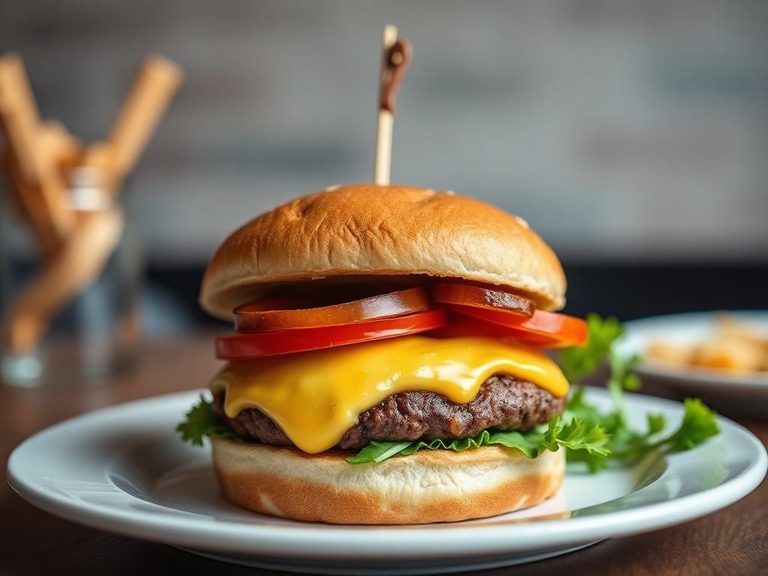
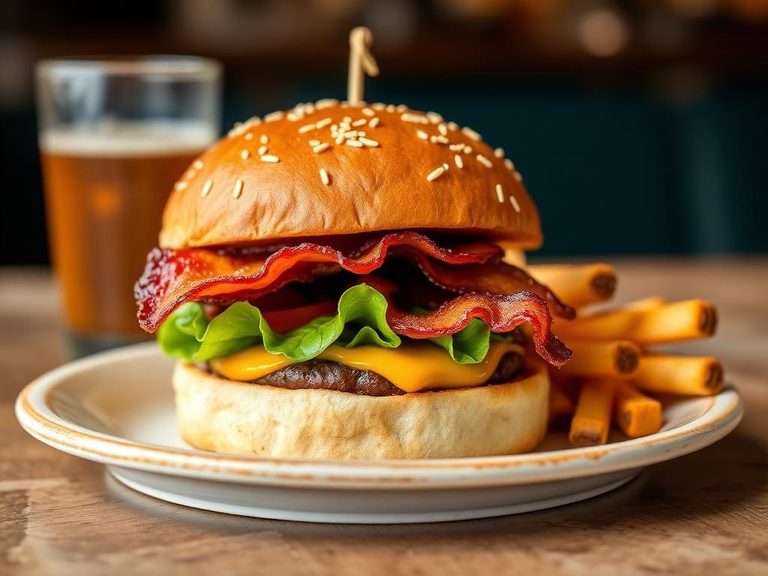
Wendy's Classic Double with cheese is a hearty, two-patty beef burger layered with melted American cheese, crisp lettuce, tomato, pickles, onions, and a creamy signature sauce on a soft, toasted bun. Each bite delivers a satisfying combination of savory, juicy beef, tangy pickles, and cool, fresh vegetables. Nutritionally, it provides a substantial 241 kcal and 16.52g of protein per 100g, making it a protein-rich meal option.
Calorie split: 27% protein · 19% carbs · 53% fat
↓ Full nutrition💚 Why it's loved
People love it for its classic, comforting flavor profile—the perfect balance of savory beef, melted cheese, and tangy toppings that hits a nostalgic, satisfying note. It's a versatile meal that can be customized and is deeply embedded in American fast-food culture as a reliable, hearty choice.
⚠️ Watch-outs & how to enjoy it better
The burger is high in sodium and saturated fat, which may be a concern for those monitoring heart health or blood pressure. The refined white bun and sugary sauce can cause a rapid blood-sugar spike. To counteract, pair it with a side salad instead of fries, choose mustard over sugary sauces, and drink water to help manage sodium intake.
Key benefits
- High-quality protein source for muscle maintenance
- Provides essential B vitamins from beef
- Contains calcium from the cheese
- Offers quick energy from carbohydrates
- Includes some dietary fiber from vegetables
🍽️ Popular dishes


🌍 Where it's eaten
💡 Did you know?
Wendy's was founded in 1969 in Columbus, Ohio, by Dave Thomas, who named the chain after his daughter, Melinda Lou 'Wendy' Thomas.
Full nutrition (USDA data · scales with serving)
| Water | 55.8 g |
| Energy | 241 kcal |
| Energy | 1007 kj |
| Protein | 16.5 g |
| Total lipid (fat) | 14.2 g |
| Ash | 1.7 g |
| Carbohydrate, by difference | 11.7 g |
| Fiber, total dietary | 1.1 g |
| Sucrose | 0.00 g |
| Glucose | 0.47 g |
| Fructose | 0.62 g |
| Lactose | 0.15 g |
| Maltose | 0.15 g |
| Starch | 8.6 g |
| Calcium, Ca | 58.0 mg |
| Iron, Fe | 2.9 mg |
| Magnesium, Mg | 19.0 mg |
| Phosphorus, P | 134 mg |
| Potassium, K | 214 mg |
| Sodium, Na | 422 mg |
| Zinc, Zn | 3.0 mg |
| Copper, Cu | 0.07 mg |
| Manganese, Mn | 0.13 mg |
| Selenium, Se | 19.9 ug |
| Vitamin C, total ascorbic acid | 0.70 mg |
| Thiamin | 0.24 mg |
| Riboflavin | 0.25 mg |
| Niacin | 3.5 mg |
| Pantothenic acid | 0.36 mg |
| Vitamin B-6 | 0.19 mg |
| Vitamin B-12 | 1.9 ug |
| Vitamin K (phylloquinone) | 6.9 ug |
| Vitamin K (Dihydrophylloquinone) | 0.00 ug |
Fat & fatty acid profile (per 100g)
| Fatty acids, total saturated | 5.9 g |
| SFA 8:0 | 0.02 g |
| SFA 10:0 | 0.05 g |
| SFA 12:0 | 0.06 g |
| SFA 14:0 | 0.50 g |
| SFA 15:0 | 0.07 g |
| SFA 16:0 | 3.2 g |
| SFA 17:0 | 0.16 g |
| SFA 18:0 | 1.8 g |
| SFA 20:0 | 0.02 g |
| SFA 22:0 | 0.00 g |
| SFA 24:0 | 0.02 g |
| Fatty acids, total monounsaturated | 5.7 g |
| MUFA 14:1 | 0.11 g |
| MUFA 15:1 | 0.00 g |
| MUFA 16:1 | 0.49 g |
| MUFA 17:1 | 0.00 g |
| MUFA 18:1 | 5.1 g |
| MUFA 20:1 | 0.05 g |
| MUFA 22:1 | 0.00 g |
| Fatty acids, total polyunsaturated | 1.3 g |
| PUFA 18:2 | 1.0 g |
| PUFA 18:3 | 0.15 g |
| PUFA 18:4 | 0.07 g |
| PUFA 20:2 n-6 c,c | 0.00 g |
| PUFA 20:3 | 0.01 g |
| PUFA 20:4 | 0.03 g |
| PUFA 20:5 n-3 (EPA) | 0.00 g |
| PUFA 22:5 n-3 (DPA) | 0.00 g |
| PUFA 22:6 n-3 (DHA) | 0.00 g |
| Cholesterol | 51.0 mg |
Amino acid profile (per 100g)
| Tryptophan | 0.16 g |
| Threonine | 0.57 g |
| Isoleucine | 0.59 g |
| Leucine | 1.1 g |
| Lysine | 1.0 g |
| Methionine | 0.34 g |
| Cystine | 0.18 g |
| Phenylalanine | 0.57 g |
| Tyrosine | 0.35 g |
| Valine | 0.68 g |
| Arginine | 0.81 g |
| Histidine | 0.38 g |
| Alanine | 0.86 g |
| Aspartic acid | 1.2 g |
| Glutamic acid | 2.4 g |
| Glycine | 0.93 g |
| Proline | 0.90 g |
| Serine | 0.60 g |
FAQ
How does the protein content compare to other fast-food burgers?
At 16.52g of protein per 100g, it's a solid protein source, often comparable to or slightly higher than similar burgers from competitors due to its two-patty design.
Is this burger suitable for a low-carb diet?
While the beef and cheese are low-carb, the bun and sugary sauce contribute 11.71g of carbs per 100g. For a lower-carb option, you could order it 'protein-style' (lettuce-wrapped) if available.
What are the main sources of fat in this burger?
The primary sources of fat are the beef patties themselves and the American cheese, contributing to its 14.2g of fat per 100g, which includes saturated fat.
Nutrient density (calculated · NRF9.3)
Nutrient Rich Foods index: beneficial nutrients (protein, fiber, vitamins, minerals) minus saturated fat, added sugar & sodium, per 100 kcal.
NRF9.3 index — Fulgoni, Keast & Drewnowski, 2009. Computed from USDA nutrients.
Weight-loss friendliness (composite index)
Energy density 2.41 kcal/g · 27% calories from protein · 1.1 g fiber · 0.0 g sugar per 100 g.
Composite of energy density (Rolls et al., 1999), protein & fiber satiety, minus sugar. A calculated heuristic — ranks satiety-per-calorie, not a clinical measure.
Dietary load (calculated from USDA values)
Potential renal acid load. Positive = acid-forming, negative = alkaline-forming.
Sodium-to-potassium ratio: 1.97 (lower is better — aim for ≤ 1)
Sodium:potassium per WHO potassium guidance. Computed from USDA nutrients.