

Rice, white, cooked, made with oil
Common food
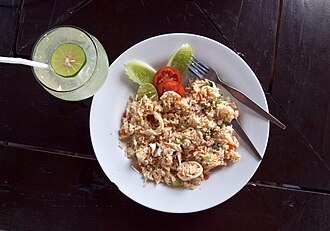
Photo: Wikipedia
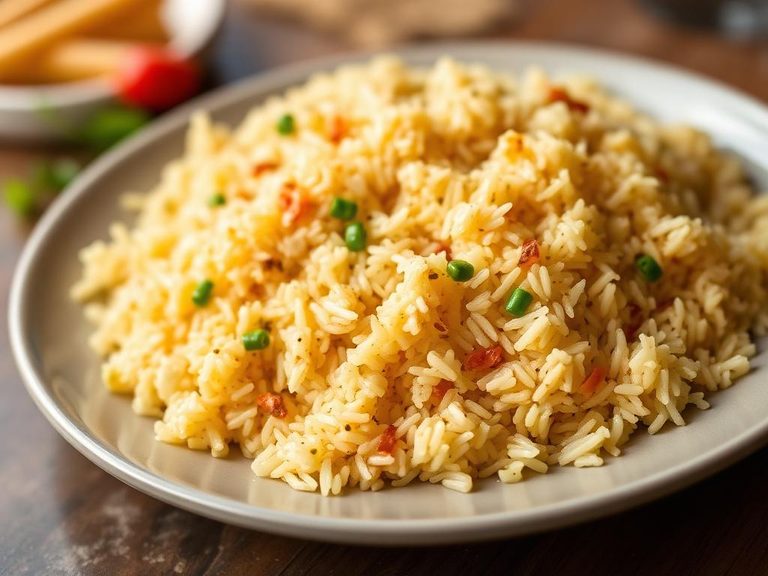
This is fluffy white rice that's been stir-fried or cooked with a touch of oil, giving each grain a subtle sheen and a richer, more savory mouthfeel than plain steamed rice. The texture is tender yet distinct, with a mild, comforting flavor that acts as a perfect canvas for other ingredients. Nutritionally, it provides quick energy from carbs with a modest boost of fat for satiety.
Calorie split: 7% protein · 74% carbs · 19% fat
↓ Full nutrition💚 Why it's loved
People love it for its comforting, familiar taste and satisfying texture that pairs seamlessly with everything from spicy curries to savory stir-fries. It's a culinary chameleon, forming the essential, flavorful backbone of countless home-cooked meals across cultures.
⚠️ Watch-outs & how to enjoy it better
As a refined carbohydrate with a high glycemic index, it can cause rapid blood sugar spikes, making it less ideal for those managing diabetes without careful portion control. To mitigate this, pair it with protein (like chicken or tofu), healthy fats, and fibrous vegetables to slow digestion. Also, be mindful of added salt during cooking.
Key benefits
- Provides quick, easily digestible energy from carbohydrates
- The added fat can help increase feelings of fullness
- A versatile, neutral base that complements a wide variety of flavors
- A staple food that is a primary source of calories for billions worldwide
🍽️ Popular dishes
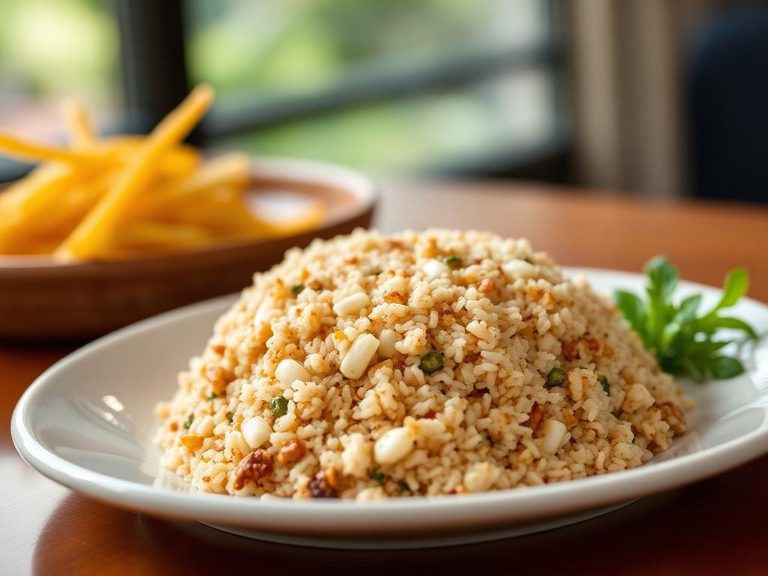
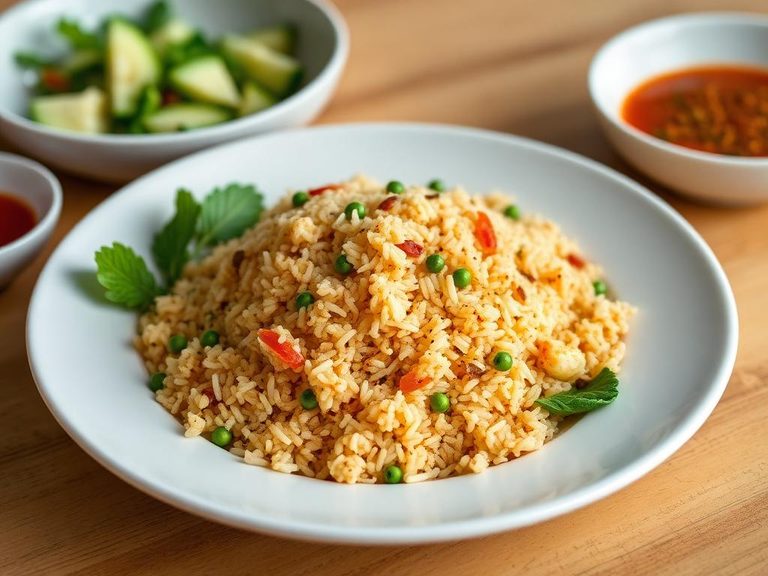
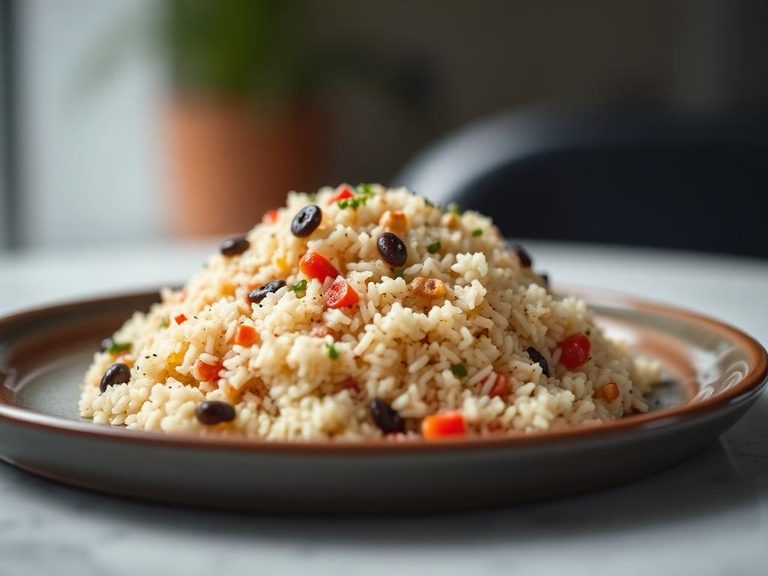
🌍 Where it's eaten
💡 Did you know?
The specific technique of cooking rice with oil before adding water is a foundational step in making many pilafs and fried rice dishes, as it helps keep the grains separate and adds a layer of nutty flavor.
Full nutrition (USDA data · scales with serving)
| Water | 66.1 g |
| Energy | 151 kcal |
| Protein | 2.6 g |
| Total lipid (fat) | 3.1 g |
| Carbohydrate, by difference | 27.2 g |
| Fiber, total dietary | 0.40 g |
| Total Sugars | 0.05 g |
| Calcium, Ca | 10.0 mg |
| Iron, Fe | 1.2 mg |
| Magnesium, Mg | 12.0 mg |
| Phosphorus, P | 42.0 mg |
| Potassium, K | 34.0 mg |
| Sodium, Na | 238 mg |
| Zinc, Zn | 0.47 mg |
| Copper, Cu | 0.07 mg |
| Selenium, Se | 7.2 ug |
| Vitamin C, total ascorbic acid | 0.00 mg |
| Thiamin | 0.16 mg |
| Riboflavin | 0.01 mg |
| Niacin | 1.4 mg |
| Vitamin B-6 | 0.09 mg |
| Folate, total | 56.0 ug |
| Folic acid | 53.0 ug |
| Folate, food | 3.0 ug |
| Folate, DFE | 94.0 ug |
| Choline, total | 2.0 mg |
| Vitamin B-12 | 0.00 ug |
| Vitamin B-12, added | 0.00 ug |
| Vitamin A, RAE | 0.00 ug |
| Retinol | 0.00 ug |
| Carotene, beta | 0.00 ug |
| Carotene, alpha | 0.00 ug |
| Cryptoxanthin, beta | 0.00 ug |
| Lycopene | 0.00 ug |
| Lutein + zeaxanthin | 0.00 ug |
| Vitamin E (alpha-tocopherol) | 0.58 mg |
| Vitamin E, added | 0.00 mg |
| Vitamin D (D2 + D3) | 0.00 ug |
| Vitamin K (phylloquinone) | 2.9 ug |
| Alcohol, ethyl | 0.00 g |
| Caffeine | 0.00 mg |
| Theobromine | 0.00 mg |
Fat & fatty acid profile (per 100g)
| Fatty acids, total saturated | 0.46 g |
| SFA 4:0 | 0.00 g |
| SFA 6:0 | 0.00 g |
| SFA 8:0 | 0.00 g |
| SFA 10:0 | 0.00 g |
| SFA 12:0 | 0.00 g |
| SFA 14:0 | 0.00 g |
| SFA 16:0 | 0.34 g |
| SFA 18:0 | 0.09 g |
| Fatty acids, total monounsaturated | 1.3 g |
| MUFA 16:1 | 0.01 g |
| MUFA 18:1 | 1.3 g |
| MUFA 20:1 | 0.02 g |
| MUFA 22:1 | 0.00 g |
| Fatty acids, total polyunsaturated | 1.2 g |
| PUFA 18:2 | 1.0 g |
| PUFA 18:3 | 0.14 g |
| PUFA 18:4 | 0.00 g |
| PUFA 20:4 | 0.00 g |
| PUFA 20:5 n-3 (EPA) | 0.00 g |
| PUFA 22:5 n-3 (DPA) | 0.00 g |
| PUFA 22:6 n-3 (DHA) | 0.00 g |
| Cholesterol | 0.00 mg |
Amino acid profile (per 100g)
Estimated from Snacks, rice cakes, brown rice, sesame seed — USDA does not publish this profile for Rice.
| Tryptophan | 0.10 g |
| Threonine | 0.28 g |
| Isoleucine | 0.32 g |
| Leucine | 0.63 g |
| Lysine | 0.29 g |
| Methionine | 0.17 g |
| Cystine | 0.09 g |
| Phenylalanine | 0.39 g |
| Tyrosine | 0.29 g |
| Valine | 0.44 g |
| Arginine | 0.59 g |
| Histidine | 0.19 g |
| Alanine | 0.44 g |
| Aspartic acid | 0.71 g |
| Glutamic acid | 1.6 g |
| Glycine | 0.38 g |
| Proline | 0.35 g |
| Serine | 0.39 g |
FAQ
How is this different from plain steamed rice?
The key difference is the addition of oil (like vegetable, canola, or sesame oil) during the cooking process. This coats the grains, giving a richer flavor, a subtle sheen, and often a slightly firmer, less sticky texture compared to simply steamed rice.
Is this considered fried rice?
Not necessarily. While it shares the oil-cooking step, 'fried rice' typically implies that fully cooked, cooled rice is stir-fried at high heat with other ingredients like eggs, vegetables, and soy sauce. This description refers to rice cooked with oil from the start, which can be a base for many dishes or served on its own.
What type of oil is best for cooking it?
Neutral oils with high smoke points are ideal, such as vegetable, canola, peanut, or light sesame oil. These oils add minimal flavor of their own, allowing the rice's taste to shine, and they can handle the heat without burning.
Nutrient density (calculated · NRF9.3)
Nutrient Rich Foods index: beneficial nutrients (protein, fiber, vitamins, minerals) minus saturated fat, added sugar & sodium, per 100 kcal.
NRF9.3 index — Fulgoni, Keast & Drewnowski, 2009. Computed from USDA nutrients.
Weight-loss friendliness (composite index)
Energy density 1.51 kcal/g · 7% calories from protein · 0.4 g fiber · 0.1 g sugar per 100 g.
Composite of energy density (Rolls et al., 1999), protein & fiber satiety, minus sugar. A calculated heuristic — ranks satiety-per-calorie, not a clinical measure.
Dietary load (calculated from USDA values)
Potential renal acid load. Positive = acid-forming, negative = alkaline-forming.
Sodium-to-potassium ratio: 7.00 (lower is better — aim for ≤ 1)
Sodium:potassium per WHO potassium guidance. Computed from USDA nutrients.