

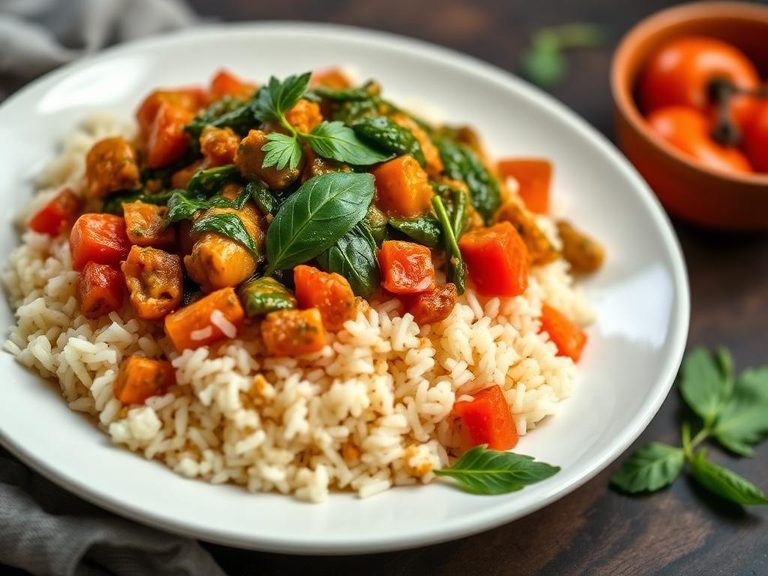
Rice, brown, with dark green vegetables and tomatoes and/or tomato-based sauce, no added fat
Common food

Photo: Wikipedia
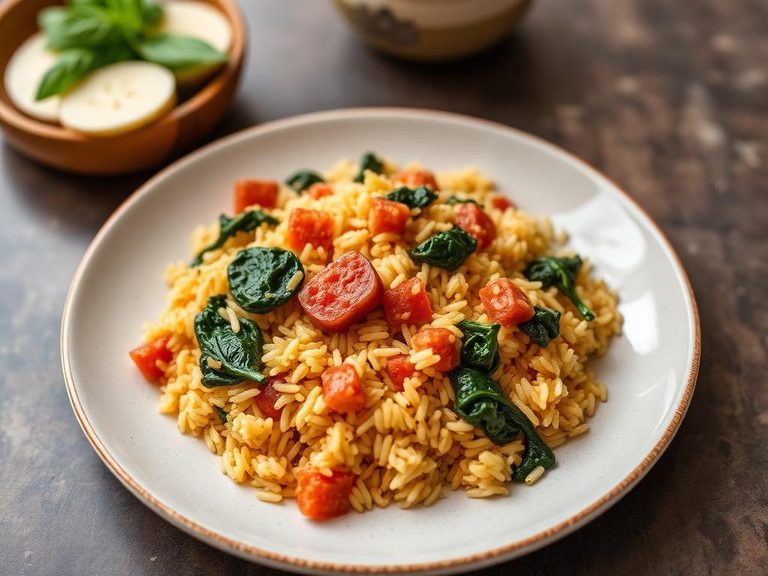
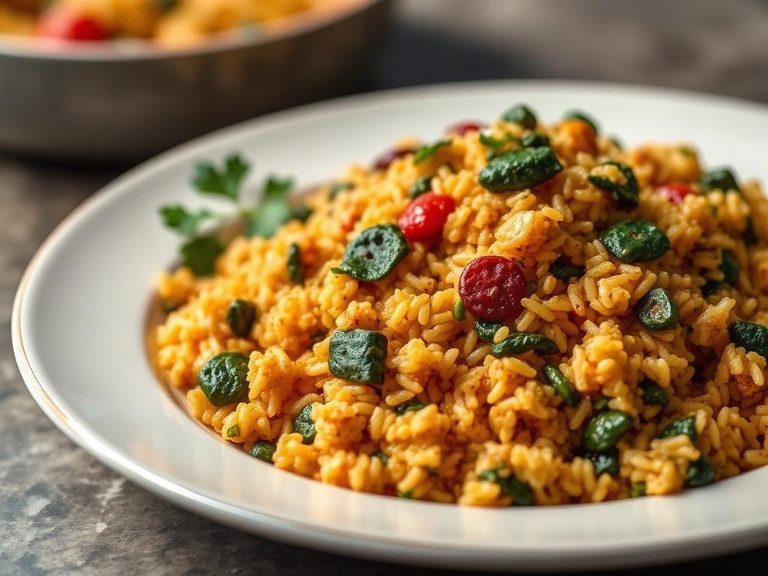
This is a hearty, plant-forward bowl of fluffy brown rice tossed with tender dark greens and bright, acidic tomatoes, all simmered in a light, oil-free sauce. The texture is satisfyingly chewy from the whole grain rice, contrasted by the soft, wilted greens and the slight burst of tomato. At under 100 calories per 100g, it's a low-fat, high-carbohydrate energy source that relies on the natural sweetness of the tomatoes and the earthiness of the greens for flavor.
Calorie split: 10% protein · 83% carbs · 7% fat
↓ Full nutrition💚 Why it's loved
People love this dish for its comforting, savory flavor profile and its incredible versatility—it can be a simple side or a complete meal. It's a staple in many cultures, offering a wholesome, satisfying experience that feels both nourishing and familiar.
⚠️ Watch-outs & how to enjoy it better
The lack of added fat can make it feel dry or less flavorful to some, and the high carbohydrate content may cause blood-sugar spikes if not balanced. To counteract this, pair it with a protein source like beans, tofu, or chicken, and consider adding a small amount of healthy fat (like avocado or nuts) to improve satiety and nutrient absorption.
Key benefits
- Low in fat (0.8g per 100g)
- Good source of dietary fiber (1.7g per 100g)
- Provides complex carbohydrates for sustained energy
- Contains lycopene from tomatoes and iron from dark greens
- Low-calorie density (98 kcal per 100g)
🍽️ Popular dishes
🌍 Where it's eaten
💡 Did you know?
Brown rice retains its bran and germ layers, which are removed in white rice, making it a whole grain that is naturally higher in fiber, magnesium, and B vitamins.
Full nutrition (USDA data · scales with serving)
| Water | 75.6 g |
| Energy | 98.0 kcal |
| Protein | 2.4 g |
| Total lipid (fat) | 0.80 g |
| Carbohydrate, by difference | 20.3 g |
| Fiber, total dietary | 1.7 g |
| Total Sugars | 0.71 g |
| Calcium, Ca | 12.0 mg |
| Iron, Fe | 0.57 mg |
| Magnesium, Mg | 33.0 mg |
| Phosphorus, P | 86.0 mg |
| Potassium, K | 124 mg |
| Sodium, Na | 173 mg |
| Zinc, Zn | 0.59 mg |
| Copper, Cu | 0.09 mg |
| Selenium, Se | 4.6 ug |
| Vitamin C, total ascorbic acid | 9.7 mg |
| Thiamin | 0.23 mg |
| Riboflavin | 0.07 mg |
| Niacin | 2.1 mg |
| Vitamin B-6 | 0.13 mg |
| Folate, total | 13.0 ug |
| Folic acid | 0.00 ug |
| Folate, food | 13.0 ug |
| Folate, DFE | 13.0 ug |
| Choline, total | 9.7 mg |
| Vitamin B-12 | 0.00 ug |
| Vitamin B-12, added | 0.00 ug |
| Vitamin A, RAE | 4.0 ug |
| Retinol | 0.00 ug |
| Carotene, beta | 46.0 ug |
| Carotene, alpha | 0.00 ug |
| Cryptoxanthin, beta | 0.00 ug |
| Lycopene | 389 ug |
| Lutein + zeaxanthin | 83.0 ug |
| Vitamin E (alpha-tocopherol) | 0.23 mg |
| Vitamin E, added | 0.00 mg |
| Vitamin D (D2 + D3) | 0.00 ug |
| Vitamin K (phylloquinone) | 10.7 ug |
| Alcohol, ethyl | 0.00 g |
| Caffeine | 0.00 mg |
| Theobromine | 0.00 mg |
Fat & fatty acid profile (per 100g)
| Fatty acids, total saturated | 0.20 g |
| SFA 4:0 | 0.00 g |
| SFA 6:0 | 0.00 g |
| SFA 8:0 | 0.00 g |
| SFA 10:0 | 0.01 g |
| SFA 12:0 | 0.00 g |
| SFA 14:0 | 0.01 g |
| SFA 16:0 | 0.15 g |
| SFA 18:0 | 0.02 g |
| Fatty acids, total monounsaturated | 0.28 g |
| MUFA 16:1 | 0.00 g |
| MUFA 18:1 | 0.28 g |
| MUFA 20:1 | 0.00 g |
| MUFA 22:1 | 0.00 g |
| Fatty acids, total polyunsaturated | 0.29 g |
| PUFA 18:2 | 0.28 g |
| PUFA 18:3 | 0.01 g |
| PUFA 18:4 | 0.00 g |
| PUFA 20:4 | 0.00 g |
| PUFA 20:5 n-3 (EPA) | 0.00 g |
| PUFA 22:5 n-3 (DPA) | 0.00 g |
| PUFA 22:6 n-3 (DHA) | 0.00 g |
| Cholesterol | 0.00 mg |
Amino acid profile (per 100g)
Estimated from Snacks, rice cakes, brown rice, sesame seed — USDA does not publish this profile for Rice.
| Tryptophan | 0.10 g |
| Threonine | 0.28 g |
| Isoleucine | 0.32 g |
| Leucine | 0.63 g |
| Lysine | 0.29 g |
| Methionine | 0.17 g |
| Cystine | 0.09 g |
| Phenylalanine | 0.39 g |
| Tyrosine | 0.29 g |
| Valine | 0.44 g |
| Arginine | 0.59 g |
| Histidine | 0.19 g |
| Alanine | 0.44 g |
| Aspartic acid | 0.71 g |
| Glutamic acid | 1.6 g |
| Glycine | 0.38 g |
| Proline | 0.35 g |
| Serine | 0.39 g |
FAQ
Is this dish suitable for a low-carb diet?
No, it is high in carbohydrates (20.26g per 100g) due to the brown rice, making it more suitable for balanced or high-carb diets.
Can I add fat to this dish?
Yes, adding a small amount of healthy fat like olive oil or avocado can improve flavor and nutrient absorption, though it will increase the calorie count.
What are the best greens to use?
Spinach, kale, Swiss chard, or collard greens work well, as they hold up to cooking and add a rich, earthy flavor.
Nutrient density (calculated · NRF9.3)
Nutrient Rich Foods index: beneficial nutrients (protein, fiber, vitamins, minerals) minus saturated fat, added sugar & sodium, per 100 kcal.
NRF9.3 index — Fulgoni, Keast & Drewnowski, 2009. Computed from USDA nutrients.
Weight-loss friendliness (composite index)
Energy density 0.98 kcal/g · 10% calories from protein · 1.7 g fiber · 0.7 g sugar per 100 g.
Composite of energy density (Rolls et al., 1999), protein & fiber satiety, minus sugar. A calculated heuristic — ranks satiety-per-calorie, not a clinical measure.
Dietary load (calculated from USDA values)
Potential renal acid load. Positive = acid-forming, negative = alkaline-forming.
Sodium-to-potassium ratio: 1.40 (lower is better — aim for ≤ 1)
Sodium:potassium per WHO potassium guidance. Computed from USDA nutrients.