

Rice, brown, with carrots, dark green vegetables, and tomatoes and/or tomato-based sauce, no added fat
Common food

Photo: Wikipedia
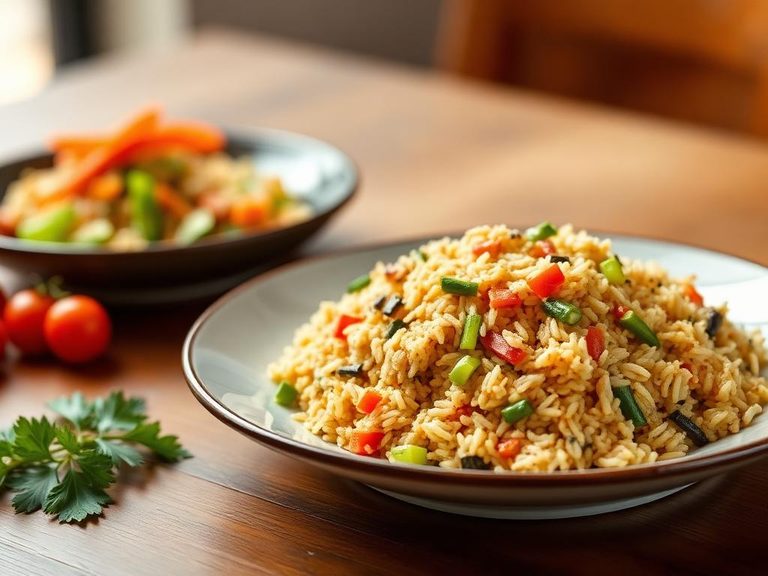
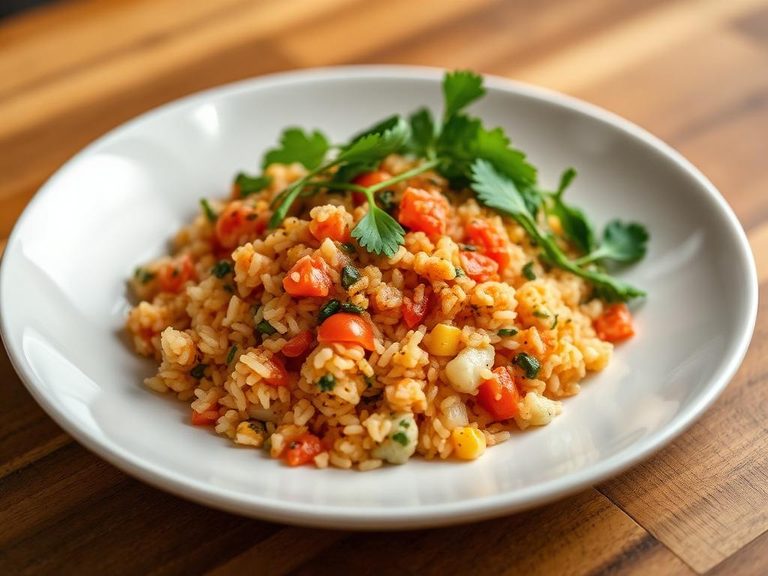
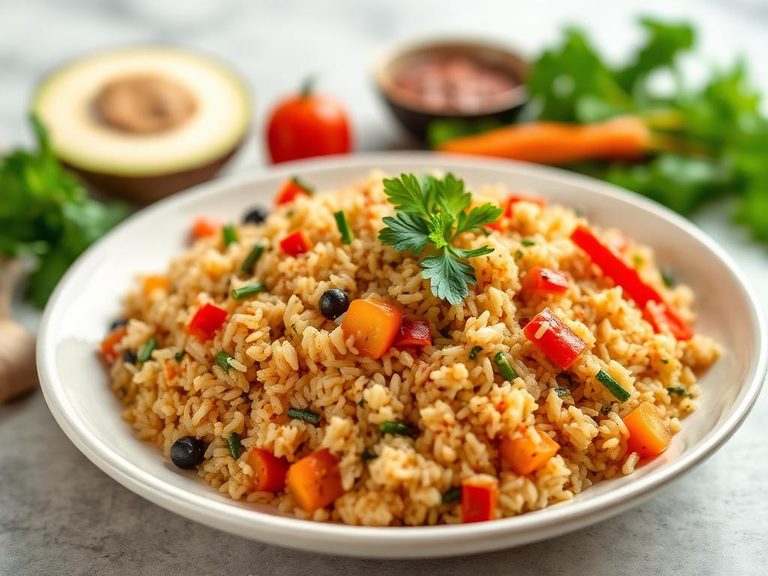
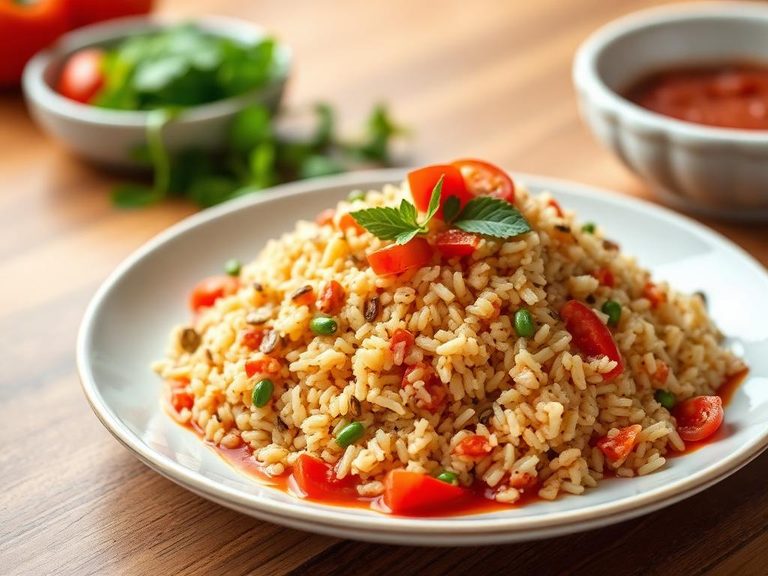
This is a hearty, wholesome bowl of cooked brown rice tossed with tender carrots, dark leafy greens, and a vibrant tomato-based sauce, all prepared without added fat. The texture is pleasantly chewy with a soft, earthy sweetness from the vegetables, while the tomato sauce adds a bright, savory tang. Nutritionally, it's a low-calorie, high-fiber staple that provides steady energy without excess fat or sugar.
Calorie split: 10% protein · 83% carbs · 7% fat
↓ Full nutrition💚 Why it's loved
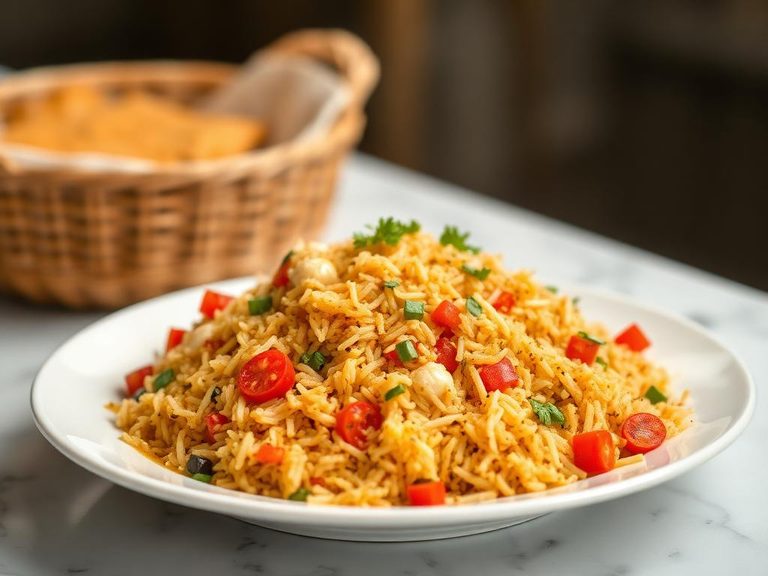
People love this dish for its comforting, home-cooked warmth and the way the earthy rice and vegetables meld with the tangy tomato sauce. It's incredibly versatile, easily adapted with different greens or spices, and fits seamlessly into many global cuisines from Latin America to South Asia.
⚠️ Watch-outs & how to enjoy it better
Some may find the texture of brown rice too chewy or the dish bland without added fat, and those monitoring blood sugar should be mindful of portion size despite the fiber. To counteract this, pair with a source of protein like beans or tofu, add a small amount of healthy fat like avocado, or season generously with herbs and spices to boost flavor without sodium.
Key benefits
- High in dietary fiber for digestive health and satiety
- Naturally low in fat and added sugars
- Rich in complex carbohydrates for sustained energy
- Contains vitamins A and C from carrots and tomatoes
- Provides plant-based iron and folate from dark greens
🍽️ Popular dishes
🌍 Where it's eaten
💡 Did you know?
Brown rice retains its bran and germ layers, which means it has about three times more fiber than white rice, making this dish a surprisingly filling low-calorie option.
Full nutrition (USDA data · scales with serving)
| Water | 75.2 g |
| Energy | 100 kcal |
| Protein | 2.4 g |
| Total lipid (fat) | 0.80 g |
| Carbohydrate, by difference | 20.8 g |
| Fiber, total dietary | 1.8 g |
| Total Sugars | 0.78 g |
| Calcium, Ca | 11.0 mg |
| Iron, Fe | 0.56 mg |
| Magnesium, Mg | 33.0 mg |
| Phosphorus, P | 87.0 mg |
| Potassium, K | 122 mg |
| Sodium, Na | 172 mg |
| Zinc, Zn | 0.59 mg |
| Copper, Cu | 0.09 mg |
| Selenium, Se | 4.6 ug |
| Vitamin C, total ascorbic acid | 6.9 mg |
| Thiamin | 0.20 mg |
| Riboflavin | 0.07 mg |
| Niacin | 2.1 mg |
| Vitamin B-6 | 0.13 mg |
| Folate, total | 12.0 ug |
| Folic acid | 0.00 ug |
| Folate, food | 12.0 ug |
| Folate, DFE | 12.0 ug |
| Choline, total | 9.5 mg |
| Vitamin B-12 | 0.00 ug |
| Vitamin B-12, added | 0.00 ug |
| Vitamin A, RAE | 60.0 ug |
| Retinol | 0.00 ug |
| Carotene, beta | 593 ug |
| Carotene, alpha | 254 ug |
| Cryptoxanthin, beta | 0.00 ug |
| Lycopene | 263 ug |
| Lutein + zeaxanthin | 103 ug |
| Vitamin E (alpha-tocopherol) | 0.27 mg |
| Vitamin E, added | 0.00 mg |
| Vitamin D (D2 + D3) | 0.00 ug |
| Vitamin K (phylloquinone) | 8.4 ug |
| Alcohol, ethyl | 0.00 g |
| Caffeine | 0.00 mg |
| Theobromine | 0.00 mg |
Fat & fatty acid profile (per 100g)
| Fatty acids, total saturated | 0.21 g |
| SFA 4:0 | 0.00 g |
| SFA 6:0 | 0.00 g |
| SFA 8:0 | 0.00 g |
| SFA 10:0 | 0.01 g |
| SFA 12:0 | 0.00 g |
| SFA 14:0 | 0.01 g |
| SFA 16:0 | 0.16 g |
| SFA 18:0 | 0.02 g |
| Fatty acids, total monounsaturated | 0.28 g |
| MUFA 16:1 | 0.00 g |
| MUFA 18:1 | 0.28 g |
| MUFA 20:1 | 0.00 g |
| MUFA 22:1 | 0.00 g |
| Fatty acids, total polyunsaturated | 0.29 g |
| PUFA 18:2 | 0.29 g |
| PUFA 18:3 | 0.01 g |
| PUFA 18:4 | 0.00 g |
| PUFA 20:4 | 0.00 g |
| PUFA 20:5 n-3 (EPA) | 0.00 g |
| PUFA 22:5 n-3 (DPA) | 0.00 g |
| PUFA 22:6 n-3 (DHA) | 0.00 g |
| Cholesterol | 0.00 mg |
Amino acid profile (per 100g)
Estimated from Snacks, rice cakes, brown rice, sesame seed — USDA does not publish this profile for Rice.
| Tryptophan | 0.10 g |
| Threonine | 0.28 g |
| Isoleucine | 0.32 g |
| Leucine | 0.63 g |
| Lysine | 0.29 g |
| Methionine | 0.17 g |
| Cystine | 0.09 g |
| Phenylalanine | 0.39 g |
| Tyrosine | 0.29 g |
| Valine | 0.44 g |
| Arginine | 0.59 g |
| Histidine | 0.19 g |
| Alanine | 0.44 g |
| Aspartic acid | 0.71 g |
| Glutamic acid | 1.6 g |
| Glycine | 0.38 g |
| Proline | 0.35 g |
| Serine | 0.39 g |
FAQ
Is this dish suitable for a low-carb diet?
Not really, as brown rice is a carbohydrate-rich grain. However, its high fiber content helps moderate blood sugar response compared to white rice.
Can I add protein to make it more filling?
Absolutely. Adding beans, lentils, tofu, or grilled chicken can boost protein content and make the meal more balanced.
How can I enhance the flavor without adding fat?
Use herbs like cilantro or parsley, spices like cumin or turmeric, a squeeze of lemon juice, or a dash of low-sodium soy sauce to add depth without extra calories.
Nutrient density (calculated · NRF9.3)
Nutrient Rich Foods index: beneficial nutrients (protein, fiber, vitamins, minerals) minus saturated fat, added sugar & sodium, per 100 kcal.
NRF9.3 index — Fulgoni, Keast & Drewnowski, 2009. Computed from USDA nutrients.
Weight-loss friendliness (composite index)
Energy density 1.00 kcal/g · 10% calories from protein · 1.8 g fiber · 0.8 g sugar per 100 g.
Composite of energy density (Rolls et al., 1999), protein & fiber satiety, minus sugar. A calculated heuristic — ranks satiety-per-calorie, not a clinical measure.
Dietary load (calculated from USDA values)
Potential renal acid load. Positive = acid-forming, negative = alkaline-forming.
Sodium-to-potassium ratio: 1.41 (lower is better — aim for ≤ 1)
Sodium:potassium per WHO potassium guidance. Computed from USDA nutrients.