

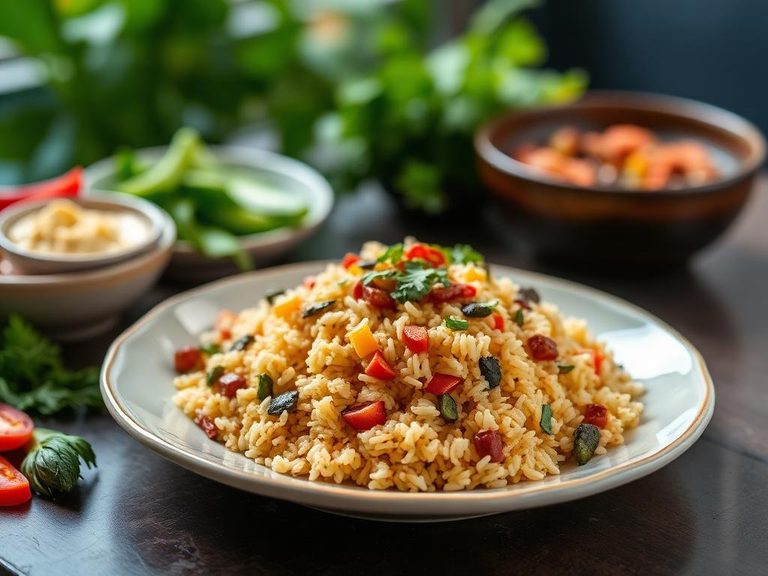
Rice, brown, with carrots, dark green vegetables, and tomatoes and/or tomato-based sauce, NS as to fat
Common food

Photo: Wikipedia
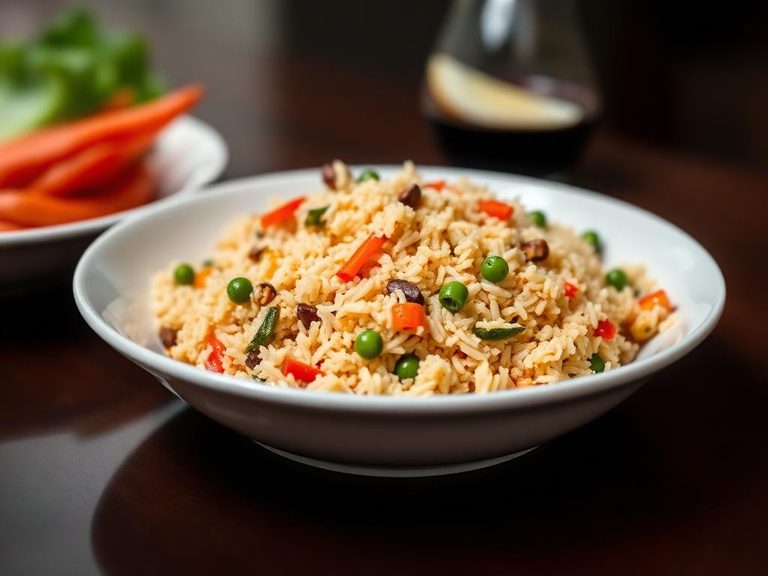
A wholesome, hearty bowl of nutty brown rice tossed with sweet carrots, earthy dark greens, and tangy tomatoes or a rich tomato-based sauce. The texture is pleasantly chewy and rustic, with the rice grains offering a satisfying bite against the soft, tender vegetables. Nutritionally, it's a low-calorie, high-fiber powerhouse that provides sustained energy without the heavy fat content.
Calorie split: 8% protein · 71% carbs · 20% fat
↓ Full nutrition💚 Why it's loved
People love this dish for its comforting, home-cooked appeal and the way the savory tomato sauce beautifully complements the nutty brown rice. It's incredibly versatile, easily adapting to whatever vegetables are on hand, and carries a warm, familiar flavor that resonates across many cultures.
⚠️ Watch-outs & how to enjoy it better
The high carbohydrate content can cause blood sugar spikes in sensitive individuals, especially if paired with sugary sauces. To counteract this, pair it with a lean protein source like grilled chicken or tofu, and opt for a low-sugar tomato sauce. Additionally, the fiber in brown rice may cause digestive discomfort for some, so gradually increasing intake and ensuring adequate water consumption can help.
Key benefits
- High in complex carbohydrates for steady energy release
- Rich in dietary fiber to support digestive health
- Low in fat, making it a heart-healthy meal option
- Packed with vitamins A and C from carrots and tomatoes
- Provides plant-based protein for muscle maintenance
🍽️ Popular dishes
🌍 Where it's eaten
💡 Did you know?
Brown rice retains its outer bran layer, which is rich in magnesium—a mineral that helps regulate blood sugar levels and supports over 300 enzymatic reactions in the body.
Full nutrition (USDA data · scales with serving)
| Water | 73.8 g |
| Energy | 114 kcal |
| Protein | 2.4 g |
| Total lipid (fat) | 2.6 g |
| Carbohydrate, by difference | 20.4 g |
| Fiber, total dietary | 1.7 g |
| Total Sugars | 0.76 g |
| Calcium, Ca | 11.0 mg |
| Iron, Fe | 0.55 mg |
| Magnesium, Mg | 32.0 mg |
| Phosphorus, P | 85.0 mg |
| Potassium, K | 120 mg |
| Sodium, Na | 169 mg |
| Zinc, Zn | 0.58 mg |
| Copper, Cu | 0.09 mg |
| Selenium, Se | 4.5 ug |
| Vitamin C, total ascorbic acid | 6.8 mg |
| Thiamin | 0.20 mg |
| Riboflavin | 0.07 mg |
| Niacin | 2.1 mg |
| Vitamin B-6 | 0.13 mg |
| Folate, total | 12.0 ug |
| Folic acid | 0.00 ug |
| Folate, food | 12.0 ug |
| Folate, DFE | 12.0 ug |
| Choline, total | 9.4 mg |
| Vitamin B-12 | 0.00 ug |
| Vitamin B-12, added | 0.00 ug |
| Vitamin A, RAE | 59.0 ug |
| Retinol | 0.00 ug |
| Carotene, beta | 582 ug |
| Carotene, alpha | 250 ug |
| Cryptoxanthin, beta | 0.00 ug |
| Lycopene | 258 ug |
| Lutein + zeaxanthin | 101 ug |
| Vitamin E (alpha-tocopherol) | 0.60 mg |
| Vitamin E, added | 0.00 mg |
| Vitamin D (D2 + D3) | 0.00 ug |
| Vitamin K (phylloquinone) | 10.0 ug |
| Alcohol, ethyl | 0.00 g |
| Caffeine | 0.00 mg |
| Theobromine | 0.00 mg |
Fat & fatty acid profile (per 100g)
| Fatty acids, total saturated | 0.44 g |
| SFA 4:0 | 0.00 g |
| SFA 6:0 | 0.00 g |
| SFA 8:0 | 0.00 g |
| SFA 10:0 | 0.01 g |
| SFA 12:0 | 0.00 g |
| SFA 14:0 | 0.01 g |
| SFA 16:0 | 0.33 g |
| SFA 18:0 | 0.07 g |
| Fatty acids, total monounsaturated | 1.0 g |
| MUFA 16:1 | 0.01 g |
| MUFA 18:1 | 1.0 g |
| MUFA 20:1 | 0.01 g |
| MUFA 22:1 | 0.00 g |
| Fatty acids, total polyunsaturated | 0.97 g |
| PUFA 18:2 | 0.89 g |
| PUFA 18:3 | 0.09 g |
| PUFA 18:4 | 0.00 g |
| PUFA 20:4 | 0.00 g |
| PUFA 20:5 n-3 (EPA) | 0.00 g |
| PUFA 22:5 n-3 (DPA) | 0.00 g |
| PUFA 22:6 n-3 (DHA) | 0.00 g |
| Cholesterol | 0.00 mg |
Amino acid profile (per 100g)
Estimated from Snacks, rice cakes, brown rice, sesame seed — USDA does not publish this profile for Rice.
| Tryptophan | 0.10 g |
| Threonine | 0.28 g |
| Isoleucine | 0.32 g |
| Leucine | 0.63 g |
| Lysine | 0.29 g |
| Methionine | 0.17 g |
| Cystine | 0.09 g |
| Phenylalanine | 0.39 g |
| Tyrosine | 0.29 g |
| Valine | 0.44 g |
| Arginine | 0.59 g |
| Histidine | 0.19 g |
| Alanine | 0.44 g |
| Aspartic acid | 0.71 g |
| Glutamic acid | 1.6 g |
| Glycine | 0.38 g |
| Proline | 0.35 g |
| Serine | 0.39 g |
FAQ
Is this dish suitable for vegetarians?
Yes, this dish is entirely plant-based and suitable for vegetarians and vegans, provided no animal-derived ingredients are added to the sauce.
Can I make this dish gluten-free?
Absolutely, as long as the tomato sauce and any added seasonings are gluten-free, the dish is naturally free of gluten.
How can I increase the protein content?
Add beans, lentils, tofu, or grilled chicken to boost the protein content while maintaining the dish's nutritional balance.
Nutrient density (calculated · NRF9.3)
Nutrient Rich Foods index: beneficial nutrients (protein, fiber, vitamins, minerals) minus saturated fat, added sugar & sodium, per 100 kcal.
NRF9.3 index — Fulgoni, Keast & Drewnowski, 2009. Computed from USDA nutrients.
Weight-loss friendliness (composite index)
Energy density 1.14 kcal/g · 8% calories from protein · 1.7 g fiber · 0.8 g sugar per 100 g.
Composite of energy density (Rolls et al., 1999), protein & fiber satiety, minus sugar. A calculated heuristic — ranks satiety-per-calorie, not a clinical measure.
Dietary load (calculated from USDA values)
Potential renal acid load. Positive = acid-forming, negative = alkaline-forming.
Sodium-to-potassium ratio: 1.41 (lower is better — aim for ≤ 1)
Sodium:potassium per WHO potassium guidance. Computed from USDA nutrients.