

Pot pie, beef
Common food

Photo: Wikipedia
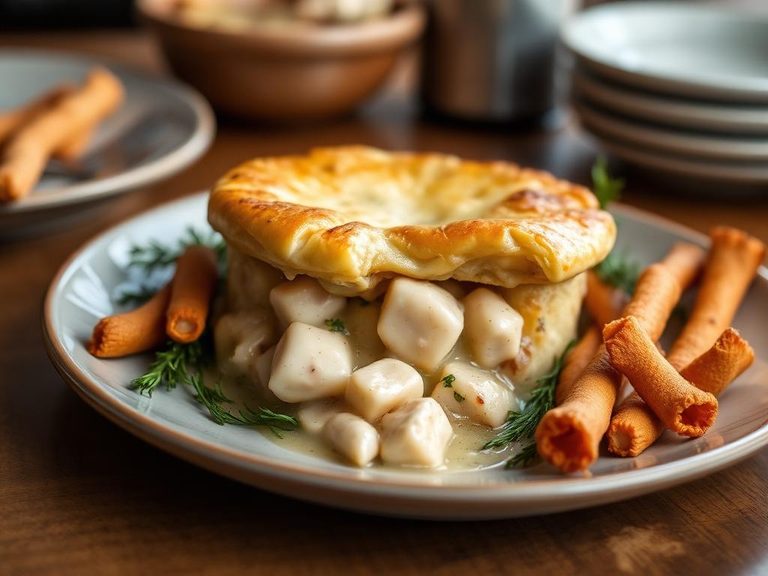
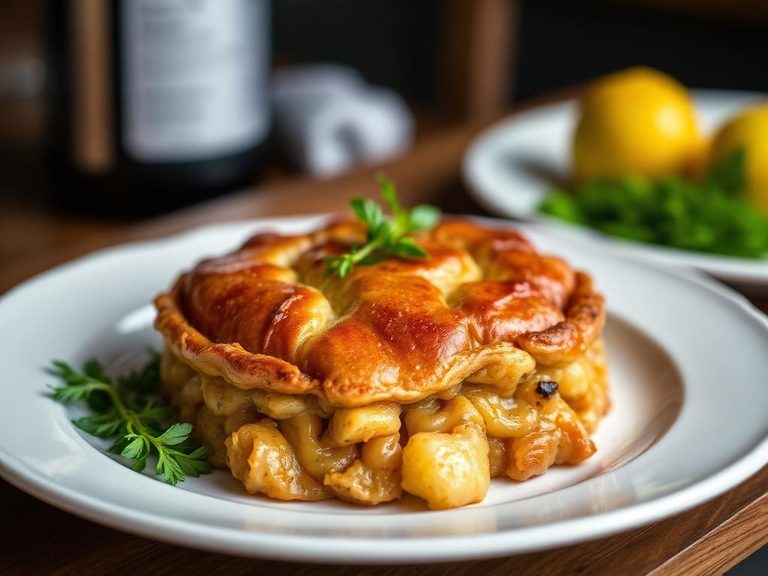
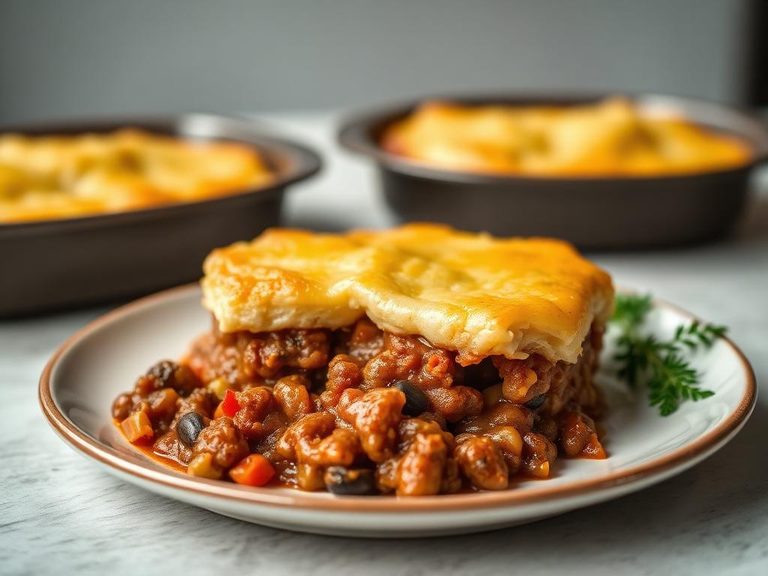
A savory pie filled with tender chunks of beef and vegetables in a rich, thick gravy, all encased in a flaky, golden pastry crust. The texture is a delightful contrast between the crisp, buttery top and the hearty, moist filling. It's a calorie-dense comfort food, providing a solid balance of protein and fats alongside its carbohydrate-rich crust.
Calorie split: 13% protein · 36% carbs · 51% fat
↓ Full nutrition💚 Why it's loved
People adore it for its profound comfort-food appeal, delivering a warm, savory, and deeply satisfying experience. It's a versatile dish that can be a family dinner staple, a holiday centerpiece, or a nostalgic reminder of home cooking.
⚠️ Watch-outs & how to enjoy it better
The high fat and refined carbohydrate content from the pastry can contribute to calorie overload and may cause blood sugar spikes. The filling can also be high in sodium. To counteract this, pair a modest portion with a large, vinegar-dressed green salad to add fiber and slow digestion, and ensure the rest of your day's meals are lower in sodium and richer in vegetables.
Key benefits
- Provides a substantial source of energy from fats and carbohydrates.
- Contains protein from the beef, essential for muscle maintenance.
- Offers a complete, satisfying meal in a single serving.
- Can be a practical way to use leftover cooked meats and vegetables.
🍽️ Popular dishes

🌍 Where it's eaten
💡 Did you know?
The earliest known recipe for a meat pie with a top and bottom crust dates back to the 14th-century English cookbook, 'The Forme of Cury'.
Full nutrition (USDA data · scales with serving)
| Water | 50.4 g |
| Energy | 271 kcal |
| Protein | 8.9 g |
| Total lipid (fat) | 15.4 g |
| Carbohydrate, by difference | 23.9 g |
| Fiber, total dietary | 2.0 g |
| Total Sugars | 3.3 g |
| Calcium, Ca | 41.0 mg |
| Iron, Fe | 1.7 mg |
| Magnesium, Mg | 16.0 mg |
| Phosphorus, P | 102 mg |
| Potassium, K | 173 mg |
| Sodium, Na | 374 mg |
| Zinc, Zn | 1.6 mg |
| Copper, Cu | 0.07 mg |
| Selenium, Se | 7.8 ug |
| Vitamin C, total ascorbic acid | 1.5 mg |
| Thiamin | 0.17 mg |
| Riboflavin | 0.14 mg |
| Niacin | 2.6 mg |
| Vitamin B-6 | 0.16 mg |
| Folate, total | 36.0 ug |
| Folic acid | 18.0 ug |
| Folate, food | 18.0 ug |
| Folate, DFE | 49.0 ug |
| Choline, total | 29.0 mg |
| Vitamin B-12 | 0.60 ug |
| Vitamin B-12, added | 0.00 ug |
| Vitamin A, RAE | 121 ug |
| Retinol | 27.0 ug |
| Carotene, beta | 950 ug |
| Carotene, alpha | 345 ug |
| Cryptoxanthin, beta | 0.00 ug |
| Lycopene | 0.00 ug |
| Lutein + zeaxanthin | 265 ug |
| Vitamin E (alpha-tocopherol) | 0.46 mg |
| Vitamin E, added | 0.00 mg |
| Vitamin D (D2 + D3) | 0.30 ug |
| Vitamin K (phylloquinone) | 7.8 ug |
| Alcohol, ethyl | 0.00 g |
| Caffeine | 0.00 mg |
| Theobromine | 0.00 mg |
Fat & fatty acid profile (per 100g)
| Fatty acids, total saturated | 5.5 g |
| SFA 4:0 | 0.04 g |
| SFA 6:0 | 0.03 g |
| SFA 8:0 | 0.01 g |
| SFA 10:0 | 0.04 g |
| SFA 12:0 | 0.04 g |
| SFA 14:0 | 0.32 g |
| SFA 16:0 | 3.1 g |
| SFA 18:0 | 1.8 g |
| Fatty acids, total monounsaturated | 6.7 g |
| MUFA 16:1 | 0.28 g |
| MUFA 18:1 | 6.3 g |
| MUFA 20:1 | 0.07 g |
| MUFA 22:1 | 0.00 g |
| Fatty acids, total polyunsaturated | 1.7 g |
| PUFA 18:2 | 1.5 g |
| PUFA 18:3 | 0.09 g |
| PUFA 18:4 | 0.00 g |
| PUFA 20:4 | 0.02 g |
| PUFA 20:5 n-3 (EPA) | 0.00 g |
| PUFA 22:5 n-3 (DPA) | 0.00 g |
| PUFA 22:6 n-3 (DHA) | 0.00 g |
| Cholesterol | 22.0 mg |
Amino acid profile (per 100g)
Estimated from Beef Pot Pie, frozen entree, prepared — USDA does not publish this profile for Pot pie.
| Tryptophan | 0.08 g |
| Threonine | 0.27 g |
| Isoleucine | 0.27 g |
| Leucine | 0.52 g |
| Lysine | 0.42 g |
| Methionine | 0.13 g |
| Cystine | 0.11 g |
| Phenylalanine | 0.30 g |
| Tyrosine | 0.20 g |
| Valine | 0.32 g |
| Arginine | 0.40 g |
| Histidine | 0.19 g |
| Alanine | 0.37 g |
| Aspartic acid | 0.54 g |
| Glutamic acid | 1.5 g |
| Glycine | 0.37 g |
| Proline | 0.55 g |
| Serine | 0.29 g |
FAQ
Can I make pot pie ahead of time?
Yes. You can assemble the pie (unbaked) and refrigerate it for up to 24 hours, or freeze it for up to 3 months. Add 10-15 minutes to the baking time if cooking from frozen or chilled.
Why is my pot pie filling runny?
The filling often thickens as it cools. Ensure you used enough flour or cornstarch in the gravy, and let the pie rest for 10-15 minutes after baking before cutting to allow it to set.
Is there a way to make it lighter?
You can use a top crust only, substitute half the beef with mushrooms or lentils, use a whole-wheat crust, or thicken the gravy with pureed vegetables instead of a roux.
Nutrient density (calculated · NRF9.3)
Nutrient Rich Foods index: beneficial nutrients (protein, fiber, vitamins, minerals) minus saturated fat, added sugar & sodium, per 100 kcal.
NRF9.3 index — Fulgoni, Keast & Drewnowski, 2009. Computed from USDA nutrients.
Weight-loss friendliness (composite index)
Energy density 2.71 kcal/g · 13% calories from protein · 2.0 g fiber · 3.3 g sugar per 100 g.
Composite of energy density (Rolls et al., 1999), protein & fiber satiety, minus sugar. A calculated heuristic — ranks satiety-per-calorie, not a clinical measure.
Dietary load (calculated from USDA values)
Potential renal acid load. Positive = acid-forming, negative = alkaline-forming.
Sodium-to-potassium ratio: 2.16 (lower is better — aim for ≤ 1)
Sodium:potassium per WHO potassium guidance. Computed from USDA nutrients.