

Pork, rice, and vegetables excluding carrots, broccoli, and dark-green leafy; tomato-based sauce
Common food

Photo: Wikipedia
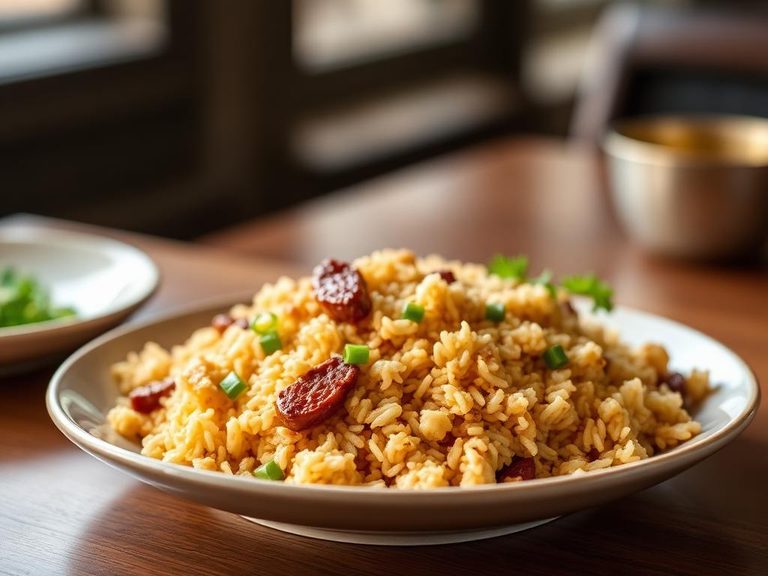
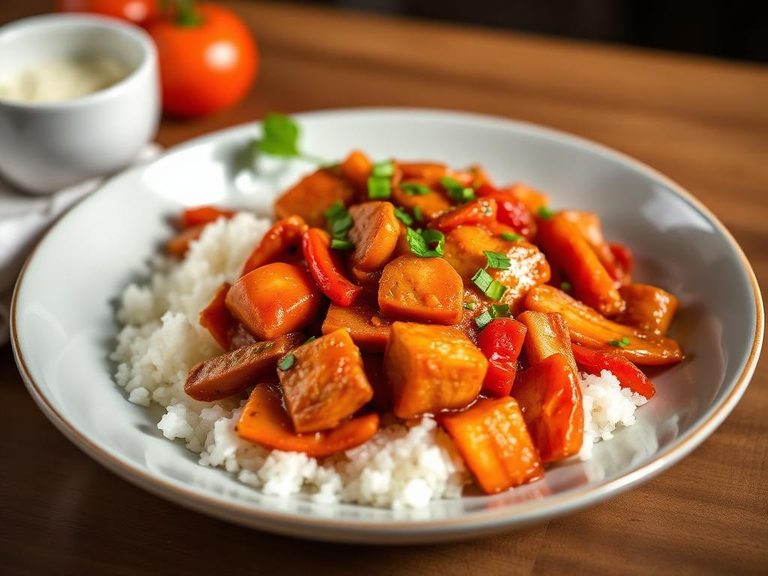
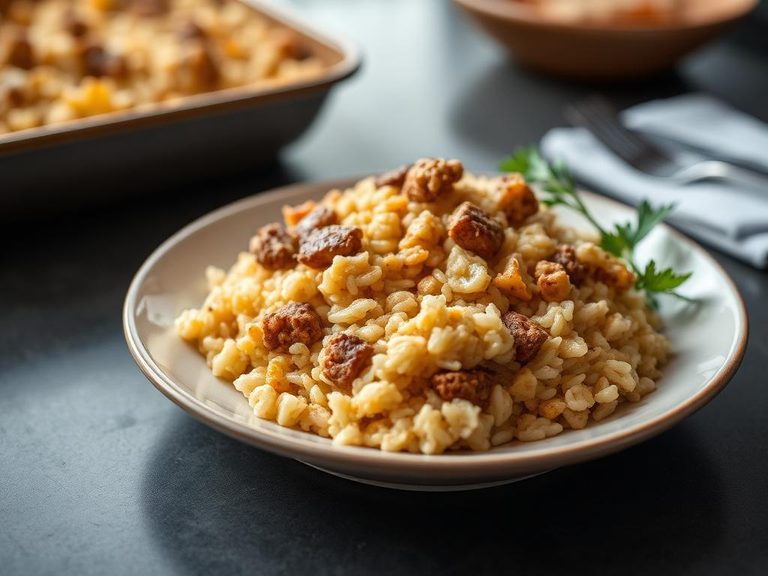
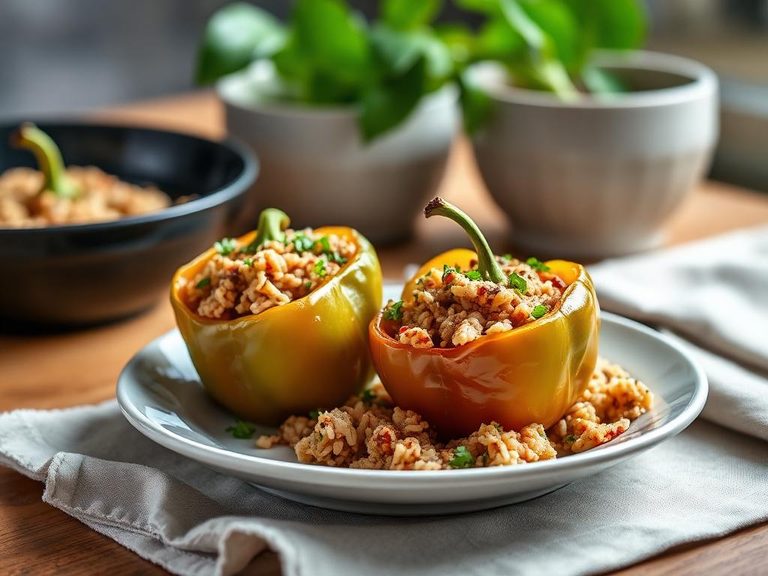
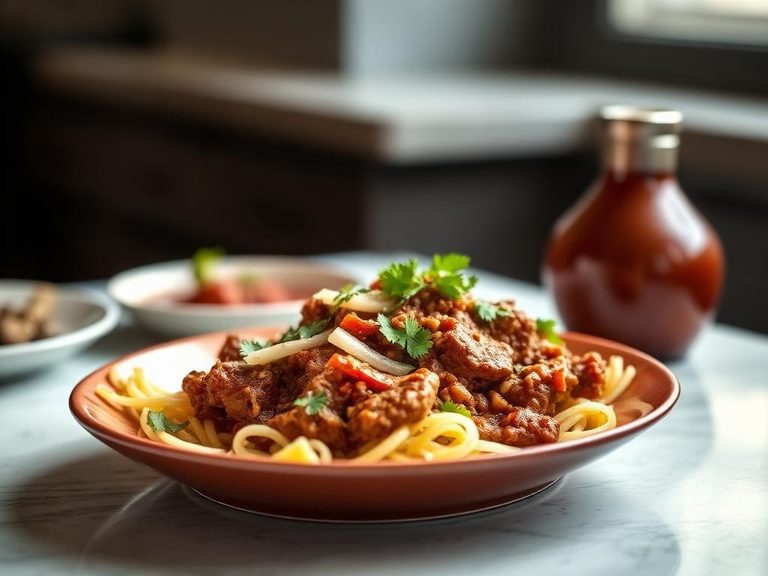
This is a hearty, savory dish of tender pork, fluffy rice, and a medley of vegetables like peas, corn, and green beans, all coated in a rich, tangy tomato-based sauce. The texture is a satisfying mix of soft rice, juicy meat, and crisp-tender vegetables. It's a balanced, comforting meal with a moderate calorie count and a good protein-to-carb ratio.
Calorie split: 17% protein · 49% carbs · 34% fat
↓ Full nutrition💚 Why it's loved
People love this dish for its deeply satisfying, savory flavor profile where the sweetness of the tomato sauce balances the savory pork. It's a one-pot comfort food that's incredibly versatile and evokes a sense of home cooking across many cultures.
⚠️ Watch-outs & how to enjoy it better
The combination of white rice and a sweetened tomato sauce can cause a rapid blood-sugar spike, which is a consideration for those managing diabetes. To counteract this, pair it with a side of non-starchy vegetables or a salad to increase fiber and slow digestion. Be mindful of sodium content in pre-made sauces; opt for low-sodium versions or make your own.
Key benefits
- Provides complete protein from pork for muscle maintenance.
- Tomato sauce is a source of the antioxidant lycopene.
- Offers quick energy from the carbohydrate-rich rice.
- Contains a mix of vegetables for varied micronutrients.
- Relatively low in fat compared to many meat-based dishes.
🍽️ Popular dishes
🌍 Where it's eaten
💡 Did you know?
The tomato-based sauce in this dish often relies on the Maillard reaction—browning the pork first—to develop a deeper, more complex flavor foundation before the tomatoes are even added.
Full nutrition (USDA data · scales with serving)
| Water | 71.9 g |
| Energy | 133 kcal |
| Protein | 5.6 g |
| Total lipid (fat) | 5.1 g |
| Carbohydrate, by difference | 16.1 g |
| Fiber, total dietary | 1.0 g |
| Total Sugars | 1.4 g |
| Calcium, Ca | 15.0 mg |
| Iron, Fe | 1.0 mg |
| Magnesium, Mg | 17.0 mg |
| Phosphorus, P | 68.0 mg |
| Potassium, K | 185 mg |
| Sodium, Na | 304 mg |
| Zinc, Zn | 0.68 mg |
| Copper, Cu | 0.08 mg |
| Selenium, Se | 8.2 ug |
| Vitamin C, total ascorbic acid | 2.6 mg |
| Thiamin | 0.22 mg |
| Riboflavin | 0.08 mg |
| Niacin | 1.8 mg |
| Vitamin B-6 | 0.15 mg |
| Folate, total | 33.0 ug |
| Folic acid | 24.0 ug |
| Folate, food | 9.0 ug |
| Folate, DFE | 50.0 ug |
| Choline, total | 19.7 mg |
| Vitamin B-12 | 0.10 ug |
| Vitamin B-12, added | 0.00 ug |
| Vitamin A, RAE | 9.0 ug |
| Retinol | 0.00 ug |
| Carotene, beta | 93.0 ug |
| Carotene, alpha | 6.0 ug |
| Cryptoxanthin, beta | 12.0 ug |
| Lycopene | 3672 ug |
| Lutein + zeaxanthin | 111 ug |
| Vitamin E (alpha-tocopherol) | 1.1 mg |
| Vitamin E, added | 0.00 mg |
| Vitamin D (D2 + D3) | 0.10 ug |
| Vitamin K (phylloquinone) | 7.7 ug |
| Alcohol, ethyl | 0.00 g |
| Caffeine | 0.00 mg |
| Theobromine | 0.00 mg |
Fat & fatty acid profile (per 100g)
| Fatty acids, total saturated | 0.99 g |
| SFA 4:0 | 0.00 g |
| SFA 6:0 | 0.00 g |
| SFA 8:0 | 0.00 g |
| SFA 10:0 | 0.00 g |
| SFA 12:0 | 0.00 g |
| SFA 14:0 | 0.02 g |
| SFA 16:0 | 0.68 g |
| SFA 18:0 | 0.26 g |
| Fatty acids, total monounsaturated | 2.1 g |
| MUFA 16:1 | 0.05 g |
| MUFA 18:1 | 2.0 g |
| MUFA 20:1 | 0.04 g |
| MUFA 22:1 | 0.00 g |
| Fatty acids, total polyunsaturated | 1.6 g |
| PUFA 18:2 | 1.4 g |
| PUFA 18:3 | 0.17 g |
| PUFA 18:4 | 0.00 g |
| PUFA 20:4 | 0.01 g |
| PUFA 20:5 n-3 (EPA) | 0.00 g |
| PUFA 22:5 n-3 (DPA) | 0.00 g |
| PUFA 22:6 n-3 (DHA) | 0.00 g |
| Cholesterol | 11.0 mg |
Amino acid profile (per 100g)
Estimated from Pork, cured, salt pork, raw — USDA does not publish this profile for Pork.
| Tryptophan | 0.02 g |
| Threonine | 0.17 g |
| Isoleucine | 0.13 g |
| Leucine | 0.35 g |
| Lysine | 0.42 g |
| Methionine | 0.07 g |
| Cystine | 0.04 g |
| Phenylalanine | 0.19 g |
| Tyrosine | 0.08 g |
| Valine | 0.24 g |
| Arginine | 0.52 g |
| Histidine | 0.06 g |
| Alanine | 0.28 g |
| Aspartic acid | 0.42 g |
| Glutamic acid | 0.69 g |
| Glycine | 0.36 g |
| Proline | 0.27 g |
| Serine | 0.19 g |
FAQ
Is this dish considered healthy?
It can be part of a balanced diet. It provides protein, carbs, and some vegetables. The key is portion control and being mindful of added sugars and sodium in the sauce.
Can I make it with brown rice?
Absolutely. Swapping white rice for brown rice increases the fiber content significantly, which helps with satiety and moderates blood sugar response.
What vegetables work best in this dish?
Classic choices are peas, corn, and green beans. You can also use diced zucchini, bell peppers, or mushrooms for added texture and nutrients.
Nutrient density (calculated · NRF9.3)
Nutrient Rich Foods index: beneficial nutrients (protein, fiber, vitamins, minerals) minus saturated fat, added sugar & sodium, per 100 kcal.
NRF9.3 index — Fulgoni, Keast & Drewnowski, 2009. Computed from USDA nutrients.
Weight-loss friendliness (composite index)
Energy density 1.33 kcal/g · 17% calories from protein · 1.0 g fiber · 1.4 g sugar per 100 g.
Composite of energy density (Rolls et al., 1999), protein & fiber satiety, minus sugar. A calculated heuristic — ranks satiety-per-calorie, not a clinical measure.
Dietary load (calculated from USDA values)
Potential renal acid load. Positive = acid-forming, negative = alkaline-forming.
Sodium-to-potassium ratio: 1.64 (lower is better — aim for ≤ 1)
Sodium:potassium per WHO potassium guidance. Computed from USDA nutrients.