

Chicken or turkey, rice, and vegetables excluding carrots, broccoli, and dark-green leafy; tomato-based sauce
Common food

Photo: Wikipedia
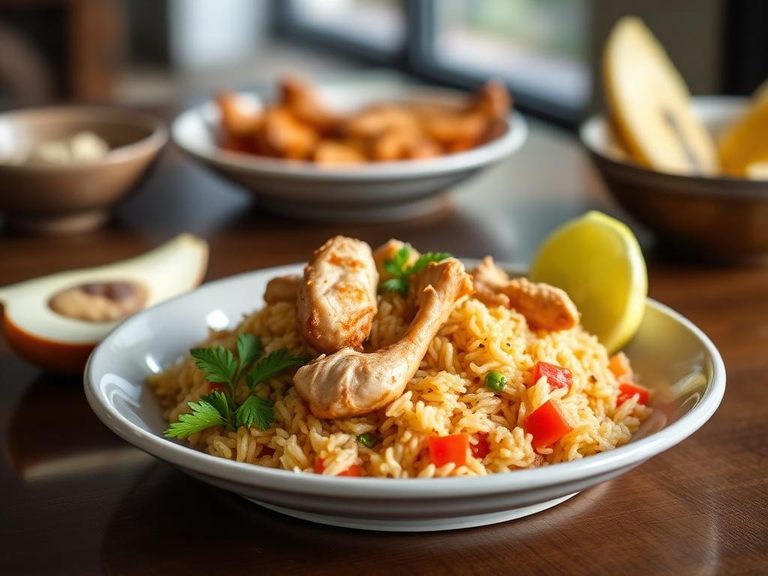
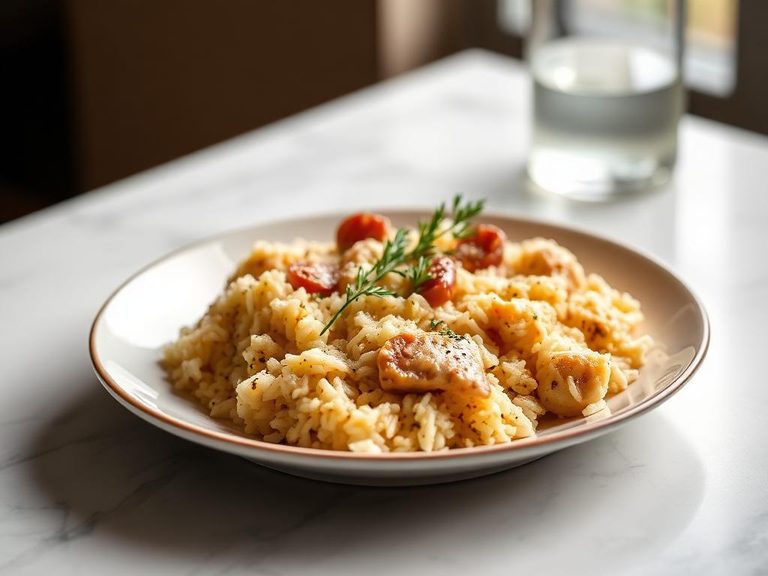
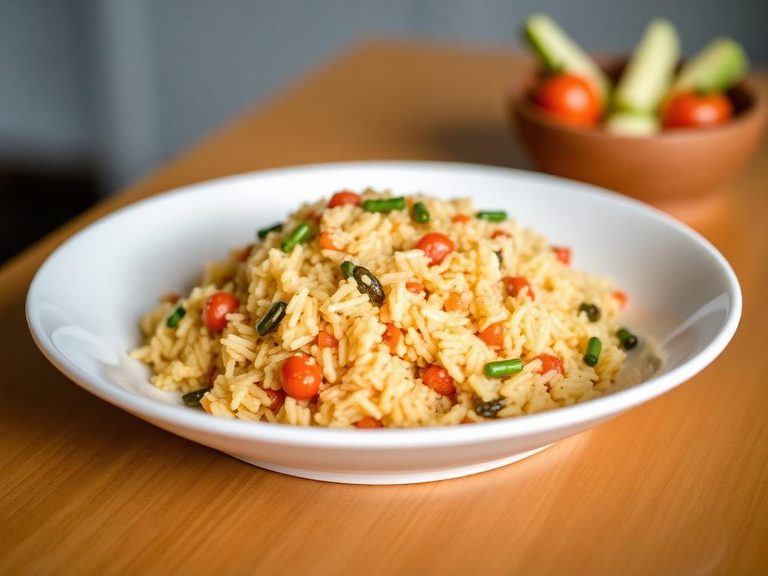
This is a hearty, savory dish where tender chicken or turkey is simmered in a bright, tangy tomato sauce alongside fluffy rice and a mix of soft vegetables like peas, corn, and green beans. The texture is satisfyingly soft with a pleasant chew from the rice and meat, while the sauce adds a rich, umami depth. Nutritionally, it's a balanced, light meal with a good protein-to-calorie ratio and a moderate carbohydrate content.
Calorie split: 16% protein · 47% carbs · 37% fat
↓ Full nutrition💚 Why it's loved
People love this dish for its comforting, familiar flavors and incredible versatility—it's a perfect canvas for using up leftover rice, veggies, and protein. It's a staple in many home kitchens because it's simple, satisfying, and evokes a sense of wholesome, home-cooked warmth.
⚠️ Watch-outs & how to enjoy it better
The soft texture and carbohydrate-rich base can lead to a rapid blood-sugar spike, especially if the rice is highly refined. To counteract this, pair it with a side of non-starchy vegetables or a dollop of plain yogurt to add fiber and fat, which slows digestion. Those watching sodium intake should be mindful, as canned tomato sauces and broths can be high; using low-sodium versions or seasoning with herbs and spices instead helps.
Key benefits
- Provides lean protein for muscle maintenance and satiety.
- Offers a balanced mix of macronutrients in one pot.
- Tomato sauce contributes lycopene, an antioxidant.
- A practical, one-pot meal that is easy to portion and store.
- Can be a good source of B vitamins from the poultry.
🍽️ Popular dishes
🌍 Where it's eaten
💡 Did you know?
The one-pot cooking method for this dish is a classic example of 'casserole' or 'one-pot' cooking, which became immensely popular in post-WWII America due to the rise of affordable, oven-safe cookware and a cultural shift towards convenient, family-style meals.
Full nutrition (USDA data · scales with serving)
| Water | 71.9 g |
| Energy | 133 kcal |
| Protein | 5.3 g |
| Total lipid (fat) | 5.5 g |
| Carbohydrate, by difference | 15.9 g |
| Fiber, total dietary | 1.0 g |
| Total Sugars | 1.4 g |
| Calcium, Ca | 14.0 mg |
| Iron, Fe | 0.98 mg |
| Magnesium, Mg | 16.0 mg |
| Phosphorus, P | 66.0 mg |
| Potassium, K | 164 mg |
| Sodium, Na | 339 mg |
| Zinc, Zn | 0.56 mg |
| Copper, Cu | 0.08 mg |
| Selenium, Se | 6.7 ug |
| Vitamin C, total ascorbic acid | 2.5 mg |
| Thiamin | 0.09 mg |
| Riboflavin | 0.06 mg |
| Niacin | 2.0 mg |
| Vitamin B-6 | 0.11 mg |
| Folate, total | 34.0 ug |
| Folic acid | 24.0 ug |
| Folate, food | 10.0 ug |
| Folate, DFE | 51.0 ug |
| Choline, total | 15.3 mg |
| Vitamin B-12 | 0.05 ug |
| Vitamin B-12, added | 0.00 ug |
| Vitamin A, RAE | 10.0 ug |
| Retinol | 1.0 ug |
| Carotene, beta | 92.0 ug |
| Carotene, alpha | 6.0 ug |
| Cryptoxanthin, beta | 11.0 ug |
| Lycopene | 3641 ug |
| Lutein + zeaxanthin | 110 ug |
| Vitamin E (alpha-tocopherol) | 1.3 mg |
| Vitamin E, added | 0.00 mg |
| Vitamin D (D2 + D3) | 0.00 ug |
| Vitamin K (phylloquinone) | 8.5 ug |
| Alcohol, ethyl | 0.00 g |
| Caffeine | 0.00 mg |
| Theobromine | 0.00 mg |
Fat & fatty acid profile (per 100g)
| Fatty acids, total saturated | 0.85 g |
| SFA 4:0 | 0.00 g |
| SFA 6:0 | 0.00 g |
| SFA 8:0 | 0.00 g |
| SFA 10:0 | 0.00 g |
| SFA 12:0 | 0.00 g |
| SFA 14:0 | 0.01 g |
| SFA 16:0 | 0.63 g |
| SFA 18:0 | 0.17 g |
| Fatty acids, total monounsaturated | 2.3 g |
| MUFA 16:1 | 0.08 g |
| MUFA 18:1 | 2.2 g |
| MUFA 20:1 | 0.03 g |
| MUFA 22:1 | 0.00 g |
| Fatty acids, total polyunsaturated | 1.9 g |
| PUFA 18:2 | 1.7 g |
| PUFA 18:3 | 0.21 g |
| PUFA 18:4 | 0.00 g |
| PUFA 20:4 | 0.00 g |
| PUFA 20:5 n-3 (EPA) | 0.00 g |
| PUFA 22:5 n-3 (DPA) | 0.00 g |
| PUFA 22:6 n-3 (DHA) | 0.00 g |
| Cholesterol | 15.0 mg |
Amino acid profile (per 100g)
Estimated from Turnover, chicken- or turkey-, and vegetable-filled, reduced fat, frozen — USDA does not publish this profile for Chicken or turkey.
| Tryptophan | 0.16 g |
| Threonine | 0.41 g |
| Isoleucine | 0.47 g |
| Leucine | 0.80 g |
| Lysine | 0.61 g |
| Methionine | 0.23 g |
| Cystine | 0.13 g |
| Phenylalanine | 0.47 g |
| Tyrosine | 0.37 g |
| Valine | 0.53 g |
| Arginine | 0.51 g |
| Histidine | 0.30 g |
| Alanine | 0.45 g |
| Aspartic acid | 0.80 g |
| Glutamic acid | 2.2 g |
| Glycine | 0.38 g |
| Proline | 0.87 g |
| Serine | 0.42 g |
| Hydroxyproline | 0.00 g |
FAQ
Can I use brown rice instead of white?
Yes, absolutely. Brown rice will increase the fiber content and give a nuttier flavor and chewier texture. You'll need to adjust the cooking time and liquid amount, as brown rice takes longer to cook.
What other vegetables work well in this dish?
Bell peppers, zucchini, celery, onions, and mushrooms are all excellent additions. Avoid very watery vegetables like cucumber or delicate greens that would overcook.
Is this dish gluten-free?
It can be, but you must check labels. The base ingredients (chicken, rice, vegetables, tomatoes) are naturally gluten-free. However, some pre-made sauces, broths, or spice blends may contain gluten as a thickener or flavoring. Use certified gluten-free products if needed.
Nutrient density (calculated · NRF9.3)
Nutrient Rich Foods index: beneficial nutrients (protein, fiber, vitamins, minerals) minus saturated fat, added sugar & sodium, per 100 kcal.
NRF9.3 index — Fulgoni, Keast & Drewnowski, 2009. Computed from USDA nutrients.
Weight-loss friendliness (composite index)
Energy density 1.33 kcal/g · 16% calories from protein · 1.0 g fiber · 1.4 g sugar per 100 g.
Composite of energy density (Rolls et al., 1999), protein & fiber satiety, minus sugar. A calculated heuristic — ranks satiety-per-calorie, not a clinical measure.
Dietary load (calculated from USDA values)
Potential renal acid load. Positive = acid-forming, negative = alkaline-forming.
Sodium-to-potassium ratio: 2.07 (lower is better — aim for ≤ 1)
Sodium:potassium per WHO potassium guidance. Computed from USDA nutrients.