

Pie, key lime
Common food

Photo: Wikipedia
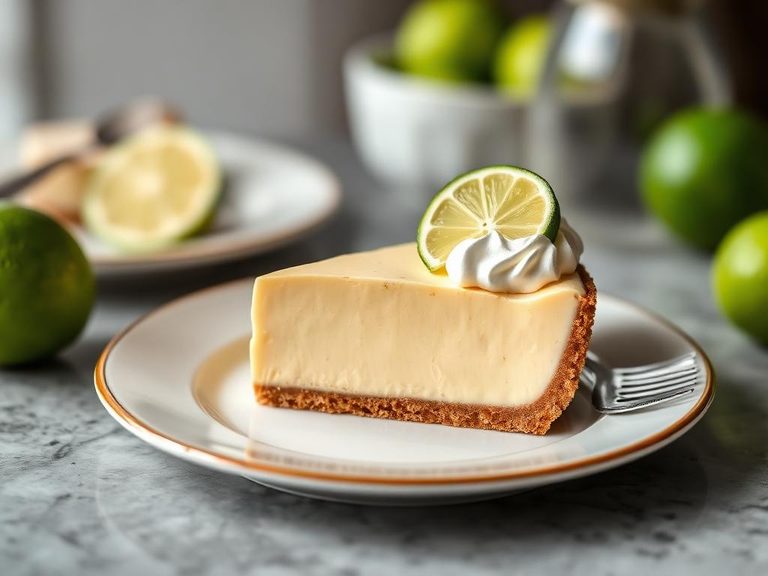
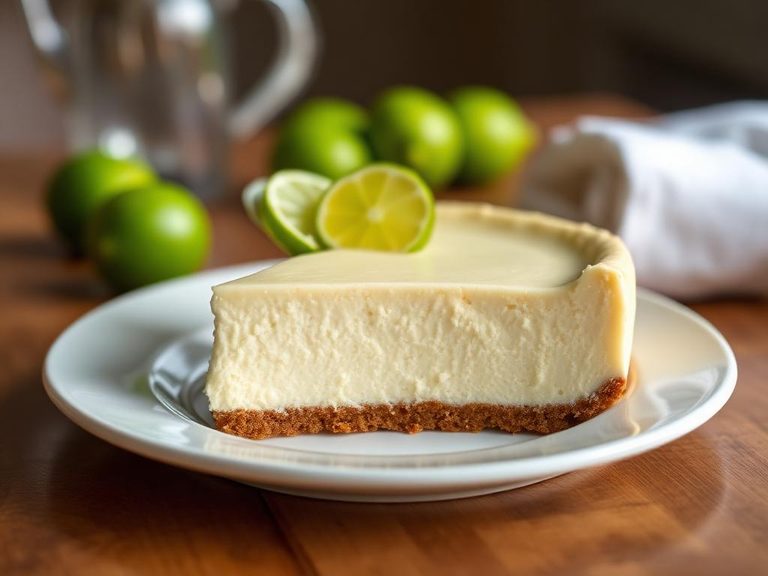
Key lime pie is a bright, tangy, and creamy dessert with a sweet-tart flavor profile. It features a smooth, custard-like filling made from key lime juice and condensed milk, set in a buttery graham cracker crust. A single 100g serving packs 322 kcal and a significant 35.88g of sugar, making it a rich, indulgent treat.
Calorie split: 7% protein · 52% carbs · 41% fat
↓ Full nutrition💚 Why it's loved
People love key lime pie for its perfect balance of sweet and tart, where the creamy filling cuts through the acidity of the limes. It is a beloved cultural icon of Florida, often associated with sunny, tropical vacations and classic American diner desserts.
⚠️ Watch-outs & how to enjoy it better
The high sugar content (35.88g per 100g) can cause blood-sugar spikes, and the fat from the crust and filling is substantial. To counteract this, enjoy a smaller portion (like the 118g medium slice) and pair it with a protein-rich food, such as a handful of nuts or a glass of milk, to slow sugar absorption.
Key benefits
- Provides a quick source of energy from carbohydrates
- Contains small amounts of protein from dairy and crust
- Offers a mood-boosting, satisfying dessert experience
- The graham cracker crust adds a satisfying textural contrast
🍽️ Popular dishes
🌍 Where it's eaten
💡 Did you know?
True key lime pie gets its pale yellow color from the egg yolks and condensed milk, not the limes themselves; the green color in many commercial versions is from added food coloring.
Full nutrition (USDA data · scales with serving)
| Water | 35.6 g |
| Energy | 322 kcal |
| Protein | 5.8 g |
| Total lipid (fat) | 14.9 g |
| Carbohydrate, by difference | 42.2 g |
| Fiber, total dietary | 0.30 g |
| Total Sugars | 35.9 g |
| Calcium, Ca | 187 mg |
| Iron, Fe | 0.46 mg |
| Magnesium, Mg | 20.0 mg |
| Phosphorus, P | 179 mg |
| Potassium, K | 256 mg |
| Sodium, Na | 182 mg |
| Zinc, Zn | 0.77 mg |
| Copper, Cu | 0.04 mg |
| Selenium, Se | 9.7 ug |
| Vitamin C, total ascorbic acid | 1.8 mg |
| Thiamin | 0.08 mg |
| Riboflavin | 0.29 mg |
| Niacin | 0.56 mg |
| Vitamin B-6 | 0.04 mg |
| Folate, total | 16.0 ug |
| Folic acid | 6.0 ug |
| Folate, food | 10.0 ug |
| Folate, DFE | 20.0 ug |
| Choline, total | 59.4 mg |
| Vitamin B-12 | 0.27 ug |
| Vitamin B-12, added | 0.00 ug |
| Vitamin A, RAE | 103 ug |
| Retinol | 102 ug |
| Carotene, beta | 19.0 ug |
| Carotene, alpha | 0.00 ug |
| Cryptoxanthin, beta | 0.00 ug |
| Lycopene | 0.00 ug |
| Lutein + zeaxanthin | 3.0 ug |
| Vitamin E (alpha-tocopherol) | 0.37 mg |
| Vitamin E, added | 0.00 mg |
| Vitamin D (D2 + D3) | 0.10 ug |
| Vitamin K (phylloquinone) | 3.7 ug |
| Alcohol, ethyl | 0.00 g |
| Caffeine | 0.00 mg |
| Theobromine | 0.00 mg |
Fat & fatty acid profile (per 100g)
| Fatty acids, total saturated | 7.6 g |
| SFA 4:0 | 0.30 g |
| SFA 6:0 | 0.20 g |
| SFA 8:0 | 0.12 g |
| SFA 10:0 | 0.19 g |
| SFA 12:0 | 0.29 g |
| SFA 14:0 | 1.1 g |
| SFA 16:0 | 3.5 g |
| SFA 18:0 | 1.6 g |
| Fatty acids, total monounsaturated | 5.0 g |
| MUFA 16:1 | 0.17 g |
| MUFA 18:1 | 4.8 g |
| MUFA 20:1 | 0.01 g |
| MUFA 22:1 | 0.00 g |
| Fatty acids, total polyunsaturated | 0.64 g |
| PUFA 18:2 | 0.51 g |
| PUFA 18:3 | 0.11 g |
| PUFA 18:4 | 0.00 g |
| PUFA 20:4 | 0.01 g |
| PUFA 20:5 n-3 (EPA) | 0.00 g |
| PUFA 22:5 n-3 (DPA) | 0.00 g |
| PUFA 22:6 n-3 (DHA) | 0.00 g |
| Cholesterol | 39.0 mg |
Amino acid profile (per 100g)
Estimated from Pie Crust, Cookie-type, Chocolate, Ready Crust — USDA does not publish this profile for Pie.
| Tryptophan | 0.08 g |
| Threonine | 0.20 g |
| Isoleucine | 0.23 g |
| Leucine | 0.38 g |
| Lysine | 0.24 g |
| Methionine | 0.07 g |
| Cystine | 0.11 g |
| Phenylalanine | 0.28 g |
| Tyrosine | 0.16 g |
| Valine | 0.32 g |
| Arginine | 0.29 g |
| Histidine | 0.11 g |
| Alanine | 0.24 g |
| Aspartic acid | 0.45 g |
| Glutamic acid | 1.3 g |
| Glycine | 0.24 g |
| Proline | 0.42 g |
| Serine | 0.26 g |
FAQ
What is the difference between key lime pie and regular lime pie?
Key lime pie uses smaller, more aromatic key limes (Citrus aurantiifolia) which have a distinct, more floral and tart flavor compared to the larger Persian limes commonly used in regular lime pie.
Is key lime pie gluten-free?
Traditional key lime pie is not gluten-free because the crust is typically made from graham crackers, which contain wheat. Gluten-free versions can be made with a crust using gluten-free graham crackers or almond flour.
Can key lime pie be made ahead of time?
Yes, key lime pie is an excellent make-ahead dessert. It needs to be refrigerated for at least 3-4 hours to set properly, and it often tastes even better the next day as the flavors meld.
Nutrient density (calculated · NRF9.3)
Nutrient Rich Foods index: beneficial nutrients (protein, fiber, vitamins, minerals) minus saturated fat, added sugar & sodium, per 100 kcal.
NRF9.3 index — Fulgoni, Keast & Drewnowski, 2009. Computed from USDA nutrients.
Weight-loss friendliness (composite index)
Energy density 3.22 kcal/g · 7% calories from protein · 0.3 g fiber · 35.9 g sugar per 100 g.
Composite of energy density (Rolls et al., 1999), protein & fiber satiety, minus sugar. A calculated heuristic — ranks satiety-per-calorie, not a clinical measure.
Dietary load (calculated from USDA values)
Potential renal acid load. Positive = acid-forming, negative = alkaline-forming.
Sodium-to-potassium ratio: 0.71 (lower is better — aim for ≤ 1)
Sodium:potassium per WHO potassium guidance. Computed from USDA nutrients.