

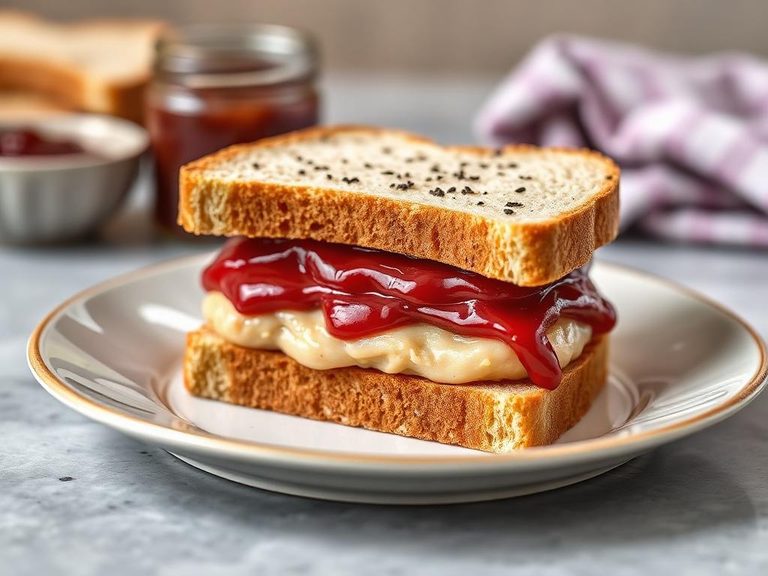
Peanut butter and jelly sandwich, with reduced fat peanut butter, on white bread
Common food

Photo: Wikipedia
A classic peanut butter and jelly sandwich, here made with reduced-fat peanut butter on white bread, offers a nostalgic blend of creamy, salty-sweet nuttiness and bright fruitiness against a soft, pillowy backdrop. Nutritionally, it provides a moderate protein boost from the peanut butter, but is primarily a carbohydrate-driven energy source from the bread and jelly. The reduced-fat version cuts some calories but often includes added sugars and thickeners to compensate for texture.
Calorie split: 14% protein · 56% carbs · 30% fat
↓ Full nutrition💚 Why it's loved
It's beloved for its perfect balance of sweet, salty, and savory flavors, and the satisfying contrast between the smooth peanut butter and sticky jelly. It's a deeply nostalgic comfort food, evoking childhood memories and simple, uncomplicated pleasure.
⚠️ Watch-outs & how to enjoy it better
The white bread and jelly can cause a rapid blood-sugar spike, and reduced-fat peanut butter often contains more sugar and sodium than regular. To counteract this, pair the sandwich with a source of additional protein or fat (like a glass of milk or a handful of nuts) and consider using whole-grain bread for more fiber to slow digestion.
Key benefits
- Quick, portable source of energy
- Provides plant-based protein from peanuts
- Convenient no-cook meal or snack
- Familiar comfort food for all ages
- Customizable with different jelly flavors
🍽️ Popular dishes
🌍 Where it's eaten
💡 Did you know?
The average American will eat over 2,500 PB&J sandwiches before graduating from high school.
Full nutrition (USDA data · scales with serving)
| Water | 24.8 g |
| Energy | 339 kcal |
| Protein | 12.5 g |
| Total lipid (fat) | 11.6 g |
| Carbohydrate, by difference | 49.0 g |
| Fiber, total dietary | 2.9 g |
| Total Sugars | 14.7 g |
| Calcium, Ca | 124 mg |
| Iron, Fe | 2.4 mg |
| Magnesium, Mg | 64.0 mg |
| Phosphorus, P | 167 mg |
| Potassium, K | 263 mg |
| Sodium, Na | 401 mg |
| Zinc, Zn | 1.3 mg |
| Copper, Cu | 0.23 mg |
| Selenium, Se | 14.6 ug |
| Vitamin C, total ascorbic acid | 0.20 mg |
| Thiamin | 0.35 mg |
| Riboflavin | 0.15 mg |
| Niacin | 6.7 mg |
| Vitamin B-6 | 0.14 mg |
| Folate, total | 77.0 ug |
| Folic acid | 46.0 ug |
| Folate, food | 31.0 ug |
| Folate, DFE | 109 ug |
| Choline, total | 27.8 mg |
| Vitamin B-12 | 0.00 ug |
| Vitamin B-12, added | 0.00 ug |
| Vitamin A, RAE | 0.00 ug |
| Retinol | 0.00 ug |
| Carotene, beta | 1.0 ug |
| Carotene, alpha | 0.00 ug |
| Cryptoxanthin, beta | 0.00 ug |
| Lycopene | 0.00 ug |
| Lutein + zeaxanthin | 28.0 ug |
| Vitamin E (alpha-tocopherol) | 2.7 mg |
| Vitamin E, added | 0.00 mg |
| Vitamin D (D2 + D3) | 0.00 ug |
| Vitamin K (phylloquinone) | 0.30 ug |
| Alcohol, ethyl | 0.00 g |
| Caffeine | 0.00 mg |
| Theobromine | 0.00 mg |
Fat & fatty acid profile (per 100g)
| Fatty acids, total saturated | 2.1 g |
| SFA 4:0 | 0.00 g |
| SFA 6:0 | 0.00 g |
| SFA 8:0 | 0.00 g |
| SFA 10:0 | 0.00 g |
| SFA 12:0 | 0.01 g |
| SFA 14:0 | 0.05 g |
| SFA 16:0 | 1.4 g |
| SFA 18:0 | 0.65 g |
| Fatty acids, total monounsaturated | 5.0 g |
| MUFA 16:1 | 0.01 g |
| MUFA 18:1 | 4.9 g |
| MUFA 20:1 | 0.09 g |
| MUFA 22:1 | 0.00 g |
| Fatty acids, total polyunsaturated | 3.6 g |
| PUFA 18:2 | 3.5 g |
| PUFA 18:3 | 0.12 g |
| PUFA 18:4 | 0.00 g |
| PUFA 20:4 | 0.00 g |
| PUFA 20:5 n-3 (EPA) | 0.00 g |
| PUFA 22:5 n-3 (DPA) | 0.00 g |
| PUFA 22:6 n-3 (DHA) | 0.00 g |
| Cholesterol | 0.00 mg |
Amino acid profile (per 100g)
Estimated from Peanut butter, chunk style, without salt — USDA does not publish this profile for Peanut butter and jelly sandwich.
| Tryptophan | 0.23 g |
| Threonine | 0.52 g |
| Isoleucine | 0.61 g |
| Leucine | 1.5 g |
| Lysine | 0.67 g |
| Methionine | 0.26 g |
| Cystine | 0.23 g |
| Phenylalanine | 1.2 g |
| Tyrosine | 0.82 g |
| Valine | 0.77 g |
| Arginine | 2.7 g |
| Histidine | 0.55 g |
| Alanine | 0.90 g |
| Aspartic acid | 3.0 g |
| Glutamic acid | 5.0 g |
| Glycine | 1.4 g |
| Proline | 1.4 g |
| Serine | 1.5 g |
| Hydroxyproline | 0.04 g |
FAQ
Why use reduced-fat peanut butter?
Reduced-fat peanut butter is typically made by removing some of the natural peanut oil, which lowers the fat and calorie content per serving. However, manufacturers often add sugar, corn syrup, and hydrogenated oils to maintain a creamy texture and shelf stability.
Is this a good post-workout snack?
It can be. The carbohydrates from the bread and jelly help replenish glycogen stores, while the protein from the peanut butter aids muscle repair. For optimal recovery, you might choose whole-grain bread and ensure your peanut butter is the natural, no-added-sugar kind.
How can I make it healthier?
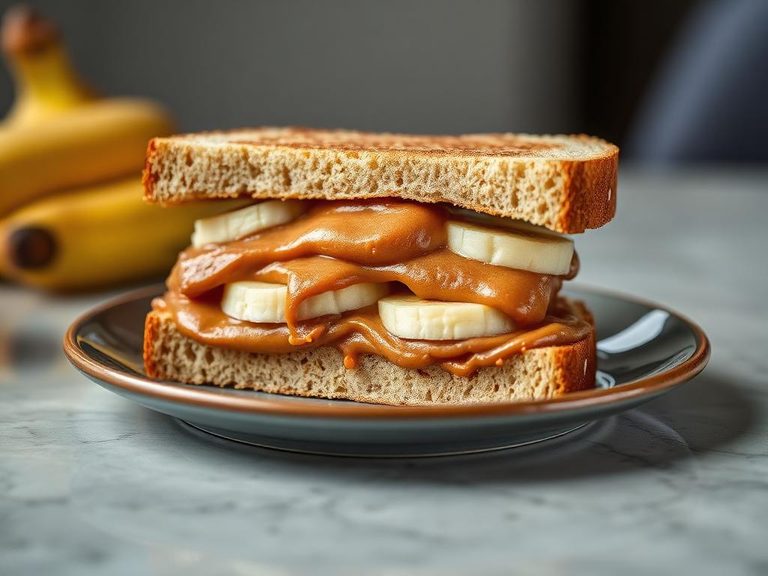
Swap white bread for 100% whole-grain or whole-wheat bread to increase fiber. Use natural peanut butter (just peanuts and salt) and choose a fruit spread with no added sugar. Adding sliced banana or strawberries can boost nutrients and fiber.
Nutrient density (calculated · NRF9.3)
Nutrient Rich Foods index: beneficial nutrients (protein, fiber, vitamins, minerals) minus saturated fat, added sugar & sodium, per 100 kcal.
NRF9.3 index — Fulgoni, Keast & Drewnowski, 2009. Computed from USDA nutrients.
Weight-loss friendliness (composite index)
Energy density 3.39 kcal/g · 15% calories from protein · 2.9 g fiber · 14.7 g sugar per 100 g.
Composite of energy density (Rolls et al., 1999), protein & fiber satiety, minus sugar. A calculated heuristic — ranks satiety-per-calorie, not a clinical measure.
Dietary load (calculated from USDA values)
Potential renal acid load. Positive = acid-forming, negative = alkaline-forming.
Sodium-to-potassium ratio: 1.52 (lower is better — aim for ≤ 1)
Sodium:potassium per WHO potassium guidance. Computed from USDA nutrients.