

Pastry, egg and cheese filled
Common food
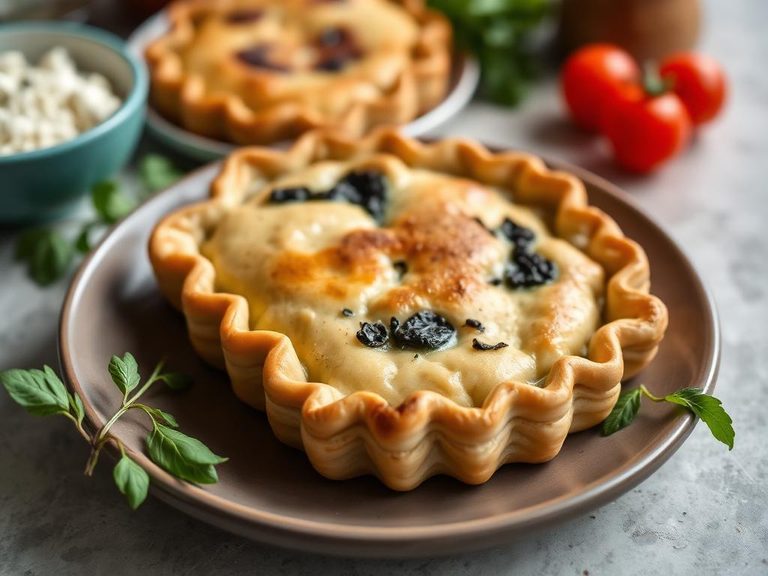
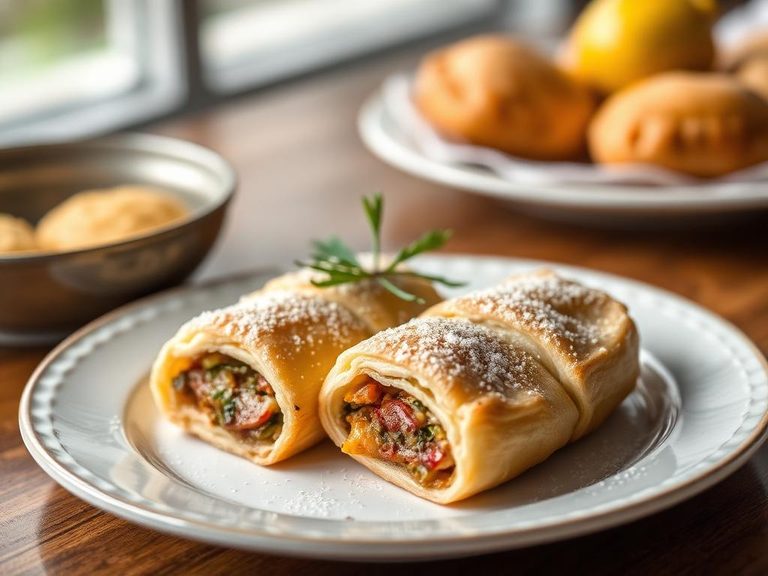
This is a flaky, golden pastry shell cradling a savory filling of egg and melted cheese, offering a rich, buttery aroma and a satisfying contrast between crisp layers and a soft, creamy interior. Nutritionally, it delivers a substantial energy punch with 349 kcal per 100g, primarily from carbohydrates and fat, while providing a moderate protein boost from the egg and cheese. It's a classic comfort food that feels indulgent yet is surprisingly substantial.
Calorie split: 10% protein · 50% carbs · 40% fat
↓ Full nutrition💚 Why it's loved
People love this pastry for its perfect balance of savory, buttery, and cheesy flavors, along with the satisfying texture of flaky dough. It's a versatile staple enjoyed for breakfast, brunch, or a quick snack across many cultures.
⚠️ Watch-outs & how to enjoy it better
The high carbohydrate and fat content can lead to blood-sugar spikes and may not suit those monitoring calorie or saturated fat intake. To counteract this, pair it with a side of leafy greens or a piece of fruit to add fiber, and practice portion control by sticking to a single, smaller pastry.
Key benefits
- Provides a quick energy source from its carbohydrate content.
- Offers a good source of protein for muscle maintenance.
- Contains calcium from the cheese for bone health.
- The fat content aids in the absorption of fat-soluble vitamins.
🍽️ Popular dishes




🌍 Where it's eaten
💡 Did you know?
The technique of laminating dough—folding butter into layers to create flaky pastry—was perfected in France in the 19th century, but filled pastries like börek date back to the Ottoman Empire centuries earlier.
Full nutrition (USDA data · scales with serving)
| Water | 31.1 g |
| Energy | 349 kcal |
| Protein | 8.4 g |
| Total lipid (fat) | 15.7 g |
| Carbohydrate, by difference | 43.8 g |
| Fiber, total dietary | 1.6 g |
| Total Sugars | 6.2 g |
| Calcium, Ca | 84.0 mg |
| Iron, Fe | 2.8 mg |
| Magnesium, Mg | 18.0 mg |
| Phosphorus, P | 123 mg |
| Potassium, K | 123 mg |
| Sodium, Na | 216 mg |
| Zinc, Zn | 0.82 mg |
| Copper, Cu | 0.09 mg |
| Selenium, Se | 11.5 ug |
| Vitamin C, total ascorbic acid | 0.00 mg |
| Thiamin | 0.51 mg |
| Riboflavin | 0.31 mg |
| Niacin | 3.4 mg |
| Vitamin B-6 | 0.07 mg |
| Folate, total | 86.0 ug |
| Folic acid | 46.0 ug |
| Folate, food | 40.0 ug |
| Folate, DFE | 119 ug |
| Choline, total | 33.3 mg |
| Vitamin B-12 | 0.21 ug |
| Vitamin B-12, added | 0.00 ug |
| Vitamin A, RAE | 125 ug |
| Retinol | 123 ug |
| Carotene, beta | 22.0 ug |
| Carotene, alpha | 1.0 ug |
| Cryptoxanthin, beta | 2.0 ug |
| Lycopene | 0.00 ug |
| Lutein + zeaxanthin | 44.0 ug |
| Vitamin E (alpha-tocopherol) | 0.77 mg |
| Vitamin E, added | 0.00 mg |
| Vitamin D (D2 + D3) | 0.50 ug |
| Vitamin K (phylloquinone) | 3.8 ug |
| Alcohol, ethyl | 0.00 g |
| Caffeine | 0.00 mg |
| Theobromine | 0.00 mg |
Fat & fatty acid profile (per 100g)
| Fatty acids, total saturated | 7.0 g |
| SFA 4:0 | 0.27 g |
| SFA 6:0 | 0.19 g |
| SFA 8:0 | 0.12 g |
| SFA 10:0 | 0.27 g |
| SFA 12:0 | 0.30 g |
| SFA 14:0 | 0.99 g |
| SFA 16:0 | 3.5 g |
| SFA 18:0 | 1.2 g |
| Fatty acids, total monounsaturated | 4.0 g |
| MUFA 16:1 | 0.21 g |
| MUFA 18:1 | 3.7 g |
| MUFA 20:1 | 0.04 g |
| MUFA 22:1 | 0.00 g |
| Fatty acids, total polyunsaturated | 1.7 g |
| PUFA 18:2 | 1.5 g |
| PUFA 18:3 | 0.18 g |
| PUFA 18:4 | 0.00 g |
| PUFA 20:4 | 0.03 g |
| PUFA 20:5 n-3 (EPA) | 0.00 g |
| PUFA 22:5 n-3 (DPA) | 0.01 g |
| PUFA 22:6 n-3 (DHA) | 0.00 g |
| Cholesterol | 68.0 mg |
Amino acid profile (per 100g)
Estimated from Puff pastry, frozen, ready-to-bake, baked — USDA does not publish this profile for Pastry.
| Tryptophan | 0.09 g |
| Threonine | 0.20 g |
| Isoleucine | 0.28 g |
| Leucine | 0.51 g |
| Lysine | 0.14 g |
| Methionine | 0.13 g |
| Cystine | 0.17 g |
| Phenylalanine | 0.37 g |
| Tyrosine | 0.20 g |
| Valine | 0.31 g |
| Arginine | 0.26 g |
| Histidine | 0.16 g |
| Alanine | 0.23 g |
| Aspartic acid | 0.30 g |
| Glutamic acid | 2.6 g |
| Glycine | 0.26 g |
| Proline | 0.88 g |
| Serine | 0.36 g |
FAQ
Is this pastry suitable for a low-carb diet?
No, with 43.76g of carbs per 100g, it's high in carbohydrates and not ideal for low-carb or ketogenic diets.
Can I freeze this pastry?
Yes, it can be frozen for up to 3 months. Reheat in an oven at 350°F (175°C) for 10-15 minutes to restore crispness.
What makes the pastry flaky?
The flakiness comes from lamination, where butter is folded into the dough in layers, creating steam pockets during baking.
Nutrient density (calculated · NRF9.3)
Nutrient Rich Foods index: beneficial nutrients (protein, fiber, vitamins, minerals) minus saturated fat, added sugar & sodium, per 100 kcal.
NRF9.3 index — Fulgoni, Keast & Drewnowski, 2009. Computed from USDA nutrients.
Weight-loss friendliness (composite index)
Energy density 3.49 kcal/g · 10% calories from protein · 1.6 g fiber · 6.2 g sugar per 100 g.
Composite of energy density (Rolls et al., 1999), protein & fiber satiety, minus sugar. A calculated heuristic — ranks satiety-per-calorie, not a clinical measure.
Dietary load (calculated from USDA values)
Potential renal acid load. Positive = acid-forming, negative = alkaline-forming.
Sodium-to-potassium ratio: 1.76 (lower is better — aim for ≤ 1)
Sodium:potassium per WHO potassium guidance. Computed from USDA nutrients.