

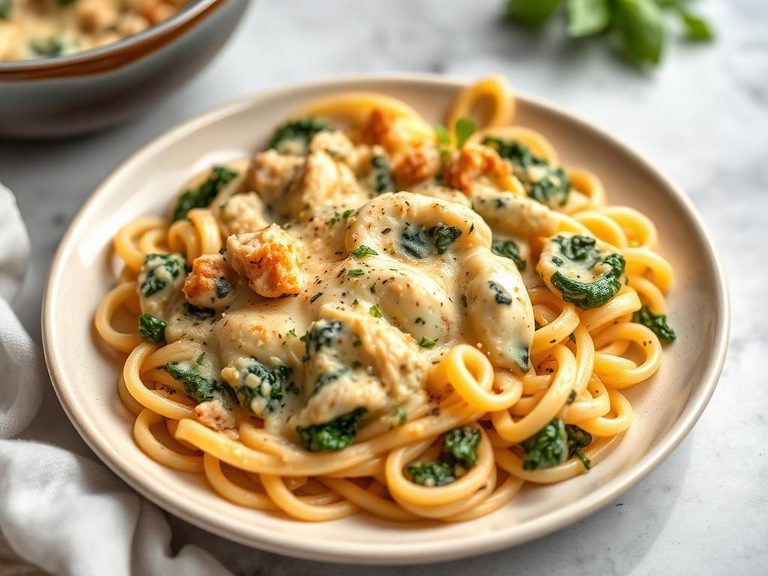
Pasta, whole grain, with cream sauce and poultry, ready-to-heat
Common food

Photo: Wikipedia
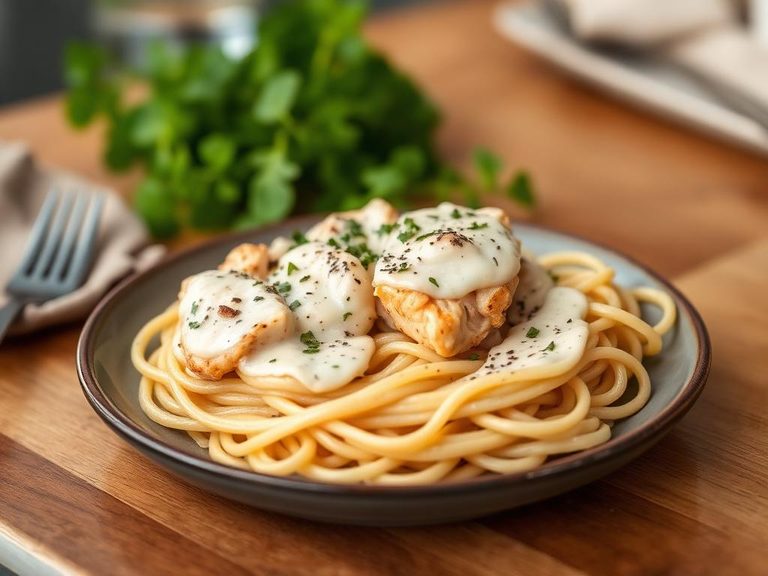
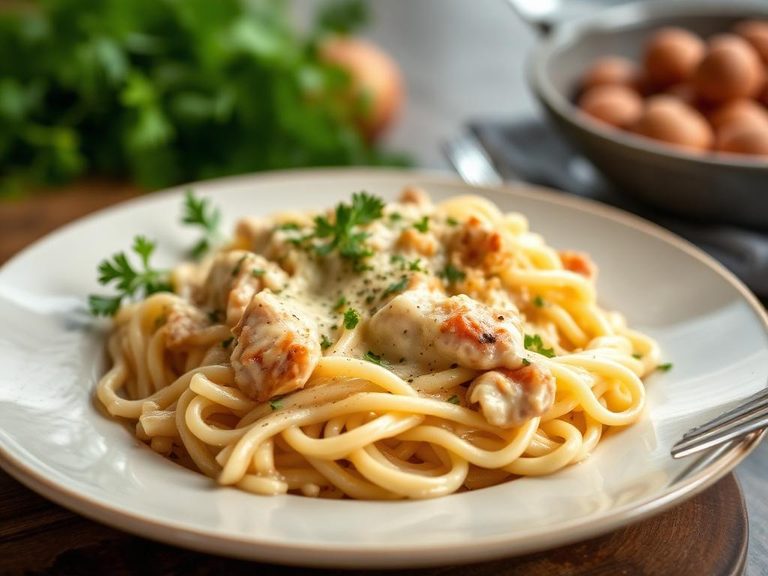
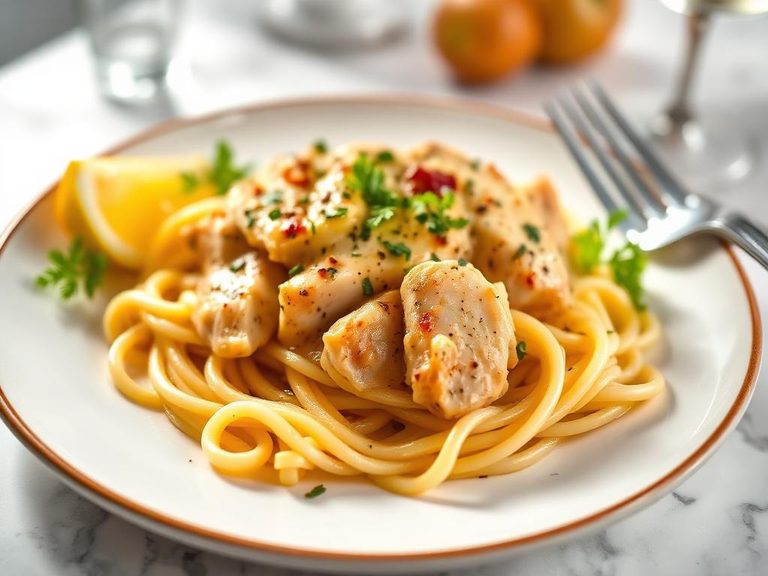
This is a convenient, ready-to-heat meal of whole grain pasta tossed in a rich cream sauce with poultry, likely chicken or turkey. It offers a comforting, savory flavor profile with a satisfying, slightly chewy texture from the whole wheat pasta and tender protein. Nutritionally, it provides a balanced mix of carbohydrates, protein, and fat, with a modest calorie count per 100g.
Calorie split: 15% protein · 37% carbs · 48% fat
↓ Full nutrition💚 Why it's loved
People love this dish for its comforting, creamy texture and savory, familiar flavors that evoke classic comfort food. It's a quick, satisfying meal that combines the wholesomeness of whole grains with the richness of a cream sauce.
⚠️ Watch-outs & how to enjoy it better
The cream sauce can be high in saturated fat and sodium, which may concern those managing cholesterol or blood pressure. To counteract, pair it with a large side of steamed vegetables or a fresh salad to increase fiber and nutrient density, and consider a smaller portion size.
Key benefits
- Whole grain pasta provides dietary fiber and sustained energy.
- Contains a good source of protein from poultry.
- Balanced macronutrient profile for a complete meal.
- Convenient and quick to prepare.
- Moderate calorie density per serving.
🍽️ Popular dishes
🌍 Where it's eaten
💡 Did you know?
Whole grain pasta can have up to three times more fiber than refined pasta, helping to slow digestion and keep you fuller longer.
Full nutrition (USDA data · scales with serving)
| Water | 67.4 g |
| Energy | 165 kcal |
| Protein | 6.3 g |
| Total lipid (fat) | 9.1 g |
| Carbohydrate, by difference | 15.9 g |
| Fiber, total dietary | 2.0 g |
| Total Sugars | 0.73 g |
| Calcium, Ca | 34.0 mg |
| Iron, Fe | 0.97 mg |
| Magnesium, Mg | 31.0 mg |
| Phosphorus, P | 106 mg |
| Potassium, K | 90.0 mg |
| Sodium, Na | 386 mg |
| Zinc, Zn | 1.0 mg |
| Copper, Cu | 0.13 mg |
| Selenium, Se | 21.7 ug |
| Vitamin C, total ascorbic acid | 0.10 mg |
| Thiamin | 0.09 mg |
| Riboflavin | 0.10 mg |
| Niacin | 2.4 mg |
| Vitamin B-6 | 0.09 mg |
| Folate, total | 12.0 ug |
| Folic acid | 0.00 ug |
| Folate, food | 12.0 ug |
| Folate, DFE | 12.0 ug |
| Choline, total | 11.8 mg |
| Vitamin B-12 | 0.12 ug |
| Vitamin B-12, added | 0.00 ug |
| Vitamin A, RAE | 54.0 ug |
| Retinol | 54.0 ug |
| Carotene, beta | 3.0 ug |
| Carotene, alpha | 0.00 ug |
| Cryptoxanthin, beta | 0.00 ug |
| Lycopene | 0.00 ug |
| Lutein + zeaxanthin | 48.0 ug |
| Vitamin E (alpha-tocopherol) | 0.60 mg |
| Vitamin E, added | 0.00 mg |
| Vitamin D (D2 + D3) | 0.20 ug |
| Vitamin K (phylloquinone) | 2.6 ug |
| Alcohol, ethyl | 0.00 g |
| Caffeine | 0.00 mg |
| Theobromine | 0.00 mg |
Fat & fatty acid profile (per 100g)
| Fatty acids, total saturated | 3.8 g |
| SFA 4:0 | 0.12 g |
| SFA 6:0 | 0.10 g |
| SFA 8:0 | 0.06 g |
| SFA 10:0 | 0.14 g |
| SFA 12:0 | 0.17 g |
| SFA 14:0 | 0.54 g |
| SFA 16:0 | 1.9 g |
| SFA 18:0 | 0.62 g |
| Fatty acids, total monounsaturated | 2.3 g |
| MUFA 16:1 | 0.13 g |
| MUFA 18:1 | 2.3 g |
| MUFA 20:1 | 0.03 g |
| MUFA 22:1 | 0.00 g |
| Fatty acids, total polyunsaturated | 1.4 g |
| PUFA 18:2 | 1.2 g |
| PUFA 18:3 | 0.13 g |
| PUFA 18:4 | 0.00 g |
| PUFA 20:4 | 0.02 g |
| PUFA 20:5 n-3 (EPA) | 0.00 g |
| PUFA 22:5 n-3 (DPA) | 0.00 g |
| PUFA 22:6 n-3 (DHA) | 0.00 g |
| Cholesterol | 25.0 mg |
Amino acid profile (per 100g)
Estimated from Restaurant, Italian, chicken parmesan without pasta — USDA does not publish this profile for Pasta.
| Tryptophan | 0.20 g |
| Threonine | 0.66 g |
| Isoleucine | 0.72 g |
| Leucine | 1.3 g |
| Lysine | 1.3 g |
| Methionine | 0.41 g |
| Cystine | 0.20 g |
| Phenylalanine | 1.1 g |
| Tyrosine | 0.53 g |
| Valine | 0.81 g |
| Arginine | 0.93 g |
| Histidine | 0.50 g |
| Alanine | 0.79 g |
| Aspartic acid | 1.4 g |
| Glutamic acid | 2.8 g |
| Glycine | 0.61 g |
| Proline | 1.3 g |
| Serine | 0.70 g |
| Hydroxyproline | 0.04 g |
FAQ
Is this a healthy meal option?
It can be part of a balanced diet due to the whole grain pasta and poultry protein, but the cream sauce may add significant fat and sodium. Pairing with vegetables and watching portion size can make it healthier.
Can I freeze this dish?
Yes, it freezes well. Store in an airtight container for up to 3 months. Reheat thoroughly in the microwave or oven for best texture.
What is the best way to reheat it?
Reheat in the microwave with a splash of water or milk to prevent drying, or in a skillet over medium heat for a creamier texture. Avoid overheating to maintain the pasta's integrity.
Nutrient density (calculated · NRF9.3)
Nutrient Rich Foods index: beneficial nutrients (protein, fiber, vitamins, minerals) minus saturated fat, added sugar & sodium, per 100 kcal.
NRF9.3 index — Fulgoni, Keast & Drewnowski, 2009. Computed from USDA nutrients.
Weight-loss friendliness (composite index)
Energy density 1.65 kcal/g · 15% calories from protein · 2.0 g fiber · 0.7 g sugar per 100 g.
Composite of energy density (Rolls et al., 1999), protein & fiber satiety, minus sugar. A calculated heuristic — ranks satiety-per-calorie, not a clinical measure.
Dietary load (calculated from USDA values)
Potential renal acid load. Positive = acid-forming, negative = alkaline-forming.
Sodium-to-potassium ratio: 4.29 (lower is better — aim for ≤ 1)
Sodium:potassium per WHO potassium guidance. Computed from USDA nutrients.