

Palm hearts, cooked
Common food

Photo: Wikipedia
Palm hearts are the tender, ivory-colored inner core of young palm trees, prized for their delicate, slightly nutty flavor and crisp, artichoke-like texture. Nutritionally, they are a light, low-calorie vegetable option with a notable carbohydrate content (24.8g per 100g), primarily from natural sugars. Their clean, subtle taste makes them a versatile ingredient that absorbs surrounding flavors beautifully.
Calorie split: 8% protein · 74% carbs · 18% fat
↓ Full nutrition💚 Why it's loved
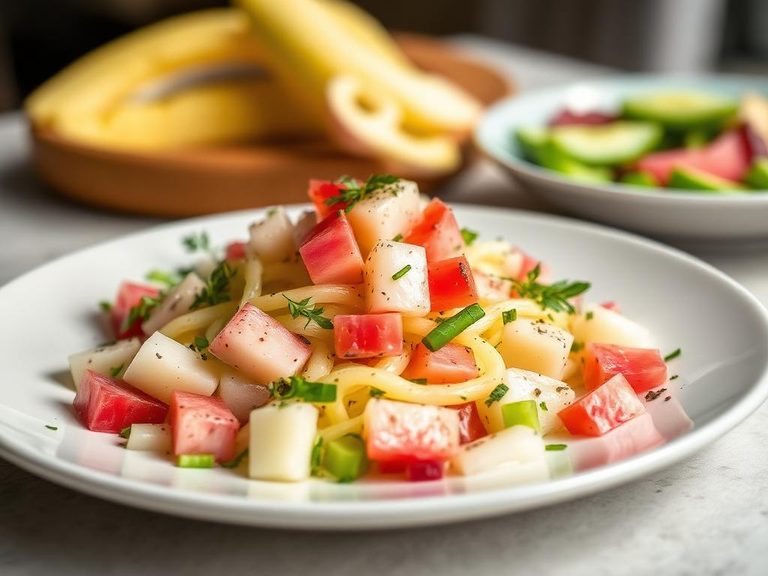
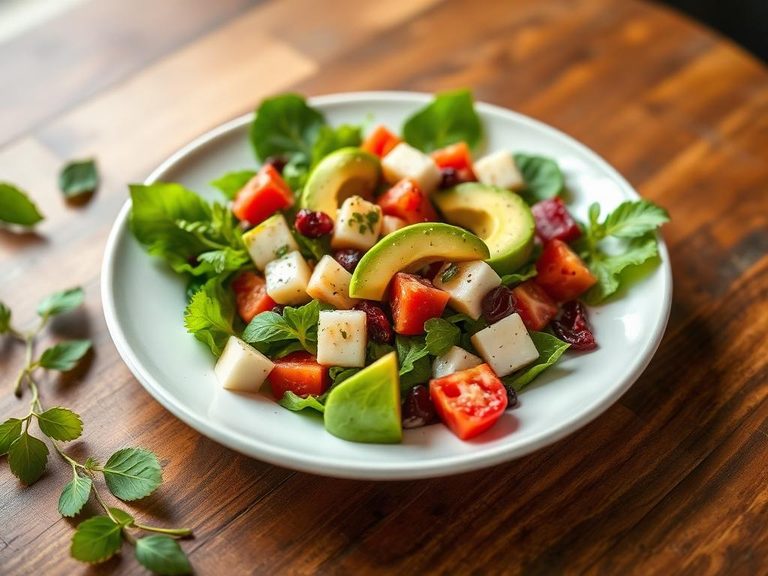
People love palm hearts for their unique, crisp texture and mild, slightly sweet flavor that complements both rich and light dishes. They are a staple in tropical and Latin American cuisines, often featured in salads and appetizers for their elegant, fresh appeal.
⚠️ Watch-outs & how to enjoy it better
The relatively high sugar content (16.62g per 100g) can be a concern for those monitoring blood sugar levels, as it may cause a spike if consumed in large quantities. To counteract this, pair palm hearts with a source of protein (like grilled chicken or shrimp) or healthy fat (like avocado or olive oil) to slow sugar absorption. Additionally, canned varieties can be high in sodium, so rinsing them thoroughly before use or opting for low-sodium versions is recommended.
Key benefits
- Low in calories, making them suitable for weight management.
- Provide a good source of dietary fiber (1.5g per 100g) for digestive health.
- Contain essential minerals like potassium and manganese.
- Naturally low in fat and cholesterol-free.
- Offer a unique texture and flavor to a variety of dishes.
🍽️ Popular dishes




🌍 Where it's eaten
💡 Did you know?
In Brazil, the most common palm heart comes from the Açaí palm (Euterpe oleracea), and its harvest is a sustainable practice that doesn't kill the tree, as only the central stem is removed, allowing the palm to continue producing fruit.
Full nutrition (USDA data · scales with serving)
| Water | 67.6 g |
| Energy | 134 kcal |
| Protein | 2.6 g |
| Total lipid (fat) | 2.7 g |
| Carbohydrate, by difference | 24.8 g |
| Fiber, total dietary | 1.5 g |
| Total Sugars | 16.6 g |
| Calcium, Ca | 18.0 mg |
| Iron, Fe | 1.6 mg |
| Magnesium, Mg | 10.0 mg |
| Phosphorus, P | 136 mg |
| Potassium, K | 1749 mg |
| Sodium, Na | 135 mg |
| Zinc, Zn | 3.6 mg |
| Copper, Cu | 0.62 mg |
| Selenium, Se | 0.70 ug |
| Vitamin C, total ascorbic acid | 6.6 mg |
| Thiamin | 0.04 mg |
| Riboflavin | 0.17 mg |
| Niacin | 0.83 mg |
| Vitamin B-6 | 0.72 mg |
| Folate, total | 20.0 ug |
| Folic acid | 0.00 ug |
| Folate, food | 20.0 ug |
| Folate, DFE | 20.0 ug |
| Choline, total | 0.20 mg |
| Vitamin B-12 | 0.00 ug |
| Vitamin B-12, added | 0.00 ug |
| Vitamin A, RAE | 14.0 ug |
| Retinol | 11.0 ug |
| Carotene, beta | 43.0 ug |
| Carotene, alpha | 0.00 ug |
| Cryptoxanthin, beta | 0.00 ug |
| Lycopene | 0.00 ug |
| Lutein + zeaxanthin | 0.00 ug |
| Vitamin E (alpha-tocopherol) | 0.86 mg |
| Vitamin E, added | 0.00 mg |
| Vitamin D (D2 + D3) | 0.00 ug |
| Vitamin K (phylloquinone) | 2.1 ug |
| Alcohol, ethyl | 0.00 g |
| Caffeine | 0.00 mg |
| Theobromine | 0.00 mg |
Fat & fatty acid profile (per 100g)
| Fatty acids, total saturated | 0.71 g |
| SFA 4:0 | 0.02 g |
| SFA 6:0 | 0.01 g |
| SFA 8:0 | 0.01 g |
| SFA 10:0 | 0.02 g |
| SFA 12:0 | 0.02 g |
| SFA 14:0 | 0.07 g |
| SFA 16:0 | 0.40 g |
| SFA 18:0 | 0.14 g |
| Fatty acids, total monounsaturated | 0.91 g |
| MUFA 16:1 | 0.01 g |
| MUFA 18:1 | 0.87 g |
| MUFA 20:1 | 0.01 g |
| MUFA 22:1 | 0.00 g |
| Fatty acids, total polyunsaturated | 0.82 g |
| PUFA 18:2 | 0.72 g |
| PUFA 18:3 | 0.09 g |
| PUFA 18:4 | 0.00 g |
| PUFA 20:4 | 0.00 g |
| PUFA 20:5 n-3 (EPA) | 0.00 g |
| PUFA 22:5 n-3 (DPA) | 0.00 g |
| PUFA 22:6 n-3 (DHA) | 0.00 g |
| Cholesterol | 2.0 mg |
Amino acid profile (per 100g)
Estimated from Hearts of palm, canned — USDA does not publish this profile for Palm hearts.
| Tryptophan | 0.02 g |
| Threonine | 0.10 g |
| Isoleucine | 0.10 g |
| Leucine | 0.17 g |
| Lysine | 0.09 g |
| Methionine | 0.04 g |
| Cystine | 0.02 g |
| Phenylalanine | 0.10 g |
| Tyrosine | 0.05 g |
| Valine | 0.11 g |
| Arginine | 0.18 g |
| Histidine | 0.06 g |
| Alanine | 0.11 g |
| Aspartic acid | 0.17 g |
| Glutamic acid | 0.30 g |
| Glycine | 0.11 g |
| Proline | 0.09 g |
| Serine | 0.08 g |
FAQ
What do palm hearts taste like?
Palm hearts have a mild, slightly nutty flavor with a hint of artichoke or asparagus. Their texture is crisp and tender, similar to a young bamboo shoot or water chestnut.
Are palm hearts healthy?
Yes, palm hearts are low in calories and fat, and they provide fiber, potassium, and manganese. However, they do contain a significant amount of natural sugars, so portion control is important for those monitoring blood sugar.
How do you prepare palm hearts?
Palm hearts can be used raw in salads, or cooked in stir-fries, soups, and risottos. If using canned palm hearts, rinse them well to remove excess sodium. They can also be grilled or sautéed for a richer flavor.
Are palm hearts sustainable?
The sustainability of palm hearts depends on the species and harvesting method. Some palms, like the Açaí palm, can be harvested sustainably without killing the tree. However, overharvesting of certain species, like the peach palm, can threaten populations.
Nutrient density (calculated · NRF9.3)
Nutrient Rich Foods index: beneficial nutrients (protein, fiber, vitamins, minerals) minus saturated fat, added sugar & sodium, per 100 kcal.
NRF9.3 index — Fulgoni, Keast & Drewnowski, 2009. Computed from USDA nutrients.
Weight-loss friendliness (composite index)
Energy density 1.34 kcal/g · 8% calories from protein · 1.5 g fiber · 16.6 g sugar per 100 g.
Composite of energy density (Rolls et al., 1999), protein & fiber satiety, minus sugar. A calculated heuristic — ranks satiety-per-calorie, not a clinical measure.
Dietary load (calculated from USDA values)
Potential renal acid load. Positive = acid-forming, negative = alkaline-forming.
Sodium-to-potassium ratio: 0.08 (lower is better — aim for ≤ 1)
Sodium:potassium per WHO potassium guidance. Computed from USDA nutrients.