

Knockwurst
Common food

Photo: Wikipedia
Knockwurst is a plump, coarse-textured German sausage, typically made from pork and veal, with a distinctively garlicky and smoky flavor. Its casing provides a satisfying snap, yielding to a juicy, tender interior. Nutritionally, it is a high-fat, high-protein food with minimal carbohydrates.
Calorie split: 14% protein · 4% carbs · 81% fat
↓ Full nutrition💚 Why it's loved
People adore knockwurst for its robust, savory flavor profile—rich garlic notes balanced by smoky undertones—and its hearty, satisfying texture. It's a beloved staple in German-American cuisine and a comforting, easy-to-prepare centerpiece for casual meals.
⚠️ Watch-outs & how to enjoy it better
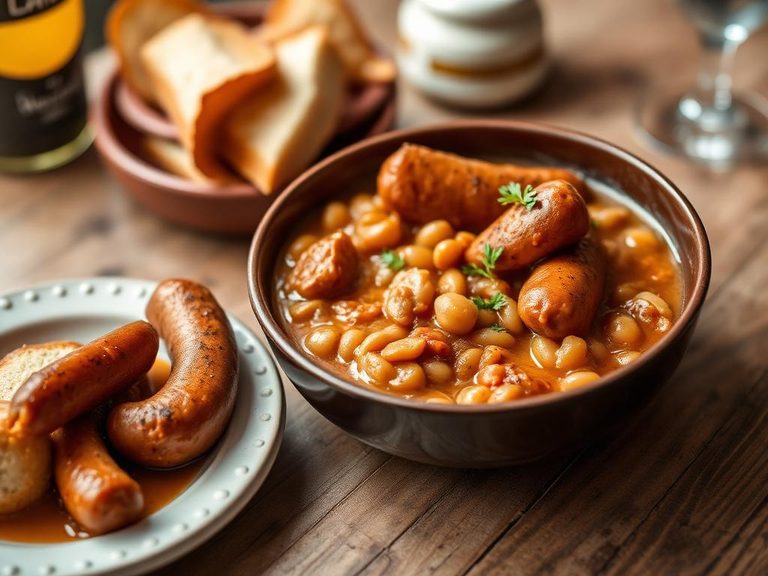
Due to its high saturated fat and sodium content, it should be consumed in moderation, especially by those monitoring heart health or blood pressure. To counteract this, pair it with fiber-rich sides like sauerkraut or roasted vegetables, and practice portion control by slicing it into a stew or soup rather than eating it whole.
Key benefits
- Excellent source of complete protein
- Provides essential B vitamins like B12
- Contains minerals such as zinc and selenium
- Offers a quick, calorie-dense energy source
- No sugar or fiber, suitable for low-carb diets
🍽️ Popular dishes
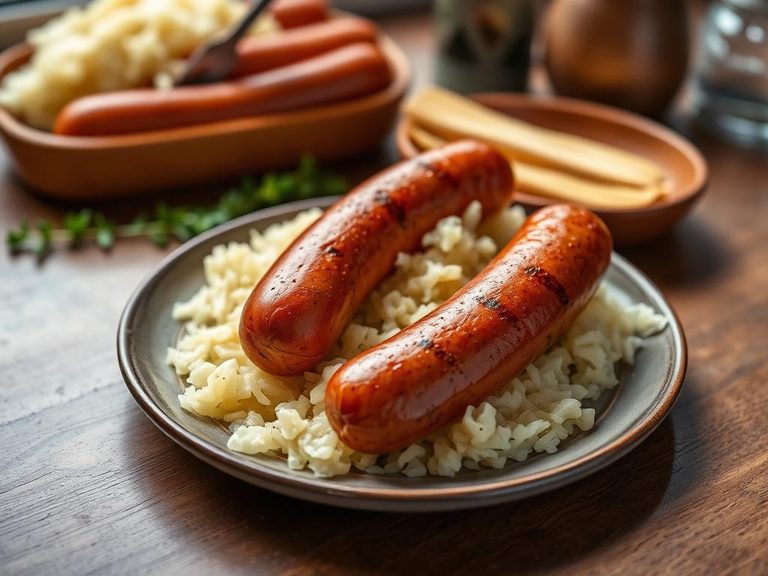
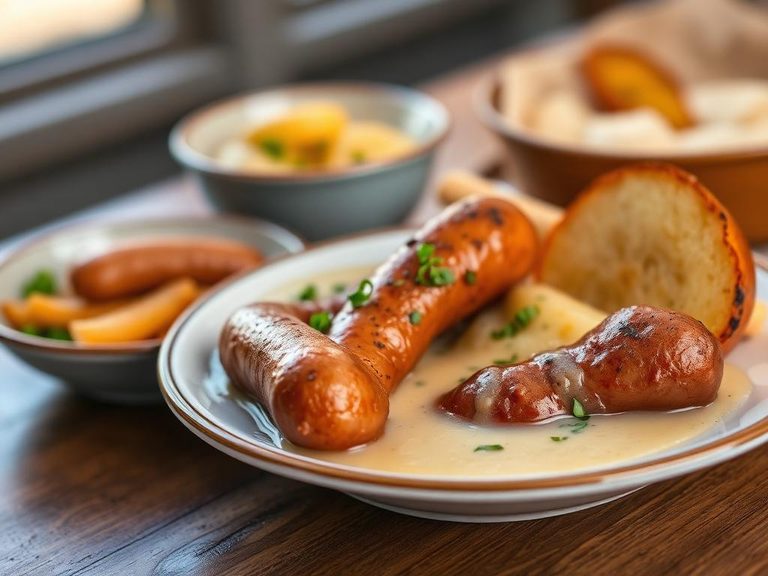
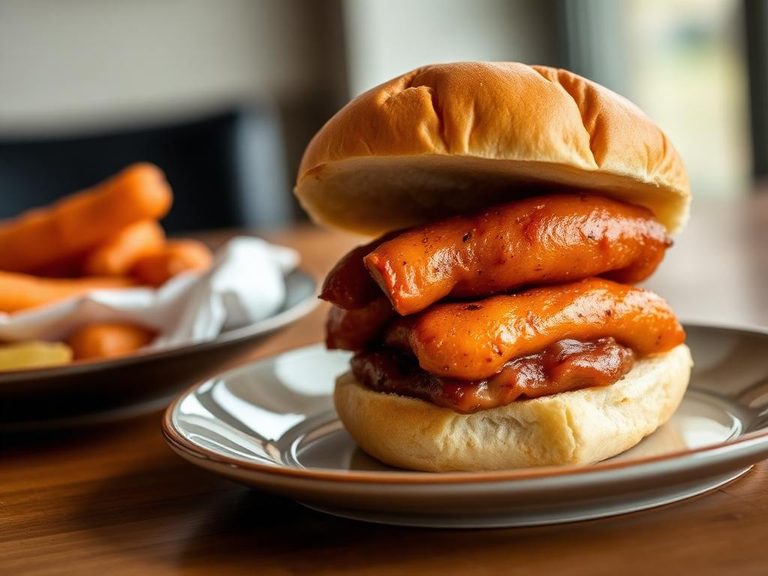
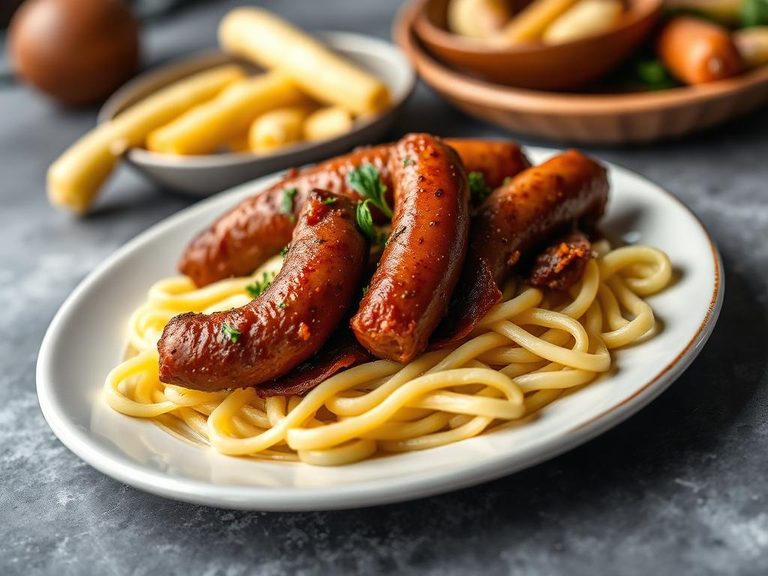
🌍 Where it's eaten
💡 Did you know?
The name 'Knockwurst' is often said to derive from the German word 'knacken,' meaning 'to crack,' a reference to the sound the casing makes when you bite into it.
Full nutrition (USDA data · scales with serving)
| Water | 55.3 g |
| Energy | 307 kcal |
| Protein | 11.1 g |
| Total lipid (fat) | 27.7 g |
| Carbohydrate, by difference | 3.2 g |
| Fiber, total dietary | 0.00 g |
| Total Sugars | 0.00 g |
| Calcium, Ca | 11.0 mg |
| Iron, Fe | 0.66 mg |
| Magnesium, Mg | 11.0 mg |
| Phosphorus, P | 98.0 mg |
| Potassium, K | 199 mg |
| Sodium, Na | 930 mg |
| Zinc, Zn | 1.7 mg |
| Copper, Cu | 0.06 mg |
| Selenium, Se | 13.5 ug |
| Vitamin C, total ascorbic acid | 0.00 mg |
| Thiamin | 0.34 mg |
| Riboflavin | 0.14 mg |
| Niacin | 2.7 mg |
| Vitamin B-6 | 0.17 mg |
| Folate, total | 2.0 ug |
| Folic acid | 0.00 ug |
| Folate, food | 2.0 ug |
| Folate, DFE | 2.0 ug |
| Choline, total | 55.0 mg |
| Vitamin B-12 | 1.2 ug |
| Vitamin B-12, added | 0.00 ug |
| Vitamin A, RAE | 0.00 ug |
| Retinol | 0.00 ug |
| Carotene, beta | 0.00 ug |
| Carotene, alpha | 0.00 ug |
| Cryptoxanthin, beta | 0.00 ug |
| Lycopene | 0.00 ug |
| Lutein + zeaxanthin | 0.00 ug |
| Vitamin E (alpha-tocopherol) | 0.57 mg |
| Vitamin E, added | 0.00 mg |
| Vitamin D (D2 + D3) | 1.1 ug |
| Vitamin K (phylloquinone) | 1.6 ug |
| Alcohol, ethyl | 0.00 g |
| Caffeine | 0.00 mg |
| Theobromine | 0.00 mg |
Fat & fatty acid profile (per 100g)
| Fatty acids, total saturated | 10.2 g |
| SFA 4:0 | 0.00 g |
| SFA 6:0 | 0.00 g |
| SFA 8:0 | 0.00 g |
| SFA 10:0 | 0.11 g |
| SFA 12:0 | 0.09 g |
| SFA 14:0 | 0.58 g |
| SFA 16:0 | 6.0 g |
| SFA 18:0 | 3.5 g |
| Fatty acids, total monounsaturated | 12.8 g |
| MUFA 16:1 | 1.3 g |
| MUFA 18:1 | 11.5 g |
| MUFA 20:1 | 0.00 g |
| MUFA 22:1 | 0.00 g |
| Fatty acids, total polyunsaturated | 2.9 g |
| PUFA 18:2 | 2.5 g |
| PUFA 18:3 | 0.44 g |
| PUFA 18:4 | 0.00 g |
| PUFA 20:4 | 0.00 g |
| PUFA 20:5 n-3 (EPA) | 0.00 g |
| PUFA 22:5 n-3 (DPA) | 0.00 g |
| PUFA 22:6 n-3 (DHA) | 0.00 g |
| Cholesterol | 60.0 mg |
Amino acid profile (per 100g)
Estimated from Knackwurst, knockwurst, pork, beef — USDA does not publish this profile for Knockwurst.
| Tryptophan | 0.14 g |
| Threonine | 0.43 g |
| Isoleucine | 0.64 g |
| Leucine | 0.87 g |
| Lysine | 1.0 g |
| Methionine | 0.28 g |
| Cystine | 0.23 g |
| Phenylalanine | 0.50 g |
| Tyrosine | 0.49 g |
| Valine | 0.64 g |
| Arginine | 0.94 g |
| Histidine | 0.31 g |
| Alanine | 0.85 g |
| Aspartic acid | 1.2 g |
| Glutamic acid | 1.6 g |
| Glycine | 1.0 g |
| Proline | 0.69 g |
| Serine | 0.53 g |
FAQ
What is the difference between knockwurst and bratwurst?
Knockwurst is typically pre-cooked and smoked, with a coarser grind and a more pronounced garlic flavor. Bratwurst is usually raw, with a finer texture and milder seasoning, meant to be grilled or pan-fried before eating.
Is knockwurst gluten-free?
Traditional knockwurst recipes are gluten-free, but some commercial brands may use fillers or binders containing wheat. Always check the ingredient list for gluten if you have celiac disease or sensitivity.
How should I store and reheat leftover knockwurst?
Store cooked knockwurst in an airtight container in the refrigerator for up to 3-4 days. Reheat gently in a skillet with a little water or beer, or in the microwave, to prevent it from drying out.
Nutrient density (calculated · NRF9.3)
Nutrient Rich Foods index: beneficial nutrients (protein, fiber, vitamins, minerals) minus saturated fat, added sugar & sodium, per 100 kcal.
NRF9.3 index — Fulgoni, Keast & Drewnowski, 2009. Computed from USDA nutrients.
Weight-loss friendliness (composite index)
Energy density 3.07 kcal/g · 14% calories from protein · 0.0 g fiber · 0.0 g sugar per 100 g.
Composite of energy density (Rolls et al., 1999), protein & fiber satiety, minus sugar. A calculated heuristic — ranks satiety-per-calorie, not a clinical measure.
Dietary load (calculated from USDA values)
Potential renal acid load. Positive = acid-forming, negative = alkaline-forming.
Sodium-to-potassium ratio: 4.67 (lower is better — aim for ≤ 1)
Sodium:potassium per WHO potassium guidance. Computed from USDA nutrients.