

Hot dog, reduced fat
Common food

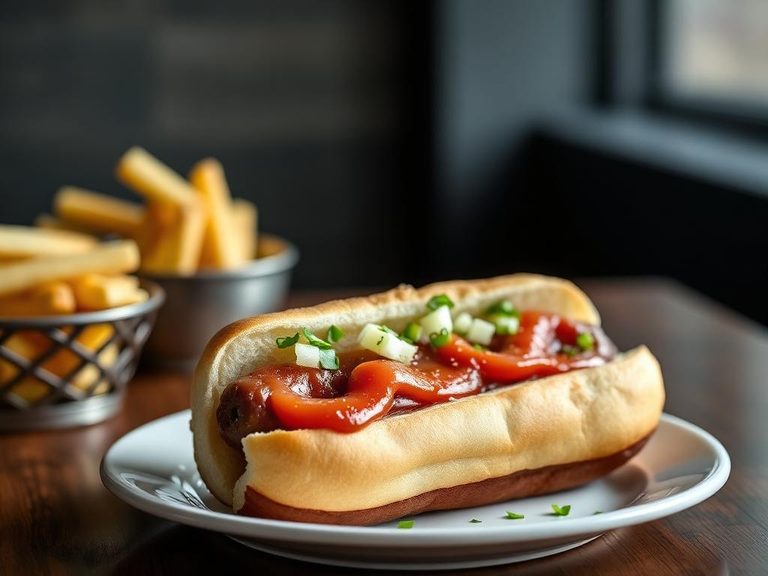
Photo: Wikipedia
A leaner take on the classic sausage, the reduced-fat hot dog offers the familiar smoky, savory flavor and satisfying snap in a lower-calorie package. It's a protein-rich, convenient option that sacrifices some of the juicy richness of its full-fat counterpart for a lighter bite. Nutritionally, it's a notable source of protein with a significantly reduced fat content compared to standard varieties.
Calorie split: 25% protein · 9% carbs · 65% fat
↓ Full nutrition💚 Why it's loved
People love it for delivering the iconic, comforting hot dog experience—the savory, slightly smoky flavor and satisfying texture—with less dietary fat. Its versatility makes it a staple for quick meals, from classic ballpark fare to creative home-cooked dishes.
⚠️ Watch-outs & how to enjoy it better
Despite the fat reduction, it remains a processed meat high in sodium, which can be a concern for blood pressure management. The protein and fat content can still impact blood sugar if not paired wisely. To counteract, serve it in a whole-grain bun with plenty of fiber-rich toppings like sauerkraut, onions, and tomatoes to slow digestion, and balance the meal with a side salad or vegetable.
Key benefits
- High in protein for muscle maintenance
- Lower in total fat than traditional hot dogs
- Convenient, quick-cooking protein source
- Provides essential B vitamins like B12
🍽️ Popular dishes




🌍 Where it's eaten
💡 Did you know?
The 'reduced fat' designation often means the fat content is at least 25% less than the original product, but it can still contain a similar amount of sodium.
Full nutrition (USDA data · scales with serving)
| Water | 63.3 g |
| Energy | 216 kcal |
| Protein | 13.8 g |
| Total lipid (fat) | 15.7 g |
| Carbohydrate, by difference | 5.1 g |
| Fiber, total dietary | 0.00 g |
| Total Sugars | 0.00 g |
| Calcium, Ca | 16.0 mg |
| Iron, Fe | 1.2 mg |
| Magnesium, Mg | 10.0 mg |
| Phosphorus, P | 115 mg |
| Potassium, K | 203 mg |
| Sodium, Na | 615 mg |
| Zinc, Zn | 2.0 mg |
| Copper, Cu | 0.06 mg |
| Selenium, Se | 17.1 ug |
| Vitamin C, total ascorbic acid | 0.20 mg |
| Thiamin | 0.15 mg |
| Riboflavin | 0.13 mg |
| Niacin | 2.5 mg |
| Vitamin B-6 | 0.16 mg |
| Folate, total | 3.0 ug |
| Folic acid | 0.00 ug |
| Folate, food | 3.0 ug |
| Folate, DFE | 3.0 ug |
| Choline, total | 58.6 mg |
| Vitamin B-12 | 0.88 ug |
| Vitamin B-12, added | 0.00 ug |
| Vitamin A, RAE | 0.00 ug |
| Retinol | 0.00 ug |
| Carotene, beta | 0.00 ug |
| Carotene, alpha | 0.00 ug |
| Cryptoxanthin, beta | 0.00 ug |
| Lycopene | 0.00 ug |
| Lutein + zeaxanthin | 0.00 ug |
| Vitamin E (alpha-tocopherol) | 0.18 mg |
| Vitamin E, added | 0.00 mg |
| Vitamin D (D2 + D3) | 0.50 ug |
| Vitamin K (phylloquinone) | 0.30 ug |
| Alcohol, ethyl | 0.00 g |
| Caffeine | 0.00 mg |
| Theobromine | 0.00 mg |
Fat & fatty acid profile (per 100g)
| Fatty acids, total saturated | 6.5 g |
| SFA 4:0 | 0.00 g |
| SFA 6:0 | 0.00 g |
| SFA 8:0 | 0.00 g |
| SFA 10:0 | 0.04 g |
| SFA 12:0 | 0.03 g |
| SFA 14:0 | 0.49 g |
| SFA 16:0 | 3.5 g |
| SFA 18:0 | 2.1 g |
| Fatty acids, total monounsaturated | 7.4 g |
| MUFA 16:1 | 0.86 g |
| MUFA 18:1 | 6.5 g |
| MUFA 20:1 | 0.00 g |
| MUFA 22:1 | 0.00 g |
| Fatty acids, total polyunsaturated | 0.87 g |
| PUFA 18:2 | 0.71 g |
| PUFA 18:3 | 0.15 g |
| PUFA 18:4 | 0.00 g |
| PUFA 20:4 | 0.00 g |
| PUFA 20:5 n-3 (EPA) | 0.00 g |
| PUFA 22:5 n-3 (DPA) | 0.00 g |
| PUFA 22:6 n-3 (DHA) | 0.00 g |
| Cholesterol | 52.0 mg |
Amino acid profile (per 100g)
Estimated from Pickle relish, hot dog — USDA does not publish this profile for Hot dog.
| Tryptophan | 0.02 g |
| Threonine | 0.05 g |
| Isoleucine | 0.05 g |
| Leucine | 0.07 g |
| Lysine | 0.07 g |
| Methionine | 0.02 g |
| Cystine | 0.02 g |
| Phenylalanine | 0.05 g |
| Tyrosine | 0.03 g |
| Valine | 0.06 g |
| Arginine | 0.10 g |
| Histidine | 0.03 g |
| Alanine | 0.06 g |
| Aspartic acid | 0.09 g |
| Glutamic acid | 0.33 g |
| Glycine | 0.06 g |
| Proline | 0.07 g |
| Serine | 0.05 g |
FAQ
How does the taste compare to a regular hot dog?
It has a very similar savory, smoky flavor profile but may taste slightly leaner and less juicy due to the reduced fat content. The texture can be a bit firmer.
Is it a good choice for a low-carb diet?
Yes, it's very low in carbohydrates (around 5g per 100g), making it suitable for low-carb and ketogenic diets, especially when served without a bun.
Can I grill it like a regular hot dog?
Absolutely. It can be grilled, boiled, steamed, or pan-fried. Be mindful that the lower fat content means it can dry out more quickly, so avoid overcooking.
Nutrient density (calculated · NRF9.3)
Nutrient Rich Foods index: beneficial nutrients (protein, fiber, vitamins, minerals) minus saturated fat, added sugar & sodium, per 100 kcal.
NRF9.3 index — Fulgoni, Keast & Drewnowski, 2009. Computed from USDA nutrients.
Weight-loss friendliness (composite index)
Energy density 2.16 kcal/g · 25% calories from protein · 0.0 g fiber · 0.0 g sugar per 100 g.
Composite of energy density (Rolls et al., 1999), protein & fiber satiety, minus sugar. A calculated heuristic — ranks satiety-per-calorie, not a clinical measure.
Dietary load (calculated from USDA values)
Potential renal acid load. Positive = acid-forming, negative = alkaline-forming.
Sodium-to-potassium ratio: 3.03 (lower is better — aim for ≤ 1)
Sodium:potassium per WHO potassium guidance. Computed from USDA nutrients.