

Hot dog, meat and poultry
Common food
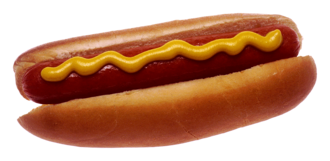
Photo: Wikipedia
A classic hot dog is a cooked sausage, typically a blend of beef, pork, and poultry, encased in a soft, steamed bun. Its signature texture is a satisfying snap from the casing, yielding to a juicy, savory, and often smoky interior. Nutritionally, it's a dense source of energy and fat, providing significant calories and protein in a compact serving.
Calorie split: 14% protein · 7% carbs · 79% fat
↓ Full nutrition💚 Why it's loved
People love the hot dog for its iconic, savory-salty flavor profile and the comforting ritual of eating it, especially at ballparks, barbecues, and street carts. Its ultimate versatility allows it to be a simple snack or a gourmet creation loaded with unique regional toppings.
⚠️ Watch-outs & how to enjoy it better
Hot dogs are often high in sodium and saturated fat, which can be a concern for heart health and blood pressure. They are also a common allergen (containing milk, soy, and wheat) and are classified as a processed meat. To counteract, choose low-sodium varieties, pair with fiber-rich sides like sauerkraut or a salad, and practice strict portion control.
Key benefits
- Excellent source of high-quality protein for muscle maintenance.
- Provides quick, dense energy from its calorie content.
- A convenient, no-preparation source of iron and B vitamins.
- Highly versatile as a base for countless toppings and preparations.
🍽️ Popular dishes





🌍 Where it's eaten
💡 Did you know?
The term 'hot dog' may have originated from a cartoonist who, unable to spell 'dachshund' (the dog breed the sausages resembled), simply wrote 'hot dog' in a 1901 cartoon at a baseball game.
Full nutrition (USDA data · scales with serving)
| Water | 57.6 g |
| Energy | 277 kcal |
| Protein | 9.7 g |
| Total lipid (fat) | 24.2 g |
| Carbohydrate, by difference | 5.0 g |
| Fiber, total dietary | 0.00 g |
| Total Sugars | 2.8 g |
| Calcium, Ca | 106 mg |
| Iron, Fe | 1.0 mg |
| Magnesium, Mg | 10.0 mg |
| Phosphorus, P | 166 mg |
| Potassium, K | 341 mg |
| Sodium, Na | 828 mg |
| Zinc, Zn | 1.1 mg |
| Copper, Cu | 0.04 mg |
| Selenium, Se | 12.4 ug |
| Vitamin C, total ascorbic acid | 18.0 mg |
| Thiamin | 0.04 mg |
| Riboflavin | 0.14 mg |
| Niacin | 2.5 mg |
| Vitamin B-6 | 0.05 mg |
| Folate, total | 5.0 ug |
| Folic acid | 0.00 ug |
| Folate, food | 5.0 ug |
| Folate, DFE | 5.0 ug |
| Choline, total | 50.2 mg |
| Vitamin B-12 | 0.60 ug |
| Vitamin B-12, added | 0.00 ug |
| Vitamin A, RAE | 26.0 ug |
| Retinol | 26.0 ug |
| Carotene, beta | 0.00 ug |
| Carotene, alpha | 0.00 ug |
| Cryptoxanthin, beta | 0.00 ug |
| Lycopene | 0.00 ug |
| Lutein + zeaxanthin | 0.00 ug |
| Vitamin E (alpha-tocopherol) | 0.44 mg |
| Vitamin E, added | 0.00 mg |
| Vitamin D (D2 + D3) | 0.70 ug |
| Vitamin K (phylloquinone) | 0.10 ug |
| Alcohol, ethyl | 0.00 g |
| Caffeine | 0.00 mg |
| Theobromine | 0.00 mg |
Fat & fatty acid profile (per 100g)
| Fatty acids, total saturated | 7.6 g |
| SFA 4:0 | 0.00 g |
| SFA 6:0 | 0.00 g |
| SFA 8:0 | 0.00 g |
| SFA 10:0 | 0.02 g |
| SFA 12:0 | 0.02 g |
| SFA 14:0 | 0.26 g |
| SFA 16:0 | 5.1 g |
| SFA 18:0 | 2.1 g |
| Fatty acids, total monounsaturated | 9.9 g |
| MUFA 16:1 | 0.74 g |
| MUFA 18:1 | 8.9 g |
| MUFA 20:1 | 0.17 g |
| MUFA 22:1 | 0.01 g |
| Fatty acids, total polyunsaturated | 5.4 g |
| PUFA 18:2 | 4.8 g |
| PUFA 18:3 | 0.24 g |
| PUFA 18:4 | 0.00 g |
| PUFA 20:4 | 0.11 g |
| PUFA 20:5 n-3 (EPA) | 0.00 g |
| PUFA 22:5 n-3 (DPA) | 0.02 g |
| PUFA 22:6 n-3 (DHA) | 0.01 g |
| Cholesterol | 78.0 mg |
Amino acid profile (per 100g)
Estimated from Pickle relish, hot dog — USDA does not publish this profile for Hot dog.
| Tryptophan | 0.02 g |
| Threonine | 0.05 g |
| Isoleucine | 0.05 g |
| Leucine | 0.07 g |
| Lysine | 0.07 g |
| Methionine | 0.02 g |
| Cystine | 0.02 g |
| Phenylalanine | 0.05 g |
| Tyrosine | 0.03 g |
| Valine | 0.06 g |
| Arginine | 0.10 g |
| Histidine | 0.03 g |
| Alanine | 0.06 g |
| Aspartic acid | 0.09 g |
| Glutamic acid | 0.33 g |
| Glycine | 0.06 g |
| Proline | 0.07 g |
| Serine | 0.05 g |
FAQ
What's the difference between a 'meat and poultry' hot dog and an all-beef one?
A 'meat and poultry' hot dog is a blend, often including pork, beef, and chicken or turkey, which can result in a milder flavor and slightly different texture. An all-beef hot dog uses only beef, typically offering a more robust, singular flavor.
Why do hot dogs sometimes get wrinkly when overcooked?
The casing and the emulsified meat inside contain water. When overcooked, this moisture evaporates rapidly, causing the sausage to shrink and the casing to wrinkle or split.
Is it safe to eat a hot dog straight from the package?
Most hot dogs sold in the US are pre-cooked and pasteurized, so they are technically safe to eat cold. However, heating them to steaming hot (165°F / 74°C) is recommended to kill any potential Listeria bacteria that could have been introduced after packaging.
Nutrient density (calculated · NRF9.3)
Nutrient Rich Foods index: beneficial nutrients (protein, fiber, vitamins, minerals) minus saturated fat, added sugar & sodium, per 100 kcal.
NRF9.3 index — Fulgoni, Keast & Drewnowski, 2009. Computed from USDA nutrients.
Weight-loss friendliness (composite index)
Energy density 2.77 kcal/g · 14% calories from protein · 0.0 g fiber · 2.8 g sugar per 100 g.
Composite of energy density (Rolls et al., 1999), protein & fiber satiety, minus sugar. A calculated heuristic — ranks satiety-per-calorie, not a clinical measure.
Dietary load (calculated from USDA values)
Potential renal acid load. Positive = acid-forming, negative = alkaline-forming.
Sodium-to-potassium ratio: 2.43 (lower is better — aim for ≤ 1)
Sodium:potassium per WHO potassium guidance. Computed from USDA nutrients.