

Hot chocolate / cocoa, reduced sugar, made with whole or reduced fat (2%) milk
Common food

Photo: Wikipedia
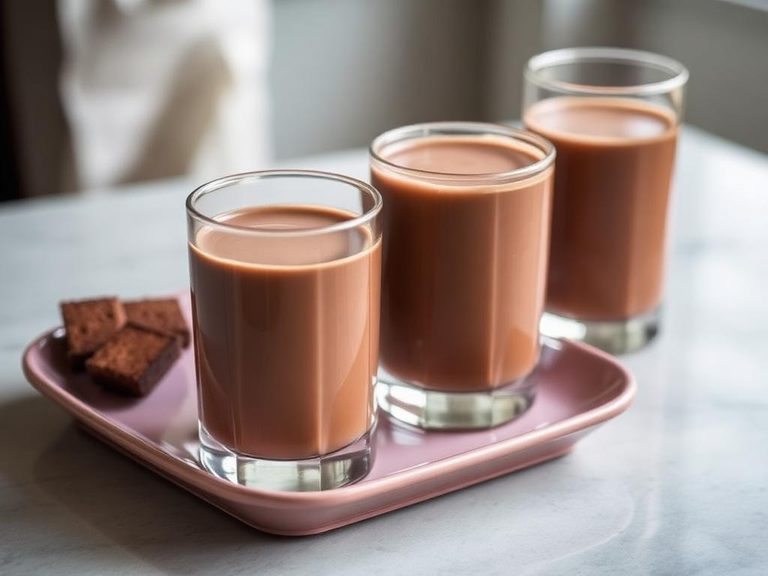
A warm, velvety beverage made from cocoa powder and milk, sweetened with less sugar than traditional versions. It delivers a rich chocolate flavor with a creamy mouthfeel, offering a comforting treat with a notable protein boost from the milk base.
Calorie split: 17% protein · 60% carbs · 22% fat
↓ Full nutrition💚 Why it's loved
People love it for its deep chocolate flavor and creamy warmth, offering a nostalgic, comforting ritual. It's a versatile base that can be customized with spices, toppings, or used in desserts.
⚠️ Watch-outs & how to enjoy it better
The reduced sugar can still cause blood sugar spikes for some, and it contains lactose and milk proteins, common allergens. To mitigate, pair it with a source of fiber or fat (like a handful of nuts), be mindful of portion size, and choose lactose-free milk if sensitive.
Key benefits
- Good source of protein from milk
- Lower in sugar than traditional hot cocoa
- Provides calcium and vitamin D from milk
- Contains antioxidants from cocoa
- Warm, satisfying comfort drink
🍽️ Popular dishes



🌍 Where it's eaten
💡 Did you know?
The original Mesoamerican chocolate drinks were often frothed by pouring the liquid between vessels from a height, a technique that created a prized foam.
Full nutrition (USDA data · scales with serving)
| Water | 84.1 g |
| Energy | 69.0 kcal |
| Protein | 3.0 g |
| Total lipid (fat) | 1.7 g |
| Carbohydrate, by difference | 10.4 g |
| Fiber, total dietary | 0.00 g |
| Total Sugars | 9.3 g |
| Calcium, Ca | 105 mg |
| Iron, Fe | 0.00 mg |
| Magnesium, Mg | 16.0 mg |
| Phosphorus, P | 94.0 mg |
| Potassium, K | 164 mg |
| Sodium, Na | 50.0 mg |
| Zinc, Zn | 0.44 mg |
| Copper, Cu | 0.05 mg |
| Selenium, Se | 1.7 ug |
| Vitamin C, total ascorbic acid | 0.20 mg |
| Thiamin | 0.05 mg |
| Riboflavin | 0.12 mg |
| Niacin | 0.12 mg |
| Vitamin B-6 | 0.05 mg |
| Folate, total | 2.0 ug |
| Folic acid | 0.00 ug |
| Folate, food | 2.0 ug |
| Folate, DFE | 2.0 ug |
| Choline, total | 14.2 mg |
| Vitamin B-12 | 0.42 ug |
| Vitamin B-12, added | 0.00 ug |
| Vitamin A, RAE | 68.0 ug |
| Retinol | 68.0 ug |
| Carotene, beta | 2.0 ug |
| Carotene, alpha | 0.00 ug |
| Cryptoxanthin, beta | 0.00 ug |
| Lycopene | 0.00 ug |
| Lutein + zeaxanthin | 1.0 ug |
| Vitamin E (alpha-tocopherol) | 0.03 mg |
| Vitamin E, added | 0.00 mg |
| Vitamin D (D2 + D3) | 0.90 ug |
| Vitamin K (phylloquinone) | 0.20 ug |
| Alcohol, ethyl | 0.00 g |
| Caffeine | 1.0 mg |
| Theobromine | 36.0 mg |
Fat & fatty acid profile (per 100g)
| Fatty acids, total saturated | 0.90 g |
| SFA 4:0 | 0.03 g |
| SFA 6:0 | 0.03 g |
| SFA 8:0 | 0.02 g |
| SFA 10:0 | 0.04 g |
| SFA 12:0 | 0.05 g |
| SFA 14:0 | 0.15 g |
| SFA 16:0 | 0.42 g |
| SFA 18:0 | 0.15 g |
| Fatty acids, total monounsaturated | 0.33 g |
| MUFA 16:1 | 0.02 g |
| MUFA 18:1 | 0.33 g |
| MUFA 20:1 | 0.00 g |
| MUFA 22:1 | 0.00 g |
| Fatty acids, total polyunsaturated | 0.05 g |
| PUFA 18:2 | 0.05 g |
| PUFA 18:3 | 0.01 g |
| PUFA 18:4 | 0.00 g |
| PUFA 20:4 | 0.00 g |
| PUFA 20:5 n-3 (EPA) | 0.00 g |
| PUFA 22:5 n-3 (DPA) | 0.00 g |
| PUFA 22:6 n-3 (DHA) | 0.00 g |
| Cholesterol | 7.0 mg |
Amino acid profile (per 100g)
Estimated from Milk, chocolate beverage, hot cocoa, homemade — USDA does not publish this profile for Hot chocolate / cocoa.
| Tryptophan | 0.04 g |
| Threonine | 0.10 g |
| Isoleucine | 0.17 g |
| Leucine | 0.30 g |
| Lysine | 0.21 g |
| Methionine | 0.08 g |
| Cystine | 0.10 g |
| Phenylalanine | 0.15 g |
| Tyrosine | 0.14 g |
| Valine | 0.20 g |
| Arginine | 0.10 g |
| Histidine | 0.07 g |
| Alanine | 0.10 g |
| Aspartic acid | 0.28 g |
| Glutamic acid | 0.72 g |
| Glycine | 0.06 g |
| Proline | 0.34 g |
| Serine | 0.18 g |
FAQ
How is this different from regular hot chocolate?
This version is made with reduced sugar and typically uses cocoa powder instead of melted chocolate, resulting in fewer calories and less fat, while still providing a rich chocolate taste.
Can I make this with plant-based milk?
Yes, you can substitute with oat, soy, or almond milk. Note that this will alter the nutritional profile, particularly reducing the protein and calcium content unless you use a fortified plant milk.
Why is there protein in a chocolate drink?
The protein comes from the whole or reduced-fat milk used as the base. Milk is a complete protein, contributing to the drink's nutritional value beyond just flavor.
Nutrient density (calculated · NRF9.3)
Nutrient Rich Foods index: beneficial nutrients (protein, fiber, vitamins, minerals) minus saturated fat, added sugar & sodium, per 100 kcal.
NRF9.3 index — Fulgoni, Keast & Drewnowski, 2009. Computed from USDA nutrients.
Weight-loss friendliness (composite index)
Energy density 0.69 kcal/g · 17% calories from protein · 0.0 g fiber · 9.3 g sugar per 100 g.
Composite of energy density (Rolls et al., 1999), protein & fiber satiety, minus sugar. A calculated heuristic — ranks satiety-per-calorie, not a clinical measure.
Dietary load (calculated from USDA values)
Potential renal acid load. Positive = acid-forming, negative = alkaline-forming.
Sodium-to-potassium ratio: 0.30 (lower is better — aim for ≤ 1)
Sodium:potassium per WHO potassium guidance. Computed from USDA nutrients.