

Hot chocolate / cocoa, reduced sugar, made with lowfat (1%) or fat free (skim) milk
Common food

Photo: Wikipedia
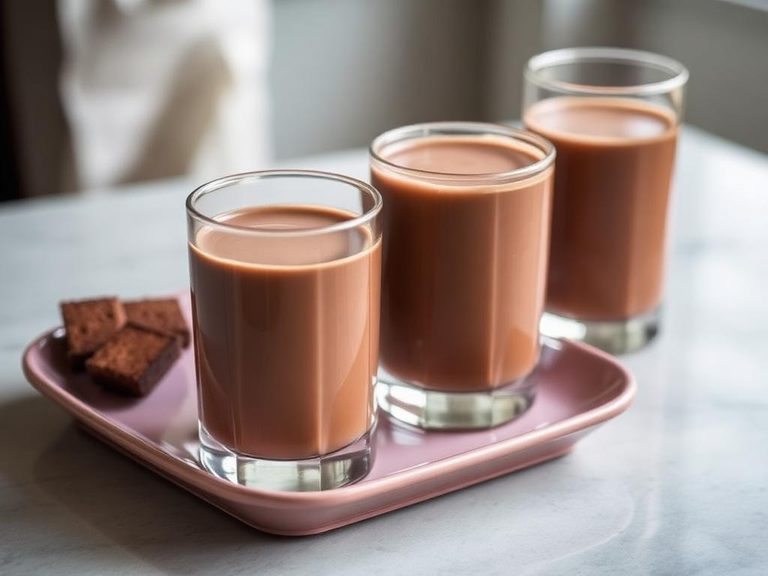
This is a lighter, guilt-free take on a classic comfort drink, made by blending reduced-sugar cocoa powder with low-fat or skim milk. The result is a smooth, creamy, and deeply chocolatey beverage with a noticeably thinner body than its full-fat counterparts. Nutritionally, it's a lean treat, delivering satisfying chocolate flavor with minimal fat and a modest calorie count.
Calorie split: 22% protein · 74% carbs · 4% fat
↓ Full nutrition💚 Why it's loved
People adore it for delivering the rich, nostalgic warmth of hot chocolate without the heavy calorie load, making it a perfect daily indulgence. Its simplicity and versatility also make it an easy canvas for spices, extracts, or a dollop of whipped cream.
⚠️ Watch-outs & how to enjoy it better
The reduced fat and sugar can make it taste less decadent or slightly watery to purists, and the cocoa can be a source of oxalates for those prone to kidney stones. To counteract the thinner texture, you can blend in a teaspoon of chia seeds or a small amount of nut butter for healthy fats and thickness. For blood sugar management, pair it with a handful of nuts or a piece of cheese to slow absorption.
Key benefits
- Lower in calories and fat than traditional hot chocolate.
- Provides a good source of calcium and vitamin D from the milk base.
- Contains cocoa flavonoids, which are antioxidants.
- Offers a protein boost from the milk, aiding satiety.
- A satisfying, lower-sugar alternative to many sweetened beverages.
🍽️ Popular dishes


🌍 Where it's eaten
💡 Did you know?
The process of making cocoa powder, which gives this drink its flavor, was patented in 1828 by Coenraad van Houten of Amsterdam, a invention that truly democratized chocolate drinks.
Full nutrition (USDA data · scales with serving)
| Water | 85.5 g |
| Energy | 56.0 kcal |
| Protein | 3.0 g |
| Total lipid (fat) | 0.25 g |
| Carbohydrate, by difference | 10.4 g |
| Fiber, total dietary | 0.00 g |
| Total Sugars | 9.4 g |
| Calcium, Ca | 109 mg |
| Iron, Fe | 0.00 mg |
| Magnesium, Mg | 16.0 mg |
| Phosphorus, P | 97.0 mg |
| Potassium, K | 171 mg |
| Sodium, Na | 52.0 mg |
| Zinc, Zn | 0.46 mg |
| Copper, Cu | 0.05 mg |
| Selenium, Se | 1.9 ug |
| Vitamin C, total ascorbic acid | 0.00 mg |
| Thiamin | 0.04 mg |
| Riboflavin | 0.11 mg |
| Niacin | 0.13 mg |
| Vitamin B-6 | 0.05 mg |
| Folate, total | 2.0 ug |
| Folic acid | 0.00 ug |
| Folate, food | 2.0 ug |
| Folate, DFE | 2.0 ug |
| Choline, total | 14.2 mg |
| Vitamin B-12 | 0.45 ug |
| Vitamin B-12, added | 0.00 ug |
| Vitamin A, RAE | 52.0 ug |
| Retinol | 52.0 ug |
| Carotene, beta | 2.0 ug |
| Carotene, alpha | 0.00 ug |
| Cryptoxanthin, beta | 0.00 ug |
| Lycopene | 0.00 ug |
| Lutein + zeaxanthin | 1.0 ug |
| Vitamin E (alpha-tocopherol) | 0.00 mg |
| Vitamin E, added | 0.00 mg |
| Vitamin D (D2 + D3) | 0.90 ug |
| Vitamin K (phylloquinone) | 0.00 ug |
| Alcohol, ethyl | 0.00 g |
| Caffeine | 1.0 mg |
| Theobromine | 36.0 mg |
Fat & fatty acid profile (per 100g)
| Fatty acids, total saturated | 0.04 g |
| SFA 4:0 | 0.00 g |
| SFA 6:0 | 0.00 g |
| SFA 8:0 | 0.00 g |
| SFA 10:0 | 0.00 g |
| SFA 12:0 | 0.00 g |
| SFA 14:0 | 0.01 g |
| SFA 16:0 | 0.02 g |
| SFA 18:0 | 0.01 g |
| Fatty acids, total monounsaturated | 0.01 g |
| MUFA 16:1 | 0.00 g |
| MUFA 18:1 | 0.01 g |
| MUFA 20:1 | 0.00 g |
| MUFA 22:1 | 0.00 g |
| Fatty acids, total polyunsaturated | 0.01 g |
| PUFA 18:2 | 0.00 g |
| PUFA 18:3 | 0.00 g |
| PUFA 18:4 | 0.00 g |
| PUFA 20:4 | 0.00 g |
| PUFA 20:5 n-3 (EPA) | 0.00 g |
| PUFA 22:5 n-3 (DPA) | 0.00 g |
| PUFA 22:6 n-3 (DHA) | 0.00 g |
| Cholesterol | 2.0 mg |
Amino acid profile (per 100g)
Estimated from Milk, chocolate beverage, hot cocoa, homemade — USDA does not publish this profile for Hot chocolate / cocoa.
| Tryptophan | 0.04 g |
| Threonine | 0.10 g |
| Isoleucine | 0.17 g |
| Leucine | 0.30 g |
| Lysine | 0.21 g |
| Methionine | 0.08 g |
| Cystine | 0.10 g |
| Phenylalanine | 0.15 g |
| Tyrosine | 0.14 g |
| Valine | 0.20 g |
| Arginine | 0.10 g |
| Histidine | 0.07 g |
| Alanine | 0.10 g |
| Aspartic acid | 0.28 g |
| Glutamic acid | 0.72 g |
| Glycine | 0.06 g |
| Proline | 0.34 g |
| Serine | 0.18 g |
FAQ
Can I make this with plant-based milk?
Absolutely. Unsweetened almond, soy, or oat milk work well. Note that the nutrition facts (especially protein and calories) will change based on the milk you choose.
Why does mine taste bitter or chalky?
This can happen if the cocoa powder isn't fully dissolved. Try mixing the cocoa with a small amount of hot water or milk to form a smooth paste first, then gradually whisk in the rest of the liquid.
Is this suitable for a low-carb diet?
While lower in sugar than regular hot chocolate, the carbs from the milk and cocoa powder still add up. For a strict low-carb version, you'd need to use a zero-carb milk alternative and unsweetened cocoa.
Nutrient density (calculated · NRF9.3)
Nutrient Rich Foods index: beneficial nutrients (protein, fiber, vitamins, minerals) minus saturated fat, added sugar & sodium, per 100 kcal.
NRF9.3 index — Fulgoni, Keast & Drewnowski, 2009. Computed from USDA nutrients.
Weight-loss friendliness (composite index)
Energy density 0.56 kcal/g · 22% calories from protein · 0.0 g fiber · 9.4 g sugar per 100 g.
Composite of energy density (Rolls et al., 1999), protein & fiber satiety, minus sugar. A calculated heuristic — ranks satiety-per-calorie, not a clinical measure.
Dietary load (calculated from USDA values)
Potential renal acid load. Positive = acid-forming, negative = alkaline-forming.
Sodium-to-potassium ratio: 0.30 (lower is better — aim for ≤ 1)
Sodium:potassium per WHO potassium guidance. Computed from USDA nutrients.