

Ham biscuit sandwich
Common food
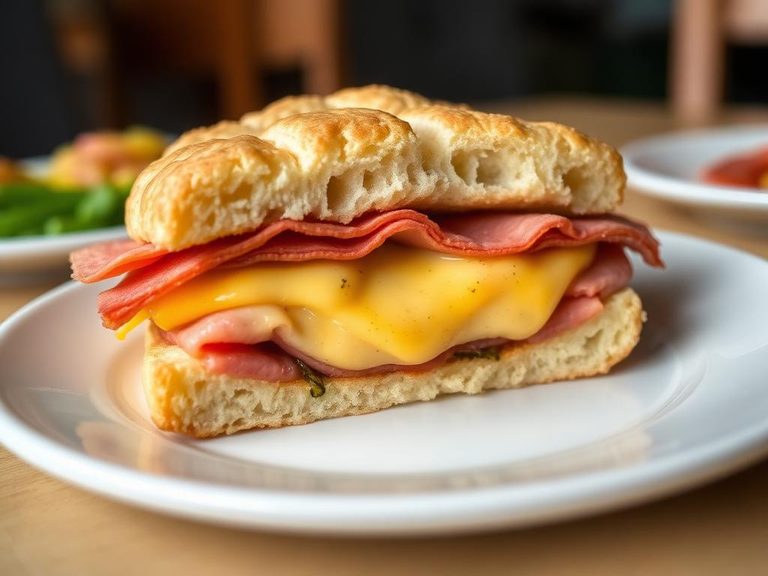
A warm, flaky buttermilk biscuit split and filled with savory, salty slices of ham, creating a perfect balance of tender, buttery dough and smoky, meaty flavor. The texture is a delightful contrast: the biscuit's crumbly, soft interior against the ham's firm, chewy bite. Nutritionally, it's a protein-rich start to the day, with over 11 grams per 100g helping to sustain energy.
Calorie split: 14% protein · 35% carbs · 51% fat
↓ Full nutrition💚 Why it's loved
People adore it for its comforting, nostalgic appeal—a staple of Southern U.S. breakfasts and a quick, satisfying meal any time. Its genius lies in the simple, perfect harmony of salty, savory ham and rich, buttery biscuit.
⚠️ Watch-outs & how to enjoy it better
The combination can be high in sodium and saturated fat, which may concern those monitoring heart health or blood pressure. To counteract this, pair it with a fiber-rich side like fresh fruit or a green salad, and opt for a whole-wheat biscuit or leaner ham to boost fiber and reduce saturated fat. Portion control is also key.
Key benefits
- High-quality protein for muscle maintenance and satiety.
- Provides quick energy from carbohydrates.
- Contains B vitamins like niacin from the ham.
- Offers a convenient, portable meal option.
- Can be a good source of iron and zinc.
🍽️ Popular dishes



🌍 Where it's eaten
💡 Did you know?
The modern American biscuit evolved from British scones, but the addition of ham and the specific buttermilk recipe became a defining culinary icon of the American South in the 19th century.
Full nutrition (USDA data · scales with serving)
| Water | 38.4 g |
| Energy | 322 kcal |
| Protein | 11.6 g |
| Total lipid (fat) | 18.1 g |
| Carbohydrate, by difference | 28.2 g |
| Fiber, total dietary | 1.6 g |
| Total Sugars | 3.3 g |
| Calcium, Ca | 216 mg |
| Iron, Fe | 2.0 mg |
| Magnesium, Mg | 18.0 mg |
| Phosphorus, P | 457 mg |
| Potassium, K | 168 mg |
| Sodium, Na | 1023 mg |
| Zinc, Zn | 1.2 mg |
| Copper, Cu | 0.07 mg |
| Selenium, Se | 18.0 ug |
| Vitamin C, total ascorbic acid | 0.00 mg |
| Thiamin | 0.35 mg |
| Riboflavin | 0.29 mg |
| Niacin | 3.4 mg |
| Vitamin B-6 | 0.12 mg |
| Folate, total | 56.0 ug |
| Folic acid | 33.0 ug |
| Folate, food | 22.0 ug |
| Folate, DFE | 79.0 ug |
| Choline, total | 17.8 mg |
| Vitamin B-12 | 0.35 ug |
| Vitamin B-12, added | 0.00 ug |
| Vitamin A, RAE | 65.0 ug |
| Retinol | 63.0 ug |
| Carotene, beta | 15.0 ug |
| Carotene, alpha | 0.00 ug |
| Cryptoxanthin, beta | 1.0 ug |
| Lycopene | 0.00 ug |
| Lutein + zeaxanthin | 4.0 ug |
| Vitamin E (alpha-tocopherol) | 0.47 mg |
| Vitamin E, added | 0.00 mg |
| Vitamin D (D2 + D3) | 0.80 ug |
| Vitamin K (phylloquinone) | 3.3 ug |
| Alcohol, ethyl | 0.00 g |
| Caffeine | 0.00 mg |
| Theobromine | 0.00 mg |
Fat & fatty acid profile (per 100g)
| Fatty acids, total saturated | 10.8 g |
| SFA 4:0 | 0.12 g |
| SFA 6:0 | 0.11 g |
| SFA 8:0 | 0.29 g |
| SFA 10:0 | 0.32 g |
| SFA 12:0 | 2.2 g |
| SFA 14:0 | 1.2 g |
| SFA 16:0 | 4.0 g |
| SFA 18:0 | 2.5 g |
| Fatty acids, total monounsaturated | 3.1 g |
| MUFA 16:1 | 0.12 g |
| MUFA 18:1 | 3.1 g |
| MUFA 20:1 | 0.03 g |
| MUFA 22:1 | 0.00 g |
| Fatty acids, total polyunsaturated | 1.7 g |
| PUFA 18:2 | 1.5 g |
| PUFA 18:3 | 0.16 g |
| PUFA 18:4 | 0.00 g |
| PUFA 20:4 | 0.02 g |
| PUFA 20:5 n-3 (EPA) | 0.00 g |
| PUFA 22:5 n-3 (DPA) | 0.00 g |
| PUFA 22:6 n-3 (DHA) | 0.00 g |
| Cholesterol | 28.0 mg |
Amino acid profile (per 100g)
Estimated from Fast foods, biscuit, with ham — USDA does not publish this profile for Ham biscuit sandwich.
| Tryptophan | 0.15 g |
| Threonine | 0.48 g |
| Isoleucine | 0.51 g |
| Leucine | 0.94 g |
| Lysine | 0.82 g |
| Methionine | 0.29 g |
| Cystine | 0.20 g |
| Phenylalanine | 0.55 g |
| Tyrosine | 0.40 g |
| Valine | 0.53 g |
| Arginine | 0.68 g |
| Histidine | 0.38 g |
| Alanine | 0.60 g |
| Aspartic acid | 0.96 g |
| Glutamic acid | 2.6 g |
| Glycine | 0.55 g |
| Proline | 0.79 g |
| Serine | 0.53 g |
FAQ
Is a ham biscuit sandwich a healthy breakfast?
It can be part of a balanced diet. Its high protein content helps with fullness, but be mindful of sodium and saturated fat from the ham and biscuit. Pairing it with vegetables or fruit adds fiber and nutrients.
Can I make a healthier version at home?
Absolutely. Use whole-wheat flour for the biscuit, choose low-sodium, lean ham, and consider adding a slice of tomato or avocado inside for extra fiber and healthy fats.
What's the best way to reheat leftovers?
To avoid sogginess, reheat in a toaster oven or air fryer at 350°F (175°C) for 3-5 minutes. This revives the biscuit's flakiness better than a microwave.
Nutrient density (calculated · NRF9.3)
Nutrient Rich Foods index: beneficial nutrients (protein, fiber, vitamins, minerals) minus saturated fat, added sugar & sodium, per 100 kcal.
NRF9.3 index — Fulgoni, Keast & Drewnowski, 2009. Computed from USDA nutrients.
Weight-loss friendliness (composite index)
Energy density 3.22 kcal/g · 14% calories from protein · 1.6 g fiber · 3.3 g sugar per 100 g.
Composite of energy density (Rolls et al., 1999), protein & fiber satiety, minus sugar. A calculated heuristic — ranks satiety-per-calorie, not a clinical measure.
Dietary load (calculated from USDA values)
Potential renal acid load. Positive = acid-forming, negative = alkaline-forming.
Sodium-to-potassium ratio: 6.09 (lower is better — aim for ≤ 1)
Sodium:potassium per WHO potassium guidance. Computed from USDA nutrients.