

French toast, NFS
Common food
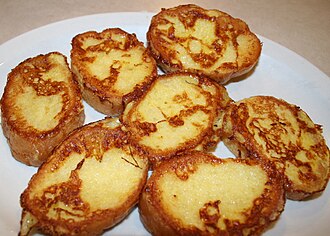
Photo: Wikipedia
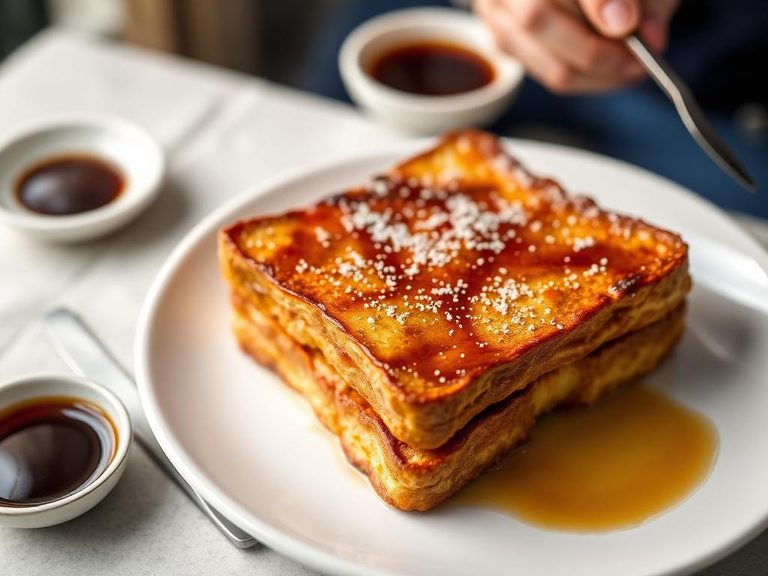
French toast is slices of bread soaked in a mixture of eggs and milk, then pan-fried to a golden-brown, custardy interior with a slightly crisp exterior. Its flavor is a comforting blend of sweet, eggy, and buttery notes, often enhanced by toppings. Nutritionally, it provides a balanced mix of protein and carbohydrates for energy, with a moderate fat content from the egg and cooking fat.
Calorie split: 15% protein · 47% carbs · 37% fat
↓ Full nutrition💚 Why it's loved
People love it for its nostalgic, comforting taste and the delightful textural contrast between the soft, custardy center and the caramelized edges. It's a beloved breakfast staple that serves as a perfect canvas for a wide array of toppings, from simple maple syrup to fresh berries and whipped cream.
⚠️ Watch-outs & how to enjoy it better
The primary downsides are the potential for high sugar and saturated fat content, especially when made with white bread and topped with syrup and butter, which can cause a rapid blood-sugar spike. To counteract this, use whole-grain or sourdough bread for more fiber, limit added sugar in the batter, and top with protein-rich Greek yogurt or nuts and fiber-rich fruit instead of just syrup.
Key benefits
- Good source of high-quality protein from eggs
- Provides quick energy from carbohydrates
- Contains B vitamins like B12 and riboflavin from eggs
- Versatile base for both sweet and savory toppings
- Can be a satisfying use for day-old bread
🍽️ Popular dishes

🌍 Where it's eaten
💡 Did you know?
The name 'pain perdu' in French literally translates to 'lost bread,' highlighting its historical origin as a way to use up stale, 'lost' bread by reviving it with an egg soak.
Full nutrition (USDA data · scales with serving)
| Water | 44.4 g |
| Energy | 273 kcal |
| Protein | 10.4 g |
| Total lipid (fat) | 11.4 g |
| Carbohydrate, by difference | 32.3 g |
| Fiber, total dietary | 1.2 g |
| Total Sugars | 10.1 g |
| Calcium, Ca | 143 mg |
| Iron, Fe | 2.4 mg |
| Magnesium, Mg | 20.0 mg |
| Phosphorus, P | 148 mg |
| Potassium, K | 135 mg |
| Sodium, Na | 302 mg |
| Zinc, Zn | 1.0 mg |
| Copper, Cu | 0.06 mg |
| Selenium, Se | 24.9 ug |
| Vitamin C, total ascorbic acid | 0.00 mg |
| Thiamin | 0.24 mg |
| Riboflavin | 0.31 mg |
| Niacin | 2.4 mg |
| Vitamin B-6 | 0.11 mg |
| Folate, total | 70.0 ug |
| Folic acid | 37.0 ug |
| Folate, food | 33.0 ug |
| Folate, DFE | 95.0 ug |
| Choline, total | 122 mg |
| Vitamin B-12 | 0.41 ug |
| Vitamin B-12, added | 0.00 ug |
| Vitamin A, RAE | 106 ug |
| Retinol | 104 ug |
| Carotene, beta | 11.0 ug |
| Carotene, alpha | 0.00 ug |
| Cryptoxanthin, beta | 6.0 ug |
| Lycopene | 0.00 ug |
| Lutein + zeaxanthin | 231 ug |
| Vitamin E (alpha-tocopherol) | 1.3 mg |
| Vitamin E, added | 0.00 mg |
| Vitamin D (D2 + D3) | 1.2 ug |
| Vitamin K (phylloquinone) | 4.5 ug |
| Alcohol, ethyl | 0.00 g |
| Caffeine | 0.00 mg |
| Theobromine | 0.00 mg |
Fat & fatty acid profile (per 100g)
| Fatty acids, total saturated | 3.3 g |
| SFA 4:0 | 0.04 g |
| SFA 6:0 | 0.03 g |
| SFA 8:0 | 0.02 g |
| SFA 10:0 | 0.04 g |
| SFA 12:0 | 0.06 g |
| SFA 14:0 | 0.18 g |
| SFA 16:0 | 2.0 g |
| SFA 18:0 | 0.77 g |
| Fatty acids, total monounsaturated | 3.8 g |
| MUFA 16:1 | 0.14 g |
| MUFA 18:1 | 3.6 g |
| MUFA 20:1 | 0.03 g |
| MUFA 22:1 | 0.00 g |
| Fatty acids, total polyunsaturated | 3.2 g |
| PUFA 18:2 | 2.8 g |
| PUFA 18:3 | 0.27 g |
| PUFA 18:4 | 0.00 g |
| PUFA 20:4 | 0.00 g |
| PUFA 20:5 n-3 (EPA) | 0.00 g |
| PUFA 22:5 n-3 (DPA) | 0.00 g |
| PUFA 22:6 n-3 (DHA) | 0.00 g |
| Cholesterol | 177 mg |
Amino acid profile (per 100g)
Estimated from BURGER KING, french toast sticks — USDA does not publish this profile for French toast.
| Tryptophan | 0.05 g |
| Threonine | 0.18 g |
| Isoleucine | 0.23 g |
| Leucine | 0.44 g |
| Lysine | 0.15 g |
| Methionine | 0.09 g |
| Cystine | 0.14 g |
| Phenylalanine | 0.30 g |
| Tyrosine | 0.18 g |
| Valine | 0.28 g |
| Arginine | 0.26 g |
| Histidine | 0.15 g |
| Alanine | 0.23 g |
| Aspartic acid | 0.32 g |
| Glutamic acid | 2.0 g |
| Glycine | 0.24 g |
| Proline | 0.62 g |
| Serine | 0.30 g |
FAQ
What's the best bread to use for French toast?
Day-old, slightly stale bread with some thickness and structure works best. Brioche, challah, or thick-cut sourdough are excellent choices as they absorb the custard without falling apart.
How do you prevent French toast from being soggy?
Use bread that's a day old or lightly toasted first. Don't over-soak the bread; a quick dip on each side is sufficient. Cook on a properly preheated griddle or skillet with enough fat to crisp the exterior.
Can French toast be made ahead of time?
Yes. You can assemble the uncooked, soaked bread slices on a baking sheet, cover, and refrigerate overnight. Alternatively, cook it fully, let it cool, and freeze individual slices between parchment paper for a quick reheat in the toaster.
Nutrient density (calculated · NRF9.3)
Nutrient Rich Foods index: beneficial nutrients (protein, fiber, vitamins, minerals) minus saturated fat, added sugar & sodium, per 100 kcal.
NRF9.3 index — Fulgoni, Keast & Drewnowski, 2009. Computed from USDA nutrients.
Weight-loss friendliness (composite index)
Energy density 2.73 kcal/g · 15% calories from protein · 1.2 g fiber · 10.1 g sugar per 100 g.
Composite of energy density (Rolls et al., 1999), protein & fiber satiety, minus sugar. A calculated heuristic — ranks satiety-per-calorie, not a clinical measure.
Dietary load (calculated from USDA values)
Potential renal acid load. Positive = acid-forming, negative = alkaline-forming.
Sodium-to-potassium ratio: 2.24 (lower is better — aim for ≤ 1)
Sodium:potassium per WHO potassium guidance. Computed from USDA nutrients.