

Fish sandwich, fried, on wheat bun, with cheese
Common food
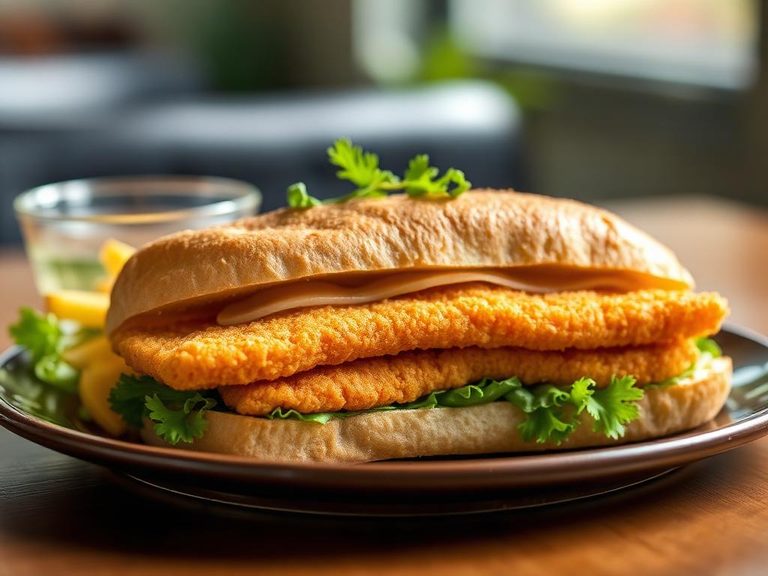
A crispy, golden-fried fish fillet nestled in a soft wheat bun, often topped with melted cheese, tangy tartar sauce, and crisp lettuce. The contrast between the crunchy coating, flaky fish, and creamy cheese creates a satisfying texture. At 247 kcal per 100g, it's a protein-rich option with a moderate fat content from the frying process.
Calorie split: 26% protein · 34% carbs · 40% fat
↓ Full nutrition💚 Why it's loved
People love it for the universal appeal of crispy, savory fish paired with the comforting, mild flavors of a soft bun and melted cheese. It's a beloved staple in fast-food culture and coastal cuisines, offering a quick, flavorful, and satisfying meal.
⚠️ Watch-outs & how to enjoy it better
The frying process increases saturated fat and calorie content, and the refined wheat bun can cause a quicker blood-sugar rise. Those watching sodium intake should be cautious, as cheese and sauces often contribute significantly. To counteract, opt for a grilled version if available, choose a whole-wheat bun for more fiber, and load up on extra lettuce, tomato, or pickles to add volume and nutrients without many calories.
Key benefits
- Good source of high-quality protein (15.88g per 100g)
- Provides dietary fiber (2.1g per 100g) from the wheat bun
- Contains essential nutrients like vitamin B12 and selenium from the fish
- Convenient and portable meal option
- Satiating combination of protein, fat, and carbohydrates
🍽️ Popular dishes


🌍 Where it's eaten
💡 Did you know?
The iconic McDonald's Filet-O-Fish was invented in 1962 by a Cincinnati franchise owner to boost sales on Fridays during Lent, when Catholics abstain from meat.
Full nutrition (USDA data · scales with serving)
| Water | 50.1 g |
| Energy | 247 kcal |
| Protein | 15.9 g |
| Total lipid (fat) | 11.0 g |
| Carbohydrate, by difference | 21.2 g |
| Fiber, total dietary | 2.1 g |
| Total Sugars | 2.3 g |
| Calcium, Ca | 193 mg |
| Iron, Fe | 1.6 mg |
| Magnesium, Mg | 37.0 mg |
| Phosphorus, P | 263 mg |
| Potassium, K | 243 mg |
| Sodium, Na | 468 mg |
| Zinc, Zn | 1.1 mg |
| Copper, Cu | 0.09 mg |
| Selenium, Se | 27.3 ug |
| Vitamin C, total ascorbic acid | 0.00 mg |
| Thiamin | 0.21 mg |
| Riboflavin | 0.18 mg |
| Niacin | 3.8 mg |
| Vitamin B-6 | 0.20 mg |
| Folate, total | 42.0 ug |
| Folic acid | 12.0 ug |
| Folate, food | 30.0 ug |
| Folate, DFE | 51.0 ug |
| Choline, total | 46.1 mg |
| Vitamin B-12 | 1.1 ug |
| Vitamin B-12, added | 0.00 ug |
| Vitamin A, RAE | 45.0 ug |
| Retinol | 44.0 ug |
| Carotene, beta | 11.0 ug |
| Carotene, alpha | 0.00 ug |
| Cryptoxanthin, beta | 1.0 ug |
| Lycopene | 0.00 ug |
| Lutein + zeaxanthin | 29.0 ug |
| Vitamin E (alpha-tocopherol) | 1.0 mg |
| Vitamin E, added | 0.00 mg |
| Vitamin D (D2 + D3) | 0.80 ug |
| Vitamin K (phylloquinone) | 10.6 ug |
| Alcohol, ethyl | 0.00 g |
| Caffeine | 0.00 mg |
| Theobromine | 0.00 mg |
Fat & fatty acid profile (per 100g)
| Fatty acids, total saturated | 4.3 g |
| SFA 4:0 | 0.08 g |
| SFA 6:0 | 0.06 g |
| SFA 8:0 | 0.04 g |
| SFA 10:0 | 0.10 g |
| SFA 12:0 | 0.12 g |
| SFA 14:0 | 0.37 g |
| SFA 16:0 | 1.7 g |
| SFA 18:0 | 1.7 g |
| Fatty acids, total monounsaturated | 2.8 g |
| MUFA 16:1 | 0.08 g |
| MUFA 18:1 | 2.7 g |
| MUFA 20:1 | 0.03 g |
| MUFA 22:1 | 0.00 g |
| Fatty acids, total polyunsaturated | 2.5 g |
| PUFA 18:2 | 2.3 g |
| PUFA 18:3 | 0.16 g |
| PUFA 18:4 | 0.00 g |
| PUFA 20:4 | 0.01 g |
| PUFA 20:5 n-3 (EPA) | 0.02 g |
| PUFA 22:5 n-3 (DPA) | 0.01 g |
| PUFA 22:6 n-3 (DHA) | 0.05 g |
| Cholesterol | 42.0 mg |
Amino acid profile (per 100g)
Estimated from BURGER KING, Premium Fish Sandwich — USDA does not publish this profile for Fish sandwich.
| Tryptophan | 0.08 g |
| Threonine | 0.36 g |
| Isoleucine | 0.39 g |
| Leucine | 0.80 g |
| Lysine | 0.66 g |
| Methionine | 0.23 g |
| Cystine | 0.15 g |
| Phenylalanine | 0.48 g |
| Tyrosine | 0.34 g |
| Valine | 0.46 g |
| Arginine | 0.49 g |
| Histidine | 0.21 g |
| Alanine | 0.38 g |
| Aspartic acid | 0.71 g |
| Glutamic acid | 2.5 g |
| Glycine | 0.41 g |
| Proline | 0.71 g |
| Serine | 0.49 g |
| Hydroxyproline | 0.00 g |
FAQ
Is a fried fish sandwich healthier than a beef burger?
Generally, yes. The fish provides lean protein and healthy omega-3 fatty acids, while a beef patty is typically higher in saturated fat. However, the frying method and added sauces can narrow this nutritional gap.
What kind of fish is typically used?
Common choices include mild, white-fleshed fish like cod, haddock, pollock, or tilapia, which hold up well to frying and have a neutral flavor.
How can I make a lighter version at home?
Use a whole-wheat bun, bake or air-fry the fish instead of deep-frying, and swap creamy sauces for a yogurt-based tartar sauce or a squeeze of lemon.
Nutrient density (calculated · NRF9.3)
Nutrient Rich Foods index: beneficial nutrients (protein, fiber, vitamins, minerals) minus saturated fat, added sugar & sodium, per 100 kcal.
NRF9.3 index — Fulgoni, Keast & Drewnowski, 2009. Computed from USDA nutrients.
Weight-loss friendliness (composite index)
Energy density 2.47 kcal/g · 26% calories from protein · 2.1 g fiber · 2.3 g sugar per 100 g.
Composite of energy density (Rolls et al., 1999), protein & fiber satiety, minus sugar. A calculated heuristic — ranks satiety-per-calorie, not a clinical measure.
Dietary load (calculated from USDA values)
Potential renal acid load. Positive = acid-forming, negative = alkaline-forming.
Sodium-to-potassium ratio: 1.93 (lower is better — aim for ≤ 1)
Sodium:potassium per WHO potassium guidance. Computed from USDA nutrients.