

Falafel
Common food

Photo: Wikipedia
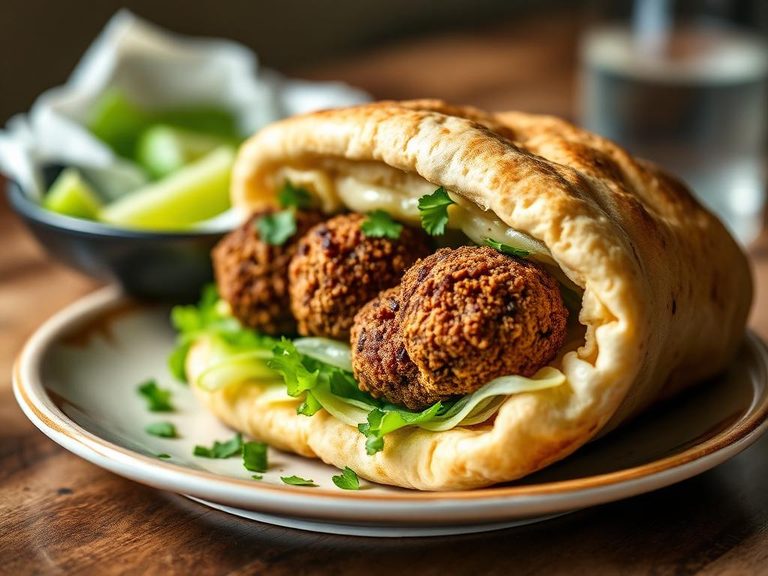
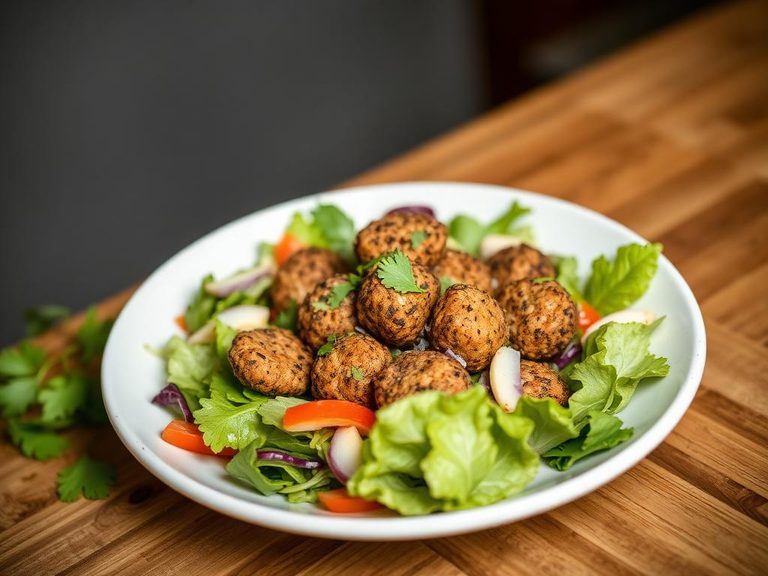
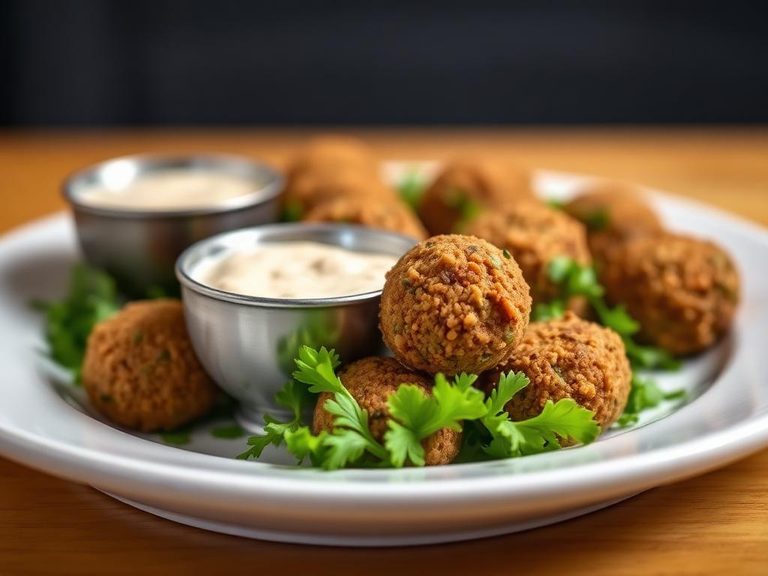
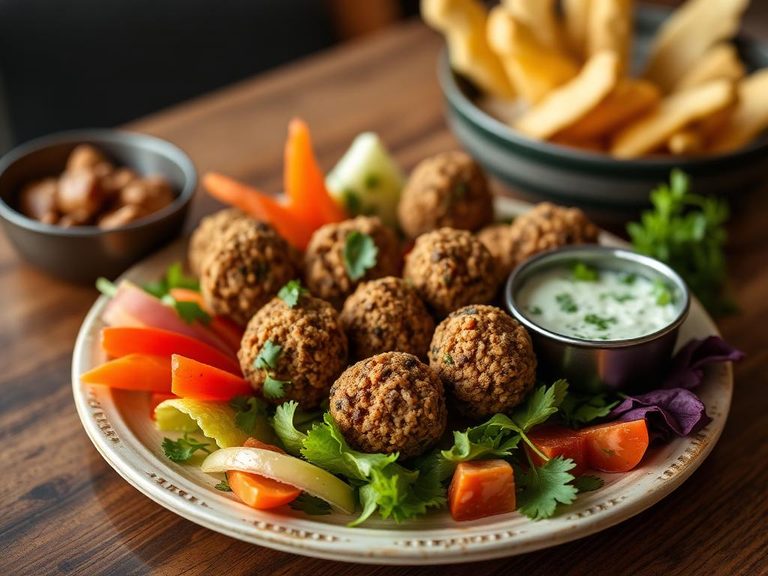
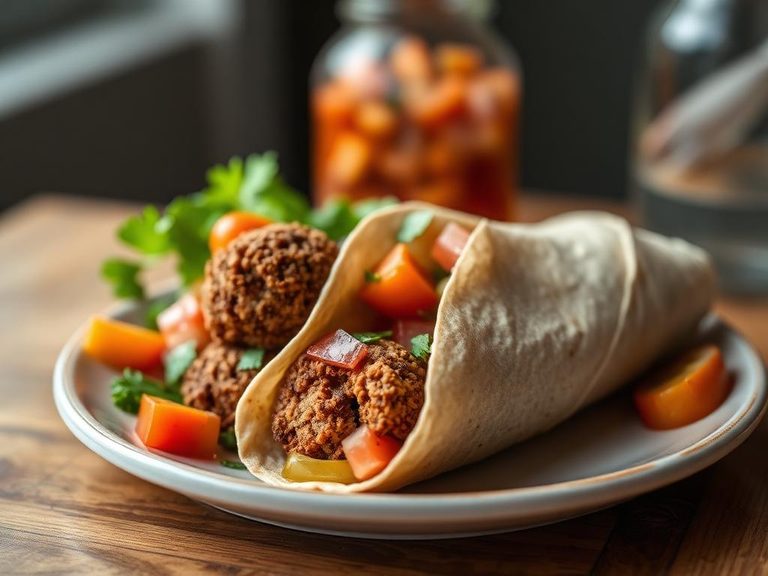
Falafel are deep-fried balls or patties made from ground chickpeas or fava beans, seasoned with herbs and spices like cumin and coriander. They offer a crispy, golden exterior that gives way to a tender, herbaceous interior, providing a satisfying texture contrast. Nutritionally, they are a plant-based protein source but are notably high in fat due to the frying process.
Calorie split: 6% protein · 22% carbs · 71% fat
↓ Full nutrition💚 Why it's loved
People love falafel for its savory, herb-forward flavor and the satisfying crunch of its fried crust, which pairs perfectly with creamy tahini or tangy pickles. It is celebrated as a versatile street food staple that can be enjoyed in pita sandwiches, salads, or as a standalone appetizer across many cultures.
⚠️ Watch-outs & how to enjoy it better
The high fat content from deep-frying can be a concern for those monitoring calorie intake or heart health, and the refined carbohydrates in the accompanying pita bread may cause blood-sugar spikes. To counteract this, opt for baked or air-fried versions, control portion sizes, and pair with fiber-rich salads or a side of protein like hummus to slow digestion.
Key benefits
- Good source of plant-based protein
- Contains dietary fiber for digestive health
- Rich in essential minerals like iron and magnesium
- Naturally cholesterol-free
- Provides complex carbohydrates for sustained energy
🍽️ Popular dishes
🌍 Where it's eaten
💡 Did you know?
Falafel is the national dish of Israel and Egypt, and the world's largest falafel was made in Jordan, weighing over 74 kilograms (163 lbs).
Full nutrition (USDA data · scales with serving)
| Water | 18.7 g |
| Energy | 514 kcal |
| Protein | 8.3 g |
| Total lipid (fat) | 41.2 g |
| Carbohydrate, by difference | 29.0 g |
| Fiber, total dietary | 4.8 g |
| Total Sugars | 4.5 g |
| Calcium, Ca | 86.0 mg |
| Iron, Fe | 2.3 mg |
| Magnesium, Mg | 31.0 mg |
| Phosphorus, P | 112 mg |
| Potassium, K | 259 mg |
| Sodium, Na | 499 mg |
| Zinc, Zn | 1.0 mg |
| Copper, Cu | 0.18 mg |
| Selenium, Se | 1.4 ug |
| Vitamin C, total ascorbic acid | 7.3 mg |
| Thiamin | 0.13 mg |
| Riboflavin | 0.10 mg |
| Niacin | 0.80 mg |
| Vitamin B-6 | 0.16 mg |
| Folate, total | 79.0 ug |
| Folic acid | 5.0 ug |
| Folate, food | 75.0 ug |
| Folate, DFE | 83.0 ug |
| Choline, total | 37.5 mg |
| Vitamin B-12 | 0.00 ug |
| Vitamin B-12, added | 0.00 ug |
| Vitamin A, RAE | 12.0 ug |
| Retinol | 0.00 ug |
| Carotene, beta | 136 ug |
| Carotene, alpha | 0.00 ug |
| Cryptoxanthin, beta | 11.0 ug |
| Lycopene | 0.00 ug |
| Lutein + zeaxanthin | 111 ug |
| Vitamin E (alpha-tocopherol) | 7.7 mg |
| Vitamin E, added | 0.00 mg |
| Vitamin D (D2 + D3) | 0.00 ug |
| Vitamin K (phylloquinone) | 72.2 ug |
| Alcohol, ethyl | 0.00 g |
| Caffeine | 0.00 mg |
| Theobromine | 0.00 mg |
Fat & fatty acid profile (per 100g)
| Fatty acids, total saturated | 5.4 g |
| SFA 4:0 | 0.00 g |
| SFA 6:0 | 0.00 g |
| SFA 8:0 | 0.00 g |
| SFA 10:0 | 0.00 g |
| SFA 12:0 | 0.00 g |
| SFA 14:0 | 0.02 g |
| SFA 16:0 | 3.9 g |
| SFA 18:0 | 1.2 g |
| Fatty acids, total monounsaturated | 17.0 g |
| MUFA 16:1 | 0.14 g |
| MUFA 18:1 | 16.6 g |
| MUFA 20:1 | 0.26 g |
| MUFA 22:1 | 0.00 g |
| Fatty acids, total polyunsaturated | 15.9 g |
| PUFA 18:2 | 14.2 g |
| PUFA 18:3 | 1.7 g |
| PUFA 18:4 | 0.00 g |
| PUFA 20:4 | 0.00 g |
| PUFA 20:5 n-3 (EPA) | 0.00 g |
| PUFA 22:5 n-3 (DPA) | 0.00 g |
| PUFA 22:6 n-3 (DHA) | 0.00 g |
| Cholesterol | 0.00 mg |
Amino acid profile (per 100g)
Estimated from Falafel, home-prepared — USDA does not publish this profile for Falafel.
| Tryptophan | 0.13 g |
| Threonine | 0.49 g |
| Isoleucine | 0.57 g |
| Leucine | 0.94 g |
| Lysine | 0.86 g |
| Methionine | 0.19 g |
| Cystine | 0.18 g |
| Phenylalanine | 0.71 g |
| Tyrosine | 0.34 g |
| Valine | 0.56 g |
| Arginine | 1.3 g |
| Histidine | 0.36 g |
| Alanine | 0.57 g |
| Aspartic acid | 1.5 g |
| Glutamic acid | 2.3 g |
| Glycine | 0.57 g |
| Proline | 0.55 g |
| Serine | 0.67 g |
FAQ
What are falafel made of?
Falafel are traditionally made from ground chickpeas or fava beans, mixed with herbs like parsley and cilantro, and spices such as cumin and coriander, then formed into balls and deep-fried.
Is falafel healthy?
Falafel can be part of a healthy diet as they provide plant-based protein and fiber, but they are often deep-fried, which increases their fat content. Baked versions are a healthier alternative.
Are falafel gluten-free?
Traditional falafel recipes are gluten-free, but some commercial versions may contain wheat flour as a binder. Always check ingredients if you have a gluten sensitivity.
How do you keep falafel from falling apart?
To prevent falafel from falling apart, ensure the chickpea mixture is not too wet, use a binder like flour or breadcrumbs, and chill the mixture before frying to help it hold its shape.
Nutrient density (calculated · NRF9.3)
Nutrient Rich Foods index: beneficial nutrients (protein, fiber, vitamins, minerals) minus saturated fat, added sugar & sodium, per 100 kcal.
NRF9.3 index — Fulgoni, Keast & Drewnowski, 2009. Computed from USDA nutrients.
Weight-loss friendliness (composite index)
Energy density 5.14 kcal/g · 6% calories from protein · 4.8 g fiber · 4.5 g sugar per 100 g.
Composite of energy density (Rolls et al., 1999), protein & fiber satiety, minus sugar. A calculated heuristic — ranks satiety-per-calorie, not a clinical measure.
Dietary load (calculated from USDA values)
Potential renal acid load. Positive = acid-forming, negative = alkaline-forming.
Sodium-to-potassium ratio: 1.93 (lower is better — aim for ≤ 1)
Sodium:potassium per WHO potassium guidance. Computed from USDA nutrients.