

Falafel sandwich
Common food

Photo: Wikipedia
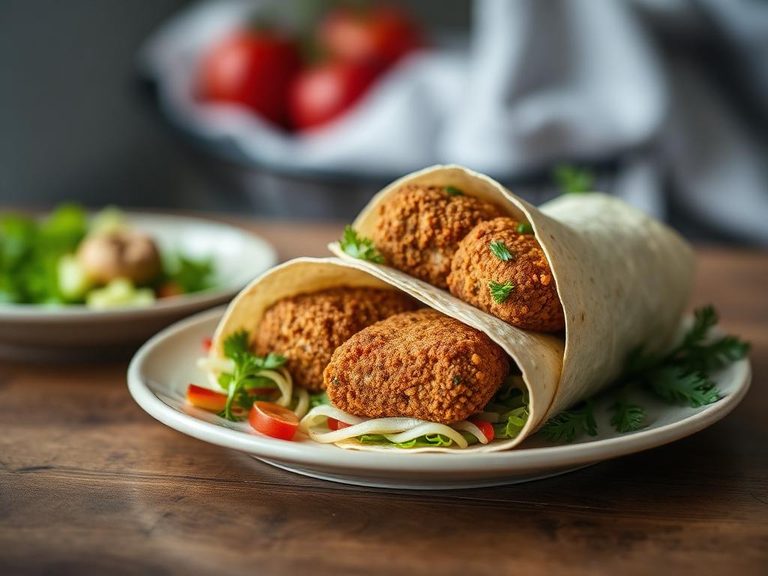
A falafel sandwich is a vibrant handheld meal featuring deep-fried or baked chickpea or fava bean patties tucked into pita bread, often loaded with fresh vegetables and creamy tahini sauce. The exterior is delightfully crisp, giving way to a tender, herb-flecked interior with earthy, garlicky notes. Nutritionally, it provides a solid plant-based protein source with a moderate calorie count, especially when baked.
Calorie split: 9% protein · 41% carbs · 50% fat
↓ Full nutrition💚 Why it's loved
People adore the satisfying contrast of the crispy, spiced falafel against cool, crunchy vegetables and tangy sauces, all held in soft pita. It's a beloved street food staple that offers a flavorful, filling, and customizable meal across many cultures.
⚠️ Watch-outs & how to enjoy it better
Traditional deep-fried falafel is high in fat and calories, and the pita bread can cause blood-sugar spikes, especially for those with insulin resistance. To counteract, opt for baked falafel, choose whole-wheat pita, and load up on non-starchy vegetables like lettuce, tomato, and cucumber to add fiber and slow digestion.
Key benefits
- Good source of plant-based protein
- Provides dietary fiber for digestive health
- Contains iron and folate from legumes
- Can be baked for a lower-fat option
- Naturally cholesterol-free
🍽️ Popular dishes


🌍 Where it's eaten
💡 Did you know?
The earliest known recipe for falafel using chickpeas appears in a 19th-century Egyptian cookbook, though the dish itself is believed to be much older.
Full nutrition (USDA data · scales with serving)
| Water | 50.2 g |
| Energy | 265 kcal |
| Protein | 6.2 g |
| Total lipid (fat) | 14.8 g |
| Carbohydrate, by difference | 27.0 g |
| Fiber, total dietary | 2.5 g |
| Total Sugars | 3.0 g |
| Calcium, Ca | 67.0 mg |
| Iron, Fe | 1.6 mg |
| Magnesium, Mg | 21.0 mg |
| Phosphorus, P | 82.0 mg |
| Potassium, K | 191 mg |
| Sodium, Na | 359 mg |
| Zinc, Zn | 0.67 mg |
| Copper, Cu | 0.12 mg |
| Selenium, Se | 8.9 ug |
| Vitamin C, total ascorbic acid | 5.2 mg |
| Thiamin | 0.23 mg |
| Riboflavin | 0.15 mg |
| Niacin | 1.7 mg |
| Vitamin B-6 | 0.09 mg |
| Folate, total | 61.0 ug |
| Folic acid | 25.0 ug |
| Folate, food | 36.0 ug |
| Folate, DFE | 79.0 ug |
| Choline, total | 19.7 mg |
| Vitamin B-12 | 0.06 ug |
| Vitamin B-12, added | 0.00 ug |
| Vitamin A, RAE | 22.0 ug |
| Retinol | 3.0 ug |
| Carotene, beta | 222 ug |
| Carotene, alpha | 7.0 ug |
| Cryptoxanthin, beta | 7.0 ug |
| Lycopene | 264 ug |
| Lutein + zeaxanthin | 120 ug |
| Vitamin E (alpha-tocopherol) | 2.8 mg |
| Vitamin E, added | 0.00 mg |
| Vitamin D (D2 + D3) | 0.00 ug |
| Vitamin K (phylloquinone) | 29.8 ug |
| Alcohol, ethyl | 0.00 g |
| Caffeine | 0.00 mg |
| Theobromine | 0.00 mg |
Fat & fatty acid profile (per 100g)
| Fatty acids, total saturated | 2.1 g |
| SFA 4:0 | 0.00 g |
| SFA 6:0 | 0.00 g |
| SFA 8:0 | 0.01 g |
| SFA 10:0 | 0.02 g |
| SFA 12:0 | 0.01 g |
| SFA 14:0 | 0.04 g |
| SFA 16:0 | 1.5 g |
| SFA 18:0 | 0.42 g |
| Fatty acids, total monounsaturated | 6.0 g |
| MUFA 16:1 | 0.06 g |
| MUFA 18:1 | 5.9 g |
| MUFA 20:1 | 0.09 g |
| MUFA 22:1 | 0.00 g |
| Fatty acids, total polyunsaturated | 5.5 g |
| PUFA 18:2 | 4.9 g |
| PUFA 18:3 | 0.59 g |
| PUFA 18:4 | 0.00 g |
| PUFA 20:4 | 0.00 g |
| PUFA 20:5 n-3 (EPA) | 0.00 g |
| PUFA 22:5 n-3 (DPA) | 0.00 g |
| PUFA 22:6 n-3 (DHA) | 0.00 g |
| Cholesterol | 1.0 mg |
FAQ
Is falafel sandwich healthy?
It can be a nutritious choice, especially if the falafel is baked and it's loaded with vegetables. It provides plant-based protein and fiber. However, deep-fried versions are higher in fat and calories, and the overall healthiness depends on the sauces and bread used.
Is falafel gluten-free?
The falafel patties themselves are typically gluten-free (made from chickpeas or fava beans, herbs, and spices). However, they are often served in wheat-based pita bread, which contains gluten. Always check if the falafel mixture contains any added flour as a binder.
Can I make falafel ahead of time?
Yes. Uncooked falafel mixture can be refrigerated for a day or two or frozen for months. Cooked falafel can be refrigerated for 3-4 days and reheated in an oven or air fryer to re-crisp. They are excellent for meal prep.
Nutrient density (calculated · NRF9.3)
Nutrient Rich Foods index: beneficial nutrients (protein, fiber, vitamins, minerals) minus saturated fat, added sugar & sodium, per 100 kcal.
NRF9.3 index — Fulgoni, Keast & Drewnowski, 2009. Computed from USDA nutrients.
Weight-loss friendliness (composite index)
Energy density 2.65 kcal/g · 9% calories from protein · 2.5 g fiber · 3.0 g sugar per 100 g.
Composite of energy density (Rolls et al., 1999), protein & fiber satiety, minus sugar. A calculated heuristic — ranks satiety-per-calorie, not a clinical measure.
Dietary load (calculated from USDA values)
Potential renal acid load. Positive = acid-forming, negative = alkaline-forming.
Sodium-to-potassium ratio: 1.88 (lower is better — aim for ≤ 1)
Sodium:potassium per WHO potassium guidance. Computed from USDA nutrients.