

Doughnut, chocolate, with chocolate icing
Common food
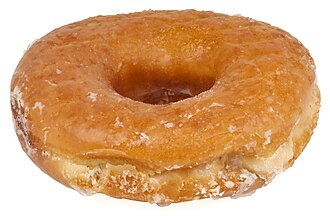
Photo: Wikipedia
A chocolate doughnut is a fried or baked ring of sweet dough, generously coated in a rich, glossy chocolate icing that hardens into a slightly crisp shell. The interior is typically soft, airy, and cakey, creating a delightful contrast with the smooth, sweet topping. Nutritionally, it's a dense source of energy, with over 400 kcal per 100g, primarily from refined carbohydrates and fats.
Calorie split: 5% protein · 47% carbs · 48% fat
↓ Full nutrition💚 Why it's loved
People love chocolate doughnuts for the indulgent, comforting combination of sweet, rich chocolate and soft, fluffy dough. They are a nostalgic, convenient treat often associated with coffee breaks, weekend mornings, and childhood celebrations.
⚠️ Watch-outs & how to enjoy it better
The high sugar and refined carb content can cause rapid blood-sugar spikes and subsequent energy crashes, making it a poor choice for those managing diabetes or insulin resistance. The significant fat and calorie density can contribute to weight gain if consumed frequently. To counteract this, practice strict portion control (e.g., share one doughnut), pair it with a source of protein or healthy fat like Greek yogurt or a handful of nuts to slow sugar absorption, and ensure it's an occasional treat within a balanced diet.
Key benefits
- Quick source of energy from carbohydrates and fats
- Provides a small amount of dietary fiber (3.9g per 100g)
- Contains some protein (5.42g per 100g)
- Offers a quick mood boost and psychological satisfaction
- A versatile treat that can be decorated for celebrations
🍽️ Popular dishes




🌍 Where it's eaten
💡 Did you know?
The hole in the center of a doughnut is widely believed to have been popularized in the mid-19th century to ensure the dough cooked evenly all the way through, preventing a raw, doughy center.
Full nutrition (USDA data · scales with serving)
| Water | 18.9 g |
| Energy | 413 kcal |
| Protein | 5.4 g |
| Total lipid (fat) | 22.7 g |
| Carbohydrate, by difference | 51.0 g |
| Fiber, total dietary | 3.9 g |
| Total Sugars | 25.0 g |
| Calcium, Ca | 39.0 mg |
| Iron, Fe | 3.1 mg |
| Magnesium, Mg | 50.0 mg |
| Phosphorus, P | 255 mg |
| Potassium, K | 239 mg |
| Sodium, Na | 388 mg |
| Zinc, Zn | 0.88 mg |
| Copper, Cu | 0.36 mg |
| Selenium, Se | 8.5 ug |
| Vitamin C, total ascorbic acid | 0.00 mg |
| Thiamin | 0.29 mg |
| Riboflavin | 0.24 mg |
| Niacin | 2.3 mg |
| Vitamin B-6 | 0.05 mg |
| Folate, total | 70.0 ug |
| Folic acid | 56.0 ug |
| Folate, food | 14.0 ug |
| Folate, DFE | 109 ug |
| Choline, total | 29.5 mg |
| Vitamin B-12 | 0.04 ug |
| Vitamin B-12, added | 0.00 ug |
| Vitamin A, RAE | 3.0 ug |
| Retinol | 2.0 ug |
| Carotene, beta | 1.0 ug |
| Carotene, alpha | 0.00 ug |
| Cryptoxanthin, beta | 0.00 ug |
| Lycopene | 0.00 ug |
| Lutein + zeaxanthin | 16.0 ug |
| Vitamin E (alpha-tocopherol) | 1.8 mg |
| Vitamin E, added | 0.00 mg |
| Vitamin D (D2 + D3) | 0.00 ug |
| Vitamin K (phylloquinone) | 7.4 ug |
| Alcohol, ethyl | 0.00 g |
| Caffeine | 16.0 mg |
| Theobromine | 153 mg |
Fat & fatty acid profile (per 100g)
| Fatty acids, total saturated | 9.8 g |
| SFA 4:0 | 0.00 g |
| SFA 6:0 | 0.00 g |
| SFA 8:0 | 0.01 g |
| SFA 10:0 | 0.02 g |
| SFA 12:0 | 0.09 g |
| SFA 14:0 | 0.20 g |
| SFA 16:0 | 7.7 g |
| SFA 18:0 | 1.7 g |
| Fatty acids, total monounsaturated | 8.4 g |
| MUFA 16:1 | 0.03 g |
| MUFA 18:1 | 8.3 g |
| MUFA 20:1 | 0.04 g |
| MUFA 22:1 | 0.00 g |
| Fatty acids, total polyunsaturated | 3.3 g |
| PUFA 18:2 | 3.1 g |
| PUFA 18:3 | 0.21 g |
| PUFA 18:4 | 0.00 g |
| PUFA 20:4 | 0.01 g |
| PUFA 20:5 n-3 (EPA) | 0.00 g |
| PUFA 22:5 n-3 (DPA) | 0.00 g |
| PUFA 22:6 n-3 (DHA) | 0.00 g |
| Cholesterol | 7.0 mg |
Amino acid profile (per 100g)
Estimated from Doughnuts, yeast-leavened, with creme filling — USDA does not publish this profile for Doughnut.
| Tryptophan | 0.08 g |
| Threonine | 0.21 g |
| Isoleucine | 0.27 g |
| Leucine | 0.48 g |
| Lysine | 0.24 g |
| Methionine | 0.12 g |
| Cystine | 0.13 g |
| Phenylalanine | 0.31 g |
| Tyrosine | 0.20 g |
| Valine | 0.30 g |
| Arginine | 0.27 g |
| Histidine | 0.15 g |
| Alanine | 0.24 g |
| Aspartic acid | 0.38 g |
| Glutamic acid | 1.9 g |
| Glycine | 0.22 g |
| Proline | 0.63 g |
| Serine | 0.33 g |
FAQ
Is a chocolate doughnut baked or fried?
It can be either. Traditional yeast doughnuts are deep-fried, giving them a lighter, airier texture. Cake doughnuts, which are denser, can be fried or baked. The icing is typically applied after cooking.
How does the nutrition differ between a cake and a yeast chocolate doughnut?
Generally, a fried yeast doughnut (like a classic glazed ring) may be slightly lower in calories and fat than a denser, fried cake doughnut of the same size. However, both are high in sugar and refined carbs. Baked versions typically have less fat than fried ones.
Can I make a healthier version at home?
Yes. You can bake instead of fry, use whole wheat or oat flour to increase fiber, reduce the sugar in the dough and icing, and use high-quality dark chocolate (70%+ cocoa) for the glaze to add antioxidants and reduce sweetness.
Nutrient density (calculated · NRF9.3)
Nutrient Rich Foods index: beneficial nutrients (protein, fiber, vitamins, minerals) minus saturated fat, added sugar & sodium, per 100 kcal.
NRF9.3 index — Fulgoni, Keast & Drewnowski, 2009. Computed from USDA nutrients.
Weight-loss friendliness (composite index)
Energy density 4.13 kcal/g · 5% calories from protein · 3.9 g fiber · 25.0 g sugar per 100 g.
Composite of energy density (Rolls et al., 1999), protein & fiber satiety, minus sugar. A calculated heuristic — ranks satiety-per-calorie, not a clinical measure.
Dietary load (calculated from USDA values)
Potential renal acid load. Positive = acid-forming, negative = alkaline-forming.
Sodium-to-potassium ratio: 1.62 (lower is better — aim for ≤ 1)
Sodium:potassium per WHO potassium guidance. Computed from USDA nutrients.