

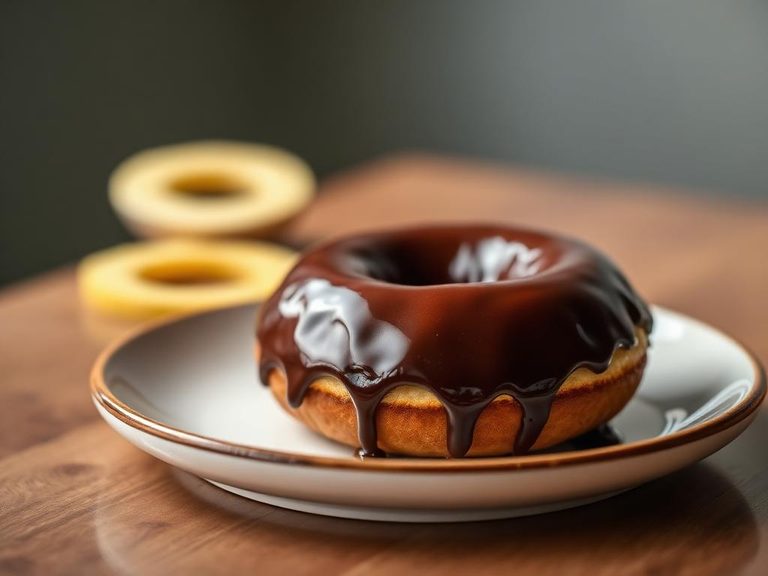
Doughnut, yeast type, with chocolate icing
Common food
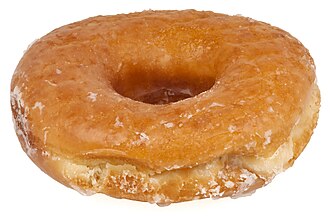
Photo: Wikipedia
A light, airy yeast doughnut, fried to a golden crisp and generously coated in a smooth, sweet chocolate icing. The interior is soft and pillowy, offering a satisfying contrast to the slightly firm, sugary exterior. Nutritionally, it's a high-energy treat, delivering nearly 420 calories and 50g of carbohydrates per 100g, primarily from refined flour and sugar.
Calorie split: 5% protein · 49% carbs · 47% fat
↓ Full nutrition💚 Why it's loved
People adore the classic combination of a tender, yeasty dough and rich chocolate glaze, which delivers an immediate hit of sweetness and comfort. It's a versatile treat enjoyed at breakfast, as a snack, or a dessert, deeply embedded in coffee-break and weekend traditions worldwide.
⚠️ Watch-outs & how to enjoy it better
The high sugar and refined carbohydrate content can lead to rapid blood sugar spikes and subsequent energy crashes, making it a poor choice for those managing diabetes or insulin resistance. To mitigate this, pair it with a source of protein or healthy fat (like a handful of nuts or Greek yogurt) to slow sugar absorption, and practice strict portion control by sharing or choosing a mini version.
Key benefits
- Quick source of energy from carbohydrates
- Provides a small amount of protein from wheat flour and eggs
- Contains some dietary fiber, though minimal
- Often enjoyed as a social or celebratory food
- Widely available and affordable comfort food
🍽️ Popular dishes




🌍 Where it's eaten
💡 Did you know?
The chocolate icing on a classic Boston Cream Doughnut is traditionally a pourable fondant, not a hard shell, which was invented at the Boston Cream Pie hotel in the 1850s.
Full nutrition (USDA data · scales with serving)
| Water | 21.0 g |
| Energy | 416 kcal |
| Protein | 5.1 g |
| Total lipid (fat) | 21.7 g |
| Carbohydrate, by difference | 51.0 g |
| Fiber, total dietary | 1.9 g |
| Total Sugars | 29.7 g |
| Calcium, Ca | 82.0 mg |
| Iron, Fe | 2.2 mg |
| Magnesium, Mg | 18.0 mg |
| Phosphorus, P | 109 mg |
| Potassium, K | 121 mg |
| Sodium, Na | 289 mg |
| Zinc, Zn | 0.55 mg |
| Copper, Cu | 0.11 mg |
| Selenium, Se | 12.7 ug |
| Vitamin C, total ascorbic acid | 1.0 mg |
| Thiamin | 0.25 mg |
| Riboflavin | 0.15 mg |
| Niacin | 2.1 mg |
| Vitamin B-6 | 0.03 mg |
| Folate, total | 87.0 ug |
| Folic acid | 54.0 ug |
| Folate, food | 32.0 ug |
| Folate, DFE | 124 ug |
| Choline, total | 24.7 mg |
| Vitamin B-12 | 0.09 ug |
| Vitamin B-12, added | 0.00 ug |
| Vitamin A, RAE | 4.0 ug |
| Retinol | 4.0 ug |
| Carotene, beta | 2.0 ug |
| Carotene, alpha | 1.0 ug |
| Cryptoxanthin, beta | 1.0 ug |
| Lycopene | 0.00 ug |
| Lutein + zeaxanthin | 29.0 ug |
| Vitamin E (alpha-tocopherol) | 1.5 mg |
| Vitamin E, added | 0.00 mg |
| Vitamin D (D2 + D3) | 0.10 ug |
| Vitamin K (phylloquinone) | 9.2 ug |
| Alcohol, ethyl | 0.00 g |
| Caffeine | 0.00 mg |
| Theobromine | 16.0 mg |
Fat & fatty acid profile (per 100g)
| Fatty acids, total saturated | 8.7 g |
| SFA 4:0 | 0.00 g |
| SFA 6:0 | 0.00 g |
| SFA 8:0 | 0.01 g |
| SFA 10:0 | 0.01 g |
| SFA 12:0 | 0.09 g |
| SFA 14:0 | 0.18 g |
| SFA 16:0 | 6.4 g |
| SFA 18:0 | 1.9 g |
| Fatty acids, total monounsaturated | 7.6 g |
| MUFA 16:1 | 0.04 g |
| MUFA 18:1 | 7.5 g |
| MUFA 20:1 | 0.04 g |
| MUFA 22:1 | 0.00 g |
| Fatty acids, total polyunsaturated | 3.3 g |
| PUFA 18:2 | 3.1 g |
| PUFA 18:3 | 0.19 g |
| PUFA 18:4 | 0.00 g |
| PUFA 20:4 | 0.00 g |
| PUFA 20:5 n-3 (EPA) | 0.00 g |
| PUFA 22:5 n-3 (DPA) | 0.00 g |
| PUFA 22:6 n-3 (DHA) | 0.01 g |
| Cholesterol | 24.0 mg |
Amino acid profile (per 100g)
Estimated from Doughnuts, yeast-leavened, with creme filling — USDA does not publish this profile for Doughnut.
| Tryptophan | 0.08 g |
| Threonine | 0.21 g |
| Isoleucine | 0.27 g |
| Leucine | 0.48 g |
| Lysine | 0.24 g |
| Methionine | 0.12 g |
| Cystine | 0.13 g |
| Phenylalanine | 0.31 g |
| Tyrosine | 0.20 g |
| Valine | 0.30 g |
| Arginine | 0.27 g |
| Histidine | 0.15 g |
| Alanine | 0.24 g |
| Aspartic acid | 0.38 g |
| Glutamic acid | 1.9 g |
| Glycine | 0.22 g |
| Proline | 0.63 g |
| Serine | 0.33 g |
FAQ
What's the difference between a yeast doughnut and a cake doughnut?
A yeast doughnut uses yeast as a leavening agent, resulting in a light, airy, and chewy texture. A cake doughnut uses chemical leaveners like baking powder, creating a denser, more crumbly, cake-like texture.
Is the chocolate icing made with real chocolate?
It varies. Commercial glazes often use a combination of sugar, fat (like palm oil), cocoa powder, and emulsifiers for a smooth, shelf-stable coating. Artisanal or homemade versions may use higher-quality chocolate or cocoa.
How does frying affect the nutrition?
Frying adds significant fat and calories compared to baking. The dough absorbs oil during cooking, which is why the fat content (21.68g per 100g) is substantial. Baking is a lower-fat alternative.
Nutrient density (calculated · NRF9.3)
Nutrient Rich Foods index: beneficial nutrients (protein, fiber, vitamins, minerals) minus saturated fat, added sugar & sodium, per 100 kcal.
NRF9.3 index — Fulgoni, Keast & Drewnowski, 2009. Computed from USDA nutrients.
Weight-loss friendliness (composite index)
Energy density 4.16 kcal/g · 5% calories from protein · 1.9 g fiber · 29.7 g sugar per 100 g.
Composite of energy density (Rolls et al., 1999), protein & fiber satiety, minus sugar. A calculated heuristic — ranks satiety-per-calorie, not a clinical measure.
Dietary load (calculated from USDA values)
Potential renal acid load. Positive = acid-forming, negative = alkaline-forming.
Sodium-to-potassium ratio: 2.39 (lower is better — aim for ≤ 1)
Sodium:potassium per WHO potassium guidance. Computed from USDA nutrients.