

Doughnut, cake type, powdered sugar
Common food
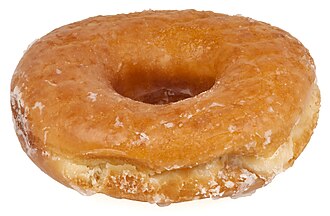
Photo: Wikipedia
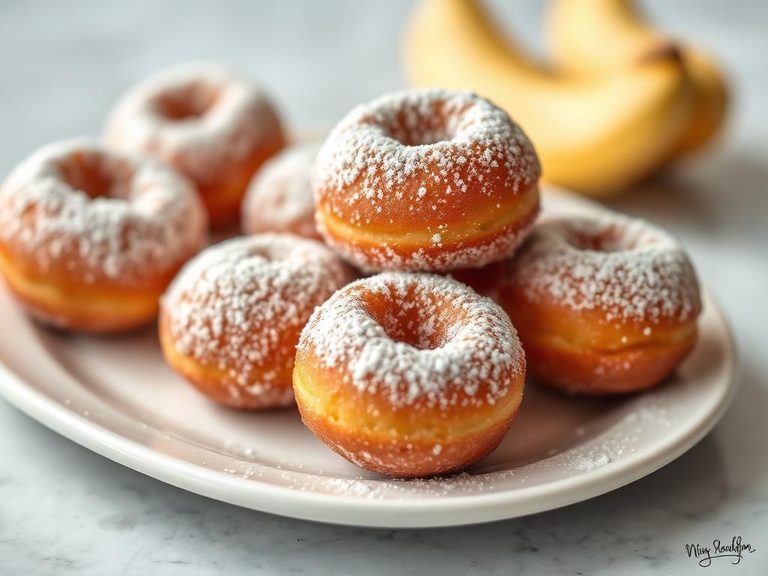
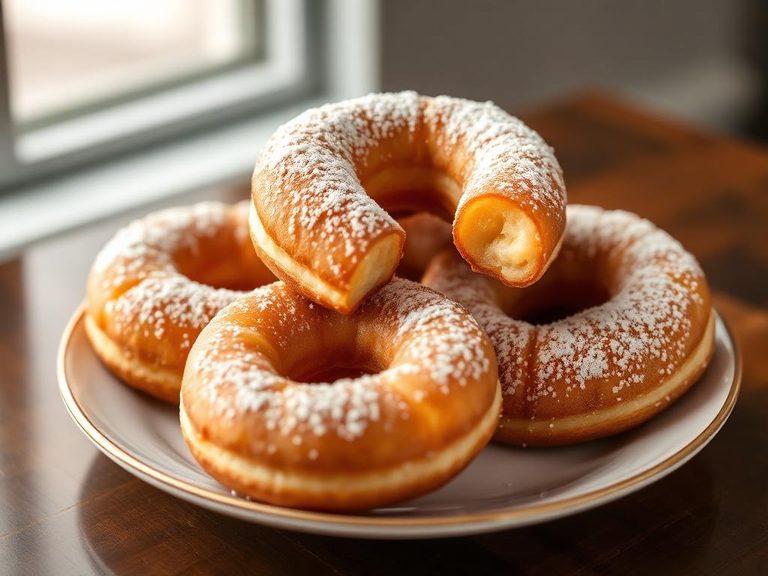
A cake-style doughnut, distinct from its yeast-raised cousin, is a dense, tender, and crumbly fried cake. Its signature feature is a generous coating of fine powdered sugar that creates a sweet, snowy exterior and a delightful, slightly messy eating experience. Nutritionally, it's an energy-dense treat, delivering a substantial 431 calories and 23 grams of fat per 100 grams.
Calorie split: 5% protein · 47% carbs · 48% fat
↓ Full nutrition💚 Why it's loved
People adore the classic contrast between the soft, cakey interior and the sweet, powdery exterior that dissolves on the tongue. It's a nostalgic comfort food often associated with coffee breaks, fairs, and childhood treats.
⚠️ Watch-outs & how to enjoy it better
The high sugar and refined carbohydrate content can lead to rapid blood sugar spikes and subsequent crashes. To mitigate this, pair it with a source of protein or healthy fat (like a handful of nuts or Greek yogurt) to slow digestion, and practice strict portion control by enjoying half or a mini version. Those with gluten sensitivities should also note it typically contains wheat.
Key benefits
- Quick source of energy from carbohydrates
- Contains small amounts of iron and B vitamins from enriched flour
- Provides dietary pleasure and cultural comfort food value
- The cake structure offers a satisfying, dense crumb texture
🍽️ Popular dishes


🌍 Where it's eaten
💡 Did you know?
The term 'doughnut' may have originated from the practice of adding nutmeg to the dough and shaping it to resemble a nut, or from the 'dough knot' that evolved into the ring shape we know today.
Full nutrition (USDA data · scales with serving)
| Water | 19.2 g |
| Energy | 431 kcal |
| Protein | 4.9 g |
| Total lipid (fat) | 23.0 g |
| Carbohydrate, by difference | 51.1 g |
| Fiber, total dietary | 1.6 g |
| Total Sugars | 24.3 g |
| Calcium, Ca | 37.0 mg |
| Iron, Fe | 2.3 mg |
| Magnesium, Mg | 16.0 mg |
| Phosphorus, P | 240 mg |
| Potassium, K | 124 mg |
| Sodium, Na | 440 mg |
| Zinc, Zn | 0.46 mg |
| Copper, Cu | 0.08 mg |
| Selenium, Se | 9.4 ug |
| Vitamin C, total ascorbic acid | 0.00 mg |
| Thiamin | 0.36 mg |
| Riboflavin | 0.28 mg |
| Niacin | 2.7 mg |
| Vitamin B-6 | 0.05 mg |
| Folate, total | 85.0 ug |
| Folic acid | 70.0 ug |
| Folate, food | 15.0 ug |
| Folate, DFE | 134 ug |
| Choline, total | 34.4 mg |
| Vitamin B-12 | 0.06 ug |
| Vitamin B-12, added | 0.00 ug |
| Vitamin A, RAE | 4.0 ug |
| Retinol | 3.0 ug |
| Carotene, beta | 1.0 ug |
| Carotene, alpha | 0.00 ug |
| Cryptoxanthin, beta | 0.00 ug |
| Lycopene | 0.00 ug |
| Lutein + zeaxanthin | 18.0 ug |
| Vitamin E (alpha-tocopherol) | 1.8 mg |
| Vitamin E, added | 0.00 mg |
| Vitamin D (D2 + D3) | 0.00 ug |
| Vitamin K (phylloquinone) | 9.0 ug |
| Alcohol, ethyl | 0.00 g |
| Caffeine | 0.00 mg |
| Theobromine | 0.00 mg |
Fat & fatty acid profile (per 100g)
| Fatty acids, total saturated | 10.3 g |
| SFA 4:0 | 0.00 g |
| SFA 6:0 | 0.00 g |
| SFA 8:0 | 0.01 g |
| SFA 10:0 | 0.02 g |
| SFA 12:0 | 0.11 g |
| SFA 14:0 | 0.23 g |
| SFA 16:0 | 8.7 g |
| SFA 18:0 | 1.0 g |
| Fatty acids, total monounsaturated | 7.9 g |
| MUFA 16:1 | 0.04 g |
| MUFA 18:1 | 7.8 g |
| MUFA 20:1 | 0.04 g |
| MUFA 22:1 | 0.00 g |
| Fatty acids, total polyunsaturated | 3.6 g |
| PUFA 18:2 | 3.4 g |
| PUFA 18:3 | 0.24 g |
| PUFA 18:4 | 0.00 g |
| PUFA 20:4 | 0.01 g |
| PUFA 20:5 n-3 (EPA) | 0.00 g |
| PUFA 22:5 n-3 (DPA) | 0.00 g |
| PUFA 22:6 n-3 (DHA) | 0.00 g |
| Cholesterol | 9.0 mg |
Amino acid profile (per 100g)
Estimated from Doughnuts, yeast-leavened, with creme filling — USDA does not publish this profile for Doughnut.
| Tryptophan | 0.08 g |
| Threonine | 0.21 g |
| Isoleucine | 0.27 g |
| Leucine | 0.48 g |
| Lysine | 0.24 g |
| Methionine | 0.12 g |
| Cystine | 0.13 g |
| Phenylalanine | 0.31 g |
| Tyrosine | 0.20 g |
| Valine | 0.30 g |
| Arginine | 0.27 g |
| Histidine | 0.15 g |
| Alanine | 0.24 g |
| Aspartic acid | 0.38 g |
| Glutamic acid | 1.9 g |
| Glycine | 0.22 g |
| Proline | 0.63 g |
| Serine | 0.33 g |
FAQ
What's the difference between a cake doughnut and a yeast doughnut?
A cake doughnut uses chemical leaveners (like baking powder) for a dense, crumbly texture, while a yeast doughnut uses biological leavening for a light, airy, and chewy texture.
Why is powdered sugar used instead of granulated?
Powdered (confectioners') sugar has a fine, melt-in-your-mouth texture that adheres easily to the doughnut's surface and provides a distinct, non-crunchy sweetness.
Can I make these at home without a deep fryer?
Yes, you can use a heavy-bottomed pot with a few inches of oil and a thermometer. Alternatively, some recipes offer baked versions, though the texture will be less authentic.
Nutrient density (calculated · NRF9.3)
Nutrient Rich Foods index: beneficial nutrients (protein, fiber, vitamins, minerals) minus saturated fat, added sugar & sodium, per 100 kcal.
NRF9.3 index — Fulgoni, Keast & Drewnowski, 2009. Computed from USDA nutrients.
Weight-loss friendliness (composite index)
Energy density 4.31 kcal/g · 5% calories from protein · 1.6 g fiber · 24.3 g sugar per 100 g.
Composite of energy density (Rolls et al., 1999), protein & fiber satiety, minus sugar. A calculated heuristic — ranks satiety-per-calorie, not a clinical measure.
Dietary load (calculated from USDA values)
Potential renal acid load. Positive = acid-forming, negative = alkaline-forming.
Sodium-to-potassium ratio: 3.55 (lower is better — aim for ≤ 1)
Sodium:potassium per WHO potassium guidance. Computed from USDA nutrients.