

Danish pastry, with fruit
Common food

Photo: Wikipedia
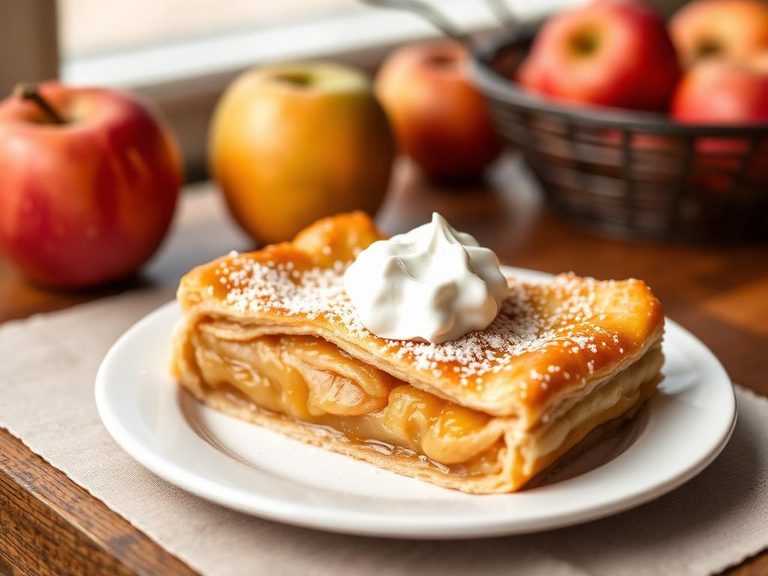
A Danish pastry with fruit is a flaky, buttery, laminated dough creation, often filled with a sweet fruit preserve or topped with fresh fruit and a light glaze. The texture is a delightful contrast of crisp, caramelized layers and a soft, tender interior. Nutritionally, it is a high-energy treat, primarily from carbohydrates and fats, with a notable sugar content from both the dough and the fruit component.
Calorie split: 6% protein · 50% carbs · 44% fat
↓ Full nutrition💚 Why it's loved
People adore it for the masterful balance of textures—the shatteringly crisp layers giving way to a soft, buttery interior—and the sweet-tart burst of fruit that cuts through the richness. It's a beloved centerpiece of the Danish 'hygge' coffee break culture, representing a moment of indulgent comfort.
⚠️ Watch-outs & how to enjoy it better
Its high sugar and refined carbohydrate content can lead to rapid blood-sugar spikes and subsequent crashes, making it a poor choice for those managing diabetes or seeking sustained energy. The high fat and calorie density also mean portion control is key. To counteract this, pair a small slice with a source of protein (like Greek yogurt or nuts) or healthy fat to slow sugar absorption, and enjoy it as an occasional treat rather than a daily staple.
Key benefits
- Provides a quick source of energy from carbohydrates.
- Contains some dietary fiber, especially with fruit fillings.
- Offers a small amount of protein from the wheat flour and egg in the dough.
- Can be a source of quick enjoyment and psychological comfort.
🍽️ Popular dishes





🌍 Where it's eaten
💡 Did you know?
Despite its name, the 'Danish' pastry technique of laminating dough with butter was actually perfected by Austrian bakers who brought it to Denmark in the 19th century, where it was then refined and popularized.
Full nutrition (USDA data · scales with serving)
| Water | 27.1 g |
| Energy | 371 kcal |
| Protein | 5.4 g |
| Total lipid (fat) | 18.5 g |
| Carbohydrate, by difference | 47.8 g |
| Fiber, total dietary | 1.9 g |
| Total Sugars | 27.5 g |
| Calcium, Ca | 46.0 mg |
| Iron, Fe | 1.8 mg |
| Magnesium, Mg | 15.0 mg |
| Phosphorus, P | 89.0 mg |
| Potassium, K | 83.0 mg |
| Sodium, Na | 445 mg |
| Zinc, Zn | 0.54 mg |
| Copper, Cu | 0.07 mg |
| Selenium, Se | 14.8 ug |
| Vitamin C, total ascorbic acid | 3.9 mg |
| Thiamin | 0.26 mg |
| Riboflavin | 0.22 mg |
| Niacin | 2.0 mg |
| Vitamin B-6 | 0.04 mg |
| Folate, total | 47.0 ug |
| Folic acid | 31.0 ug |
| Folate, food | 16.0 ug |
| Folate, DFE | 68.0 ug |
| Choline, total | 21.8 mg |
| Vitamin B-12 | 0.09 ug |
| Vitamin B-12, added | 0.00 ug |
| Vitamin A, RAE | 15.0 ug |
| Retinol | 15.0 ug |
| Carotene, beta | 1.0 ug |
| Carotene, alpha | 0.00 ug |
| Cryptoxanthin, beta | 1.0 ug |
| Lycopene | 0.00 ug |
| Lutein + zeaxanthin | 49.0 ug |
| Vitamin E (alpha-tocopherol) | 0.34 mg |
| Vitamin E, added | 0.00 mg |
| Vitamin D (D2 + D3) | 0.00 ug |
| Vitamin K (phylloquinone) | 5.3 ug |
| Alcohol, ethyl | 0.00 g |
| Caffeine | 0.00 mg |
| Theobromine | 0.00 mg |
Fat & fatty acid profile (per 100g)
| Fatty acids, total saturated | 4.9 g |
| SFA 4:0 | 0.00 g |
| SFA 6:0 | 0.00 g |
| SFA 8:0 | 0.00 g |
| SFA 10:0 | 0.00 g |
| SFA 12:0 | 0.00 g |
| SFA 14:0 | 0.09 g |
| SFA 16:0 | 2.7 g |
| SFA 18:0 | 2.1 g |
| Fatty acids, total monounsaturated | 10.0 g |
| MUFA 16:1 | 0.07 g |
| MUFA 18:1 | 9.9 g |
| MUFA 20:1 | 0.01 g |
| MUFA 22:1 | 0.00 g |
| Fatty acids, total polyunsaturated | 2.4 g |
| PUFA 18:2 | 2.2 g |
| PUFA 18:3 | 0.11 g |
| PUFA 18:4 | 0.00 g |
| PUFA 20:4 | 0.04 g |
| PUFA 20:5 n-3 (EPA) | 0.02 g |
| PUFA 22:5 n-3 (DPA) | 0.00 g |
| PUFA 22:6 n-3 (DHA) | 0.01 g |
| Cholesterol | 114 mg |
Amino acid profile (per 100g)
Estimated from Danish pastry, cinnamon, enriched — USDA does not publish this profile for Danish pastry.
| Tryptophan | 0.08 g |
| Threonine | 0.24 g |
| Isoleucine | 0.31 g |
| Leucine | 0.53 g |
| Lysine | 0.30 g |
| Methionine | 0.14 g |
| Cystine | 0.14 g |
| Phenylalanine | 0.35 g |
| Tyrosine | 0.23 g |
| Valine | 0.34 g |
| Arginine | 0.31 g |
| Histidine | 0.16 g |
| Alanine | 0.27 g |
| Aspartic acid | 0.46 g |
| Glutamic acid | 1.9 g |
| Glycine | 0.24 g |
| Proline | 0.64 g |
| Serine | 0.38 g |
FAQ
Is a fruit Danish pastry a healthy breakfast?
While delicious, it is not considered a nutritionally balanced breakfast due to its high sugar, fat, and refined carbohydrate content. It lacks sufficient protein and fiber for sustained energy. It's better enjoyed occasionally as a treat, perhaps paired with protein-rich foods like eggs or yogurt to create a more balanced meal.
What's the difference between a Danish pastry and a croissant?
Both use laminated dough, but Danish pastry dough typically contains eggs, sugar, and milk, making it richer, sweeter, and more cake-like. Croissant dough is leaner, relying primarily on flour, water, yeast, salt, and butter, resulting in a more open, honeycomb structure and a less sweet, more bread-like flavor.
Can I freeze Danish pastries?
Yes, they freeze very well. Wrap them tightly in plastic wrap and foil, or place in a freezer bag. They can be stored for up to 3 months. Reheat from frozen in a 300°F (150°C) oven for 10-15 minutes to restore crispness, avoiding the microwave which makes them soggy.
Nutrient density (calculated · NRF9.3)
Nutrient Rich Foods index: beneficial nutrients (protein, fiber, vitamins, minerals) minus saturated fat, added sugar & sodium, per 100 kcal.
NRF9.3 index — Fulgoni, Keast & Drewnowski, 2009. Computed from USDA nutrients.
Weight-loss friendliness (composite index)
Energy density 3.71 kcal/g · 6% calories from protein · 1.9 g fiber · 27.5 g sugar per 100 g.
Composite of energy density (Rolls et al., 1999), protein & fiber satiety, minus sugar. A calculated heuristic — ranks satiety-per-calorie, not a clinical measure.
Dietary load (calculated from USDA values)
Potential renal acid load. Positive = acid-forming, negative = alkaline-forming.
Sodium-to-potassium ratio: 5.36 (lower is better — aim for ≤ 1)
Sodium:potassium per WHO potassium guidance. Computed from USDA nutrients.