

Danish pastry, fruit, unenriched (includes apple, cinnamon, raisin, strawberry)
Whole food · Baked Products

Photo: Wikipedia
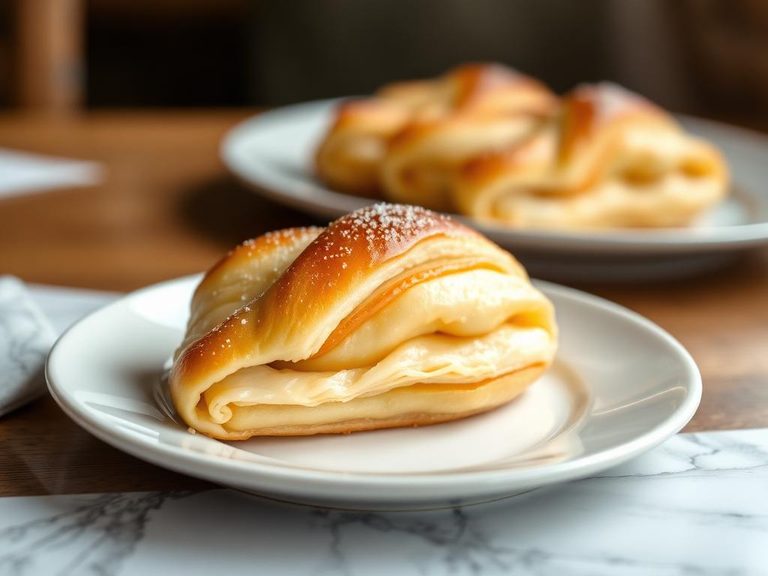
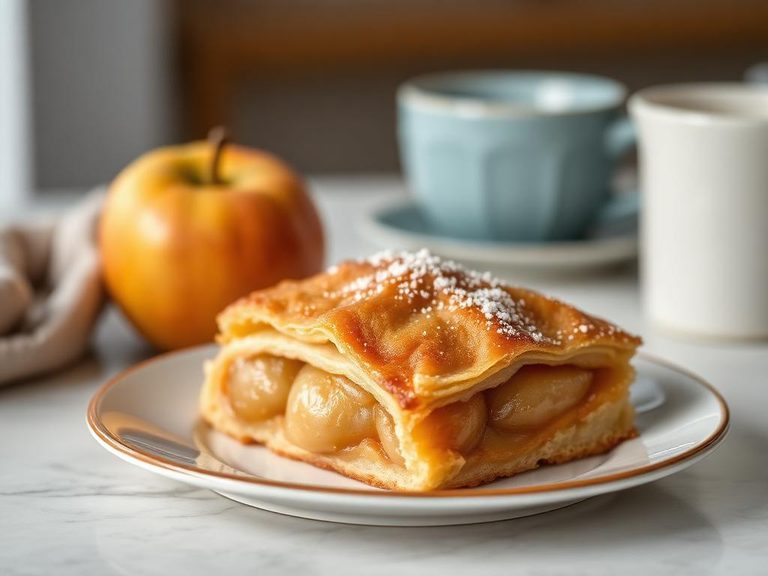
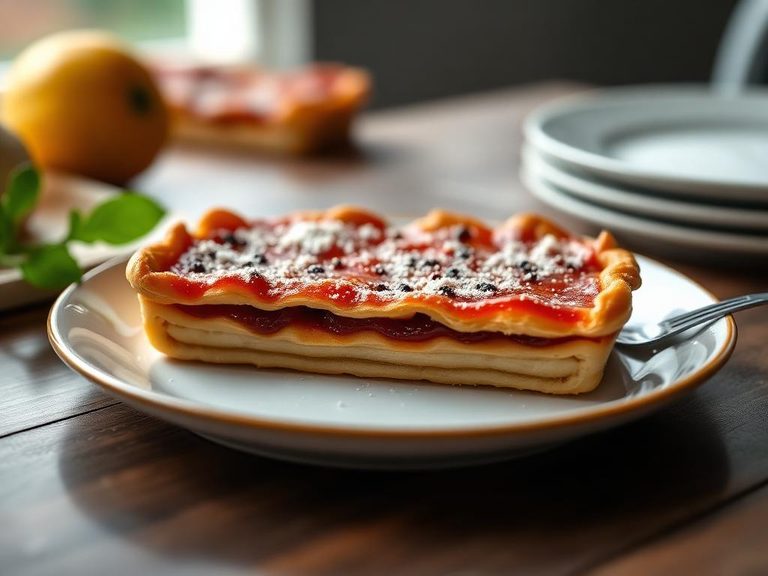
A fruit Danish pastry is a flaky, buttery, laminated dough creation, often folded into a square or rectangle, with a central well of fruit filling like apple, cinnamon, raisin, or strawberry. Its texture is a delightful contrast between the shattering, crisp layers of the pastry and the soft, sweet, sometimes jammy fruit center. While indulgent at 371 kcal per 100g, it provides a quick energy boost from its carbohydrate-rich dough.
Calorie split: 6% protein · 50% carbs · 44% fat
↓ Full nutrition💚 Why it's loved
People love it for the perfect marriage of rich, buttery, flaky pastry and the bright, sweet-tart burst of fruit filling. It's a beloved breakfast or coffee break staple, representing a moment of everyday luxury across many cultures.
⚠️ Watch-outs & how to enjoy it better
Its high calorie, fat, and refined carbohydrate content can lead to blood sugar spikes and is not ideal for regular consumption by those managing diabetes or weight. To counteract this, pair it with a source of protein (like Greek yogurt or eggs) or healthy fat (like nuts) to slow digestion, and practice strict portion control by enjoying a smaller piece alongside a balanced meal.
Key benefits
- Quick source of energy from carbohydrates
- Contains small amounts of protein and dietary fiber
- Provides a comforting, mood-boosting treat
- Versatile base for various fruit fillings
- A staple of café and bakery culture
🍽️ Popular dishes


🌍 Where it's eaten
💡 Did you know?
Despite its name, the iconic laminated dough technique for 'Danish' pastry was actually introduced to Denmark by Austrian bakers in the 19th century.
Full nutrition (USDA data · scales with serving)
| Water | 27.1 g |
| Energy | 371 kcal |
| Energy | 1552 kj |
| Protein | 5.4 g |
| Total lipid (fat) | 18.5 g |
| Ash | 1.2 g |
| Carbohydrate, by difference | 47.8 g |
| Fiber, total dietary | 1.9 g |
| Calcium, Ca | 46.0 mg |
| Iron, Fe | 0.75 mg |
| Magnesium, Mg | 15.0 mg |
| Phosphorus, P | 89.0 mg |
| Potassium, K | 83.0 mg |
| Sodium, Na | 354 mg |
| Zinc, Zn | 0.54 mg |
| Copper, Cu | 0.07 mg |
| Manganese, Mn | 0.25 mg |
| Vitamin C, total ascorbic acid | 3.9 mg |
| Thiamin | 0.07 mg |
| Riboflavin | 0.09 mg |
| Niacin | 0.77 mg |
| Pantothenic acid | 0.63 mg |
| Vitamin B-6 | 0.04 mg |
| Folate, total | 16.0 ug |
| Folic acid | 0.00 ug |
| Folate, food | 16.0 ug |
| Folate, DFE | 16.0 ug |
| Vitamin B-12 | 0.13 ug |
| Vitamin A, RAE | 22.0 ug |
| Retinol | 22.0 ug |
| Vitamin A, IU | 74.0 iu |
Fat & fatty acid profile (per 100g)
| Fatty acids, total saturated | 2.8 g |
| SFA 4:0 | 0.00 g |
| SFA 6:0 | 0.00 g |
| SFA 8:0 | 0.00 g |
| SFA 10:0 | 0.00 g |
| SFA 12:0 | 0.00 g |
| SFA 14:0 | 0.05 g |
| SFA 16:0 | 1.5 g |
| SFA 18:0 | 1.2 g |
| Fatty acids, total monounsaturated | 5.9 g |
| MUFA 16:1 | 0.03 g |
| MUFA 18:1 | 5.9 g |
| MUFA 20:1 | 0.00 g |
| MUFA 22:1 | 0.00 g |
| Fatty acids, total polyunsaturated | 1.5 g |
| PUFA 18:2 | 1.4 g |
| PUFA 18:3 | 0.07 g |
| PUFA 20:4 | 0.01 g |
| PUFA 20:5 n-3 (EPA) | 0.00 g |
| PUFA 22:6 n-3 (DHA) | 0.00 g |
| Cholesterol | 40.0 mg |
Amino acid profile (per 100g)
| Tryptophan | 0.06 g |
| Threonine | 0.17 g |
| Isoleucine | 0.22 g |
| Leucine | 0.40 g |
| Lysine | 0.18 g |
| Methionine | 0.11 g |
| Cystine | 0.12 g |
| Phenylalanine | 0.27 g |
| Tyrosine | 0.17 g |
| Valine | 0.25 g |
| Arginine | 0.21 g |
| Histidine | 0.12 g |
| Alanine | 0.19 g |
| Aspartic acid | 0.30 g |
| Glutamic acid | 1.6 g |
| Glycine | 0.18 g |
| Proline | 0.54 g |
| Serine | 0.28 g |
FAQ
What's the difference between a Danish and a croissant?
Both use laminated (layered) dough, but Danish dough typically includes eggs and sugar in the recipe, making it richer, sweeter, and more cake-like than the leaner, crescent-shaped croissant.
Why is it called 'unenriched' in some databases?
'Unenriched' refers to the flour used in the dough, meaning it hasn't had certain vitamins and minerals (like iron, B vitamins) added back after processing, unlike 'enriched' flour.
Can I freeze fruit Danish pastries?
Yes, they freeze well. Wrap them tightly in plastic wrap and foil, or place in a freezer bag. Reheat from frozen in a 300°F (150°C) oven for 10-15 minutes to restore crispness.
Nutrient density (calculated · NRF9.3)
Nutrient Rich Foods index: beneficial nutrients (protein, fiber, vitamins, minerals) minus saturated fat, added sugar & sodium, per 100 kcal.
NRF9.3 index — Fulgoni, Keast & Drewnowski, 2009. Computed from USDA nutrients.
Weight-loss friendliness (composite index)
Energy density 3.71 kcal/g · 6% calories from protein · 1.9 g fiber · 0.0 g sugar per 100 g.
Composite of energy density (Rolls et al., 1999), protein & fiber satiety, minus sugar. A calculated heuristic — ranks satiety-per-calorie, not a clinical measure.
Dietary load (calculated from USDA values)
Potential renal acid load. Positive = acid-forming, negative = alkaline-forming.
Sodium-to-potassium ratio: 4.27 (lower is better — aim for ≤ 1)
Sodium:potassium per WHO potassium guidance. Computed from USDA nutrients.