

Croissant
Common food
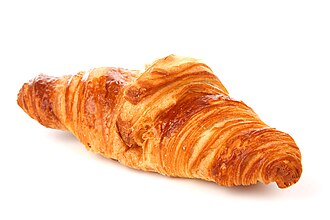
Photo: Wikipedia
A golden, crescent-shaped pastry of laminated dough, the croissant offers a shatteringly crisp crust that gives way to a tender, honeycomb interior of buttery, airy layers. Its high fat content, primarily from butter, delivers a rich, savory flavor and a satisfyingly flaky texture that melts in the mouth. Nutritionally, it is an energy-dense food, providing a quick source of calories and carbohydrates, but with minimal protein and fiber.
Calorie split: 8% protein · 45% carbs · 47% fat
↓ Full nutrition💚 Why it's loved
People love the croissant for its unparalleled textural contrast—the audible crunch of the crust followed by the soft, buttery interior. It is deeply embedded in café culture, symbolizing a moment of indulgence, whether for a classic breakfast or a sophisticated sandwich base.
⚠️ Watch-outs & how to enjoy it better
The high fat and refined carbohydrate content can lead to blood sugar spikes and is calorie-dense, which may be a concern for those managing weight or blood sugar. The primary allergens are gluten (wheat) and dairy (butter). To counteract, pair a smaller portion with protein (like eggs or ham) and fiber (like fruit or a side salad) to slow digestion and enhance satiety.
Key benefits
- Quick source of energy from carbohydrates and fats
- Provides small amounts of B vitamins and iron from enriched flour
- Butter contributes fat-soluble vitamins like Vitamin A
- Cultural staple offering comfort and ritual in many diets
- Versatile base for both sweet and savory preparations
🍽️ Popular dishes
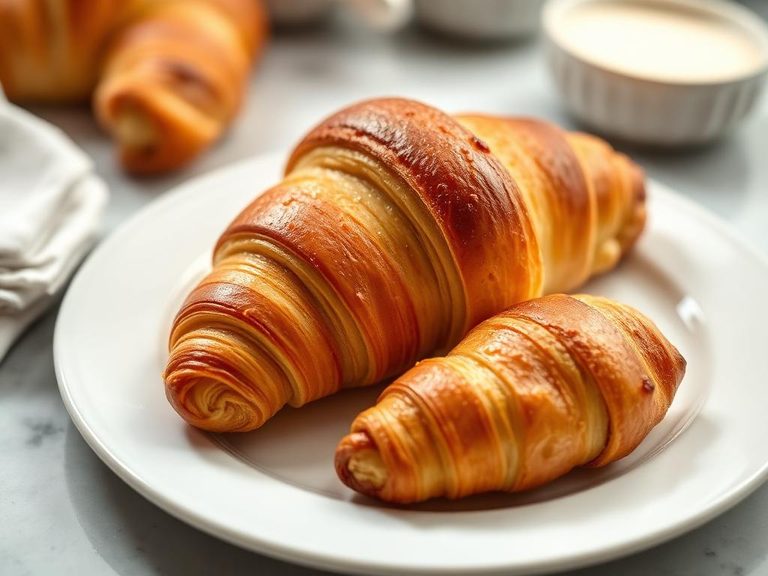


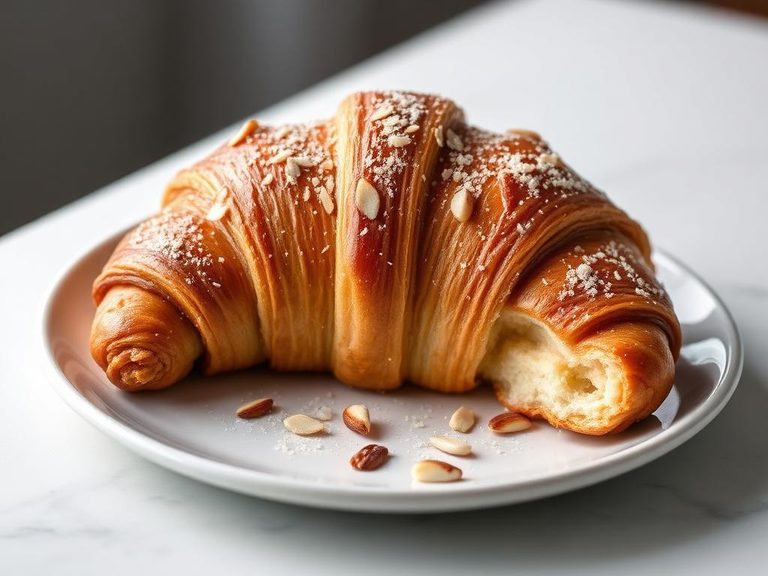

🌍 Where it's eaten
💡 Did you know?
The croissant's iconic layered structure is achieved through a process called 'lamination,' where butter is folded into dough repeatedly to create hundreds of alternating layers of dough and fat that steam and separate during baking.
Full nutrition (USDA data · scales with serving)
| Water | 23.2 g |
| Energy | 406 kcal |
| Protein | 8.2 g |
| Total lipid (fat) | 21.0 g |
| Carbohydrate, by difference | 45.8 g |
| Fiber, total dietary | 2.6 g |
| Total Sugars | 11.3 g |
| Calcium, Ca | 37.0 mg |
| Iron, Fe | 2.0 mg |
| Magnesium, Mg | 16.0 mg |
| Phosphorus, P | 105 mg |
| Potassium, K | 118 mg |
| Sodium, Na | 300 mg |
| Zinc, Zn | 0.75 mg |
| Copper, Cu | 0.08 mg |
| Selenium, Se | 22.7 ug |
| Vitamin C, total ascorbic acid | 0.20 mg |
| Thiamin | 0.39 mg |
| Riboflavin | 0.24 mg |
| Niacin | 2.2 mg |
| Vitamin B-6 | 0.06 mg |
| Folate, total | 88.0 ug |
| Folic acid | 60.0 ug |
| Folate, food | 28.0 ug |
| Folate, DFE | 130 ug |
| Choline, total | 38.8 mg |
| Vitamin B-12 | 0.16 ug |
| Vitamin B-12, added | 0.00 ug |
| Vitamin A, RAE | 206 ug |
| Retinol | 202 ug |
| Carotene, beta | 38.0 ug |
| Carotene, alpha | 0.00 ug |
| Cryptoxanthin, beta | 1.0 ug |
| Lycopene | 0.00 ug |
| Lutein + zeaxanthin | 74.0 ug |
| Vitamin E (alpha-tocopherol) | 0.84 mg |
| Vitamin E, added | 0.00 mg |
| Vitamin D (D2 + D3) | 0.00 ug |
| Vitamin K (phylloquinone) | 1.8 ug |
| Alcohol, ethyl | 0.00 g |
| Caffeine | 0.00 mg |
| Theobromine | 0.00 mg |
Fat & fatty acid profile (per 100g)
| Fatty acids, total saturated | 11.7 g |
| SFA 4:0 | 0.59 g |
| SFA 6:0 | 0.35 g |
| SFA 8:0 | 0.20 g |
| SFA 10:0 | 0.46 g |
| SFA 12:0 | 0.51 g |
| SFA 14:0 | 1.8 g |
| SFA 16:0 | 5.0 g |
| SFA 18:0 | 2.3 g |
| Fatty acids, total monounsaturated | 5.5 g |
| MUFA 16:1 | 0.43 g |
| MUFA 18:1 | 4.8 g |
| MUFA 20:1 | 0.00 g |
| MUFA 22:1 | 0.00 g |
| Fatty acids, total polyunsaturated | 1.1 g |
| PUFA 18:2 | 0.80 g |
| PUFA 18:3 | 0.29 g |
| PUFA 18:4 | 0.00 g |
| PUFA 20:4 | 0.01 g |
| PUFA 20:5 n-3 (EPA) | 0.00 g |
| PUFA 22:5 n-3 (DPA) | 0.00 g |
| PUFA 22:6 n-3 (DHA) | 0.00 g |
| Cholesterol | 67.0 mg |
Amino acid profile (per 100g)
Estimated from Croissants, cheese — USDA does not publish this profile for Croissant.
| Tryptophan | 0.11 g |
| Threonine | 0.30 g |
| Isoleucine | 0.41 g |
| Leucine | 0.69 g |
| Lysine | 0.37 g |
| Methionine | 0.19 g |
| Cystine | 0.18 g |
| Phenylalanine | 0.46 g |
| Tyrosine | 0.30 g |
| Valine | 0.45 g |
| Arginine | 0.36 g |
| Histidine | 0.21 g |
| Alanine | 0.34 g |
| Aspartic acid | 0.53 g |
| Glutamic acid | 2.6 g |
| Glycine | 0.30 g |
| Proline | 0.89 g |
| Serine | 0.48 g |
FAQ
What is the difference between a croissant and a crescent roll?
A true croissant is made with a laminated, yeast-leavened dough, creating distinct flaky layers. A crescent roll is typically made from a softer, non-laminated dough, resulting in a more bread-like, uniform texture.
Why is my croissant not flaky?
Common reasons include the butter melting into the dough before baking (due to a warm environment), insufficient lamination folds, or not allowing the dough to proof properly, which prevents the layers from separating.
Can I freeze croissants?
Yes, they freeze very well. For best results, freeze them uncooked after shaping and before the final proof. You can also freeze fully baked croissants and reheat them in a 300°F (150°C) oven for 5-10 minutes to restore crispness.
Nutrient density (calculated · NRF9.3)
Nutrient Rich Foods index: beneficial nutrients (protein, fiber, vitamins, minerals) minus saturated fat, added sugar & sodium, per 100 kcal.
NRF9.3 index — Fulgoni, Keast & Drewnowski, 2009. Computed from USDA nutrients.
Weight-loss friendliness (composite index)
Energy density 4.06 kcal/g · 8% calories from protein · 2.6 g fiber · 11.3 g sugar per 100 g.
Composite of energy density (Rolls et al., 1999), protein & fiber satiety, minus sugar. A calculated heuristic — ranks satiety-per-calorie, not a clinical measure.
Dietary load (calculated from USDA values)
Potential renal acid load. Positive = acid-forming, negative = alkaline-forming.
Sodium-to-potassium ratio: 2.54 (lower is better — aim for ≤ 1)
Sodium:potassium per WHO potassium guidance. Computed from USDA nutrients.