

Cranberry juice blend, 100% juice, with calcium added
Common food

Photo: Wikipedia
This is a tart, ruby-red beverage made from a blend of cranberry juices, not from concentrate, and fortified with calcium. It has a smooth, slightly viscous texture and a signature sweet-tart flavor profile that's more complex than pure cranberry juice. The added calcium makes it a functional drink, contributing to daily mineral intake alongside its natural fruit sugars.
Calorie split: 2% protein · 95% carbs · 2% fat
↓ Full nutrition💚 Why it's loved
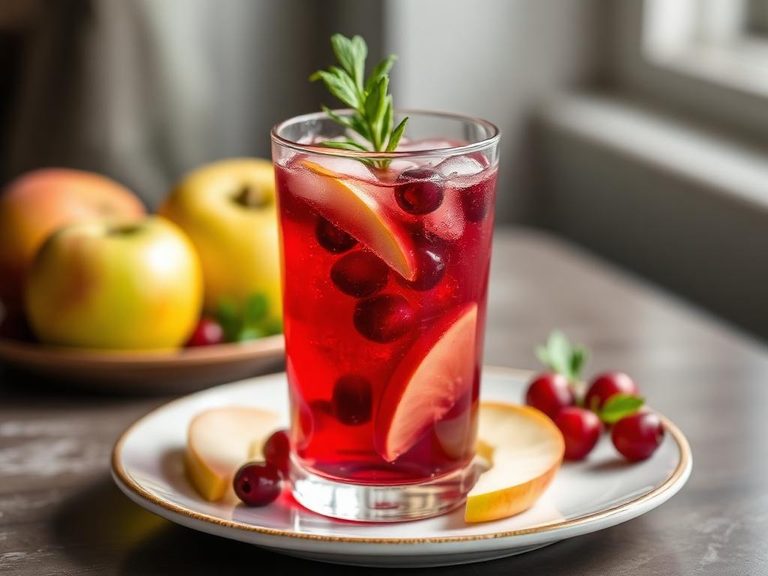
People love its distinctive, sharp-sweet taste that cuts through richness and quenches thirst. It's a versatile base for both non-alcoholic spritzers and festive cocktails like a Cape Codder.
⚠️ Watch-outs & how to enjoy it better
The high sugar content (9.8g per 100g) can cause blood sugar spikes, and the natural acidity may aggravate acid reflux or bladder irritation in sensitive individuals. To counteract this, enjoy a small portion (4-6 oz) alongside a meal with protein and fat, or dilute it with sparkling water to reduce sugar concentration per serving.
Key benefits
- Provides calcium for bone and tooth health
- Contains natural fruit sugars for quick energy
- Offers the tart, refreshing flavor of cranberries
- A convenient, ready-to-drink source of hydration
🍽️ Popular dishes

🌍 Where it's eaten
💡 Did you know?
Cranberries are one of only three native North American fruits commercially grown, and they bounce when fully ripe due to tiny air pockets inside.
Full nutrition (USDA data · scales with serving)
| Water | 88.6 g |
| Energy | 45.0 kcal |
| Protein | 0.27 g |
| Total lipid (fat) | 0.12 g |
| Carbohydrate, by difference | 10.9 g |
| Fiber, total dietary | 0.10 g |
| Total Sugars | 9.8 g |
| Calcium, Ca | 19.0 mg |
| Iron, Fe | 0.08 mg |
| Magnesium, Mg | 5.0 mg |
| Phosphorus, P | 8.0 mg |
| Potassium, K | 76.0 mg |
| Sodium, Na | 6.0 mg |
| Zinc, Zn | 0.05 mg |
| Copper, Cu | 0.02 mg |
| Selenium, Se | 0.10 ug |
| Vitamin C, total ascorbic acid | 31.5 mg |
| Thiamin | 0.01 mg |
| Riboflavin | 0.01 mg |
| Niacin | 0.09 mg |
| Vitamin B-6 | 0.02 mg |
| Folate, total | 18.0 ug |
| Folic acid | 0.00 ug |
| Folate, food | 18.0 ug |
| Folate, DFE | 18.0 ug |
| Choline, total | 1.8 mg |
| Vitamin B-12 | 0.00 ug |
| Vitamin B-12, added | 0.00 ug |
| Vitamin A, RAE | 1.0 ug |
| Retinol | 0.00 ug |
| Carotene, beta | 15.0 ug |
| Carotene, alpha | 0.00 ug |
| Cryptoxanthin, beta | 0.00 ug |
| Lycopene | 0.00 ug |
| Lutein + zeaxanthin | 68.0 ug |
| Vitamin E (alpha-tocopherol) | 0.01 mg |
| Vitamin E, added | 0.00 mg |
| Vitamin D (D2 + D3) | 0.00 ug |
| Vitamin K (phylloquinone) | 0.00 ug |
| Alcohol, ethyl | 0.00 g |
| Caffeine | 0.00 mg |
| Theobromine | 0.00 mg |
Fat & fatty acid profile (per 100g)
| Fatty acids, total saturated | 0.00 g |
| SFA 4:0 | 0.00 g |
| SFA 6:0 | 0.00 g |
| SFA 8:0 | 0.00 g |
| SFA 10:0 | 0.00 g |
| SFA 12:0 | 0.00 g |
| SFA 14:0 | 0.00 g |
| SFA 16:0 | 0.00 g |
| SFA 18:0 | 0.00 g |
| Fatty acids, total monounsaturated | 0.00 g |
| MUFA 16:1 | 0.00 g |
| MUFA 18:1 | 0.00 g |
| MUFA 20:1 | 0.00 g |
| MUFA 22:1 | 0.00 g |
| Fatty acids, total polyunsaturated | 0.00 g |
| PUFA 18:2 | 0.00 g |
| PUFA 18:3 | 0.00 g |
| PUFA 18:4 | 0.00 g |
| PUFA 20:4 | 0.00 g |
| PUFA 20:5 n-3 (EPA) | 0.00 g |
| PUFA 22:5 n-3 (DPA) | 0.00 g |
| PUFA 22:6 n-3 (DHA) | 0.00 g |
| Cholesterol | 0.00 mg |
Amino acid profile (per 100g)
Estimated from Cranberry juice cocktail, bottled, low calorie, with calcium, saccharin and corn sweetener — USDA does not publish this profile for Cranberry juice blend.
| Tryptophan | 0.00 g |
| Threonine | 0.00 g |
| Isoleucine | 0.00 g |
| Leucine | 0.00 g |
| Lysine | 0.00 g |
| Methionine | 0.00 g |
| Cystine | 0.00 g |
| Phenylalanine | 0.00 g |
| Tyrosine | 0.00 g |
| Valine | 0.00 g |
| Arginine | 0.00 g |
| Histidine | 0.00 g |
| Alanine | 0.00 g |
| Aspartic acid | 0.00 g |
| Glutamic acid | 0.00 g |
| Glycine | 0.00 g |
| Proline | 0.00 g |
| Serine | 0.00 g |
FAQ
Is this the same as cranberry cocktail?
No. A '100% juice' blend contains only fruit juice, while a 'cocktail' typically has added water and sugar, resulting in less actual fruit content.
Why is calcium added to juice?
Calcium is added to fortify the beverage, making it a source of this essential mineral, which is particularly useful for those who don't consume dairy.
Does the calcium affect the taste?
In well-formulated blends, the calcium (often as calcium citrate) is added at a level that provides nutritional benefit without noticeably altering the juice's characteristic tart flavor.
Nutrient density (calculated · NRF9.3)
Nutrient Rich Foods index: beneficial nutrients (protein, fiber, vitamins, minerals) minus saturated fat, added sugar & sodium, per 100 kcal.
NRF9.3 index — Fulgoni, Keast & Drewnowski, 2009. Computed from USDA nutrients.
Weight-loss friendliness (composite index)
Energy density 0.45 kcal/g · 2% calories from protein · 0.1 g fiber · 9.8 g sugar per 100 g.
Composite of energy density (Rolls et al., 1999), protein & fiber satiety, minus sugar. A calculated heuristic — ranks satiety-per-calorie, not a clinical measure.
Dietary load (calculated from USDA values)
Potential renal acid load. Positive = acid-forming, negative = alkaline-forming.
Sodium-to-potassium ratio: 0.08 (lower is better — aim for ≤ 1)
Sodium:potassium per WHO potassium guidance. Computed from USDA nutrients.