

Corn oil
Common food
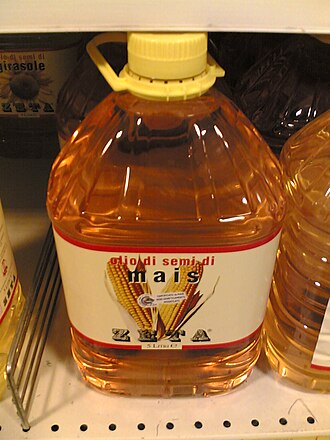
Photo: Wikipedia
Corn oil is a pale golden, neutral-tasting vegetable oil pressed from the germ of corn kernels. It has a very light, clean mouthfeel and a high smoke point, making it ideal for high-heat cooking. Nutritionally, it is 100% fat, providing a concentrated source of energy and vitamin E.
Calorie split: 0% protein · 0% carbs · 100% fat
↓ Full nutrition💚 Why it's loved
People love corn oil for its incredibly versatile, neutral flavor that lets the taste of the food shine through. It's a kitchen workhorse, perfect for everything from stir-fries and deep-frying to baking and salad dressings.
⚠️ Watch-outs & how to enjoy it better
As a pure fat, it is very calorie-dense, so portion control is key for those monitoring energy intake. It is also high in omega-6 fatty acids; balancing it with omega-3 rich foods (like fatty fish or flaxseeds) is a good practice. Tip: Use it as part of a varied fat intake, not as your sole cooking oil.
Key benefits
- Rich in polyunsaturated fats, including omega-6 fatty acids.
- High smoke point (around 230°C/450°F), suitable for frying and sautéing.
- Good source of vitamin E, an antioxidant that helps protect cells.
- Neutral flavor profile that doesn't overpower other ingredients.
- Contains phytosterols, which can help support healthy cholesterol levels.
🍽️ Popular dishes





🌍 Where it's eaten
💡 Did you know?
In the U.S., corn oil is the most widely used vegetable oil in the food service industry, largely due to its performance in commercial deep fryers.
Full nutrition (USDA data · scales with serving)
| Water | 0.00 g |
| Energy | 900 kcal |
| Protein | 0.00 g |
| Total lipid (fat) | 100 g |
| Carbohydrate, by difference | 0.00 g |
| Fiber, total dietary | 0.00 g |
| Total Sugars | 0.00 g |
| Calcium, Ca | 0.00 mg |
| Iron, Fe | 0.00 mg |
| Magnesium, Mg | 0.00 mg |
| Phosphorus, P | 0.00 mg |
| Potassium, K | 0.00 mg |
| Sodium, Na | 0.00 mg |
| Zinc, Zn | 0.00 mg |
| Copper, Cu | 0.00 mg |
| Selenium, Se | 0.00 ug |
| Vitamin C, total ascorbic acid | 0.00 mg |
| Thiamin | 0.00 mg |
| Riboflavin | 0.00 mg |
| Niacin | 0.00 mg |
| Vitamin B-6 | 0.00 mg |
| Folate, total | 0.00 ug |
| Folic acid | 0.00 ug |
| Folate, food | 0.00 ug |
| Folate, DFE | 0.00 ug |
| Choline, total | 0.20 mg |
| Vitamin B-12 | 0.00 ug |
| Vitamin B-12, added | 0.00 ug |
| Vitamin A, RAE | 0.00 ug |
| Retinol | 0.00 ug |
| Carotene, beta | 0.00 ug |
| Carotene, alpha | 0.00 ug |
| Cryptoxanthin, beta | 0.00 ug |
| Lycopene | 0.00 ug |
| Lutein + zeaxanthin | 0.00 ug |
| Vitamin E (alpha-tocopherol) | 22.6 mg |
| Vitamin E, added | 0.00 mg |
| Vitamin D (D2 + D3) | 0.00 ug |
| Vitamin K (phylloquinone) | 1.9 ug |
| Alcohol, ethyl | 0.00 g |
| Caffeine | 0.00 mg |
| Theobromine | 0.00 mg |
Fat & fatty acid profile (per 100g)
| Fatty acids, total saturated | 13.4 g |
| SFA 4:0 | 0.00 g |
| SFA 6:0 | 0.00 g |
| SFA 8:0 | 0.00 g |
| SFA 10:0 | 0.00 g |
| SFA 12:0 | 0.00 g |
| SFA 14:0 | 0.03 g |
| SFA 16:0 | 11.1 g |
| SFA 18:0 | 1.6 g |
| Fatty acids, total monounsaturated | 27.7 g |
| MUFA 16:1 | 0.09 g |
| MUFA 18:1 | 27.2 g |
| MUFA 20:1 | 0.36 g |
| MUFA 22:1 | 0.00 g |
| Fatty acids, total polyunsaturated | 52.9 g |
| PUFA 18:2 | 51.9 g |
| PUFA 18:3 | 1.0 g |
| PUFA 18:4 | 0.00 g |
| PUFA 20:4 | 0.00 g |
| PUFA 20:5 n-3 (EPA) | 0.00 g |
| PUFA 22:5 n-3 (DPA) | 0.00 g |
| PUFA 22:6 n-3 (DHA) | 0.00 g |
| Cholesterol | 0.00 mg |
Amino acid profile (per 100g)
Estimated from Oil, corn, industrial and retail, all purpose salad or cooking — USDA does not publish this profile for Corn oil.
| Tryptophan | 0.00 g |
| Threonine | 0.00 g |
| Isoleucine | 0.00 g |
| Leucine | 0.00 g |
| Lysine | 0.00 g |
| Methionine | 0.00 g |
| Cystine | 0.00 g |
| Phenylalanine | 0.00 g |
| Tyrosine | 0.00 g |
| Valine | 0.00 g |
| Arginine | 0.00 g |
| Histidine | 0.00 g |
| Alanine | 0.00 g |
| Aspartic acid | 0.00 g |
| Glutamic acid | 0.00 g |
| Glycine | 0.00 g |
| Proline | 0.00 g |
| Serine | 0.00 g |
FAQ
Is corn oil the same as corn syrup?
No. Corn oil is a fat pressed from the corn germ. Corn syrup is a liquid sweetener made from corn starch, primarily composed of sugars like glucose.
Can you use corn oil for baking?
Yes, absolutely. Its neutral flavor makes it a good substitute for vegetable oil or canola oil in cakes, muffins, and quick breads, providing moisture and a tender crumb.
What does 'high smoke point' mean for cooking?
It means the oil can be heated to a high temperature before it starts to break down and smoke. This makes corn oil stable for frying and searing without burning easily or imparting off-flavors.
Nutrient density (calculated · NRF9.3)
Nutrient Rich Foods index: beneficial nutrients (protein, fiber, vitamins, minerals) minus saturated fat, added sugar & sodium, per 100 kcal.
NRF9.3 index — Fulgoni, Keast & Drewnowski, 2009. Computed from USDA nutrients.
Weight-loss friendliness (composite index)
Energy density 9.00 kcal/g · 0% calories from protein · 0.0 g fiber · 0.0 g sugar per 100 g.
Composite of energy density (Rolls et al., 1999), protein & fiber satiety, minus sugar. A calculated heuristic — ranks satiety-per-calorie, not a clinical measure.
Dietary load (calculated from USDA values)
Potential renal acid load. Positive = acid-forming, negative = alkaline-forming.
Sodium:potassium per WHO potassium guidance. Computed from USDA nutrients.