

Cookies, chocolate cream covered biscuit sticks
Whole food · Baked Products

Photo: Wikipedia
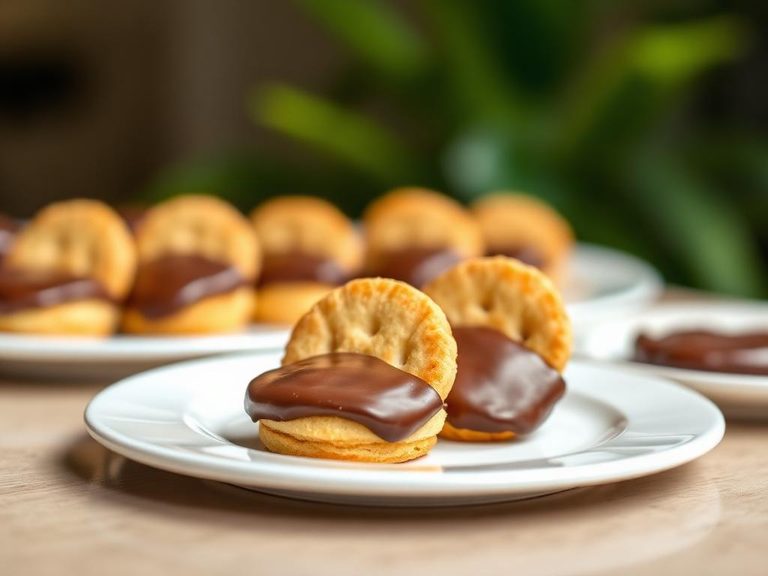
These are crisp biscuit sticks enrobed in a smooth layer of chocolate cream, offering a satisfying snap followed by a rich, sweet coating. The texture is a delightful contrast between the crunchy biscuit core and the creamy, melting exterior. Nutritionally, they are an energy-dense treat, primarily providing quick-release carbohydrates and fats.
Calorie split: 9% protein · 46% carbs · 45% fat
↓ Full nutrition💚 Why it's loved
People love them for the addictive combination of crunchy and creamy textures, and the familiar, comforting taste of chocolate and biscuit. They are also cherished for their versatility, often enjoyed as a standalone snack, a coffee companion, or a playful addition to dessert platters.
⚠️ Watch-outs & how to enjoy it better
The high sugar and fat content can lead to blood-sugar spikes and is not ideal for those managing weight or diabetes. To mitigate this, practice strict portion control (e.g., 3-4 sticks) and pair them with a source of protein or healthy fat, like a handful of nuts or a glass of milk, to slow sugar absorption. Those with gluten or dairy allergies should also be cautious.
Key benefits
- Provides a quick source of energy from carbohydrates
- Offers a convenient, portable snack format
- The biscuit base contributes a small amount of dietary fiber
- Can serve as a morale-boosting treat or dessert component
🍽️ Popular dishes

🌍 Where it's eaten
💡 Did you know?
The most iconic brand of this snack, Pocky, was invented in Japan in 1966 and its name was derived from the sound of the biscuit being bitten ('poki-poki').
Full nutrition (USDA data · scales with serving)
| Water | 15.1 g |
| Energy | 447 kcal |
| Energy | 1870 kj |
| Protein | 10.0 g |
| Total lipid (fat) | 22.5 g |
| Ash | 1.3 g |
| Carbohydrate, by difference | 51.1 g |
| Fiber, total dietary | 5.0 g |
| Total Sugars | 25.0 g |
| Calcium, Ca | 50.0 mg |
| Iron, Fe | 0.90 mg |
| Magnesium, Mg | 36.0 mg |
| Phosphorus, P | 184 mg |
| Potassium, K | 181 mg |
| Sodium, Na | 213 mg |
| Zinc, Zn | 0.90 mg |
| Copper, Cu | 0.23 mg |
| Selenium, Se | 14.7 ug |
| Vitamin C, total ascorbic acid | 0.00 mg |
| Thiamin | 0.07 mg |
| Riboflavin | 0.20 mg |
| Niacin | 0.64 mg |
| Vitamin B-6 | 0.05 mg |
| Folate, total | 17.0 ug |
| Folic acid | 0.00 ug |
| Folate, food | 17.0 ug |
| Folate, DFE | 17.0 ug |
| Choline, total | 4.4 mg |
| Vitamin B-12 | 0.40 ug |
| Vitamin B-12, added | 0.00 ug |
| Vitamin A, RAE | 1.0 ug |
| Retinol | 1.0 ug |
| Carotene, beta | 1.0 ug |
| Carotene, alpha | 0.00 ug |
| Cryptoxanthin, beta | 0.00 ug |
| Vitamin A, IU | 4.0 iu |
| Lycopene | 0.00 ug |
| Lutein + zeaxanthin | 7.0 ug |
| Vitamin E (alpha-tocopherol) | 8.9 mg |
| Vitamin E, added | 0.00 mg |
| Vitamin D (D2 + D3), International Units | 0.00 iu |
| Vitamin D (D2 + D3) | 0.00 ug |
| Vitamin K (phylloquinone) | 1.7 ug |
| Alcohol, ethyl | 0.00 g |
| Caffeine | 2.0 mg |
| Theobromine | 64.0 mg |
Fat & fatty acid profile (per 100g)
| Fatty acids, total saturated | 12.6 g |
| SFA 4:0 | 0.00 g |
| SFA 6:0 | 0.00 g |
| SFA 8:0 | 0.00 g |
| SFA 10:0 | 0.00 g |
| SFA 12:0 | 0.00 g |
| SFA 14:0 | 0.01 g |
| SFA 16:0 | 7.1 g |
| SFA 18:0 | 5.4 g |
| Fatty acids, total monounsaturated | 2.1 g |
| MUFA 16:1 | 0.00 g |
| MUFA 18:1 | 2.1 g |
| MUFA 20:1 | 0.00 g |
| MUFA 22:1 | 0.00 g |
| Fatty acids, total polyunsaturated | 6.7 g |
| PUFA 18:2 | 6.7 g |
| PUFA 18:3 | 0.01 g |
| PUFA 18:4 | 0.00 g |
| PUFA 20:4 | 0.00 g |
| PUFA 20:5 n-3 (EPA) | 0.00 g |
| PUFA 22:5 n-3 (DPA) | 0.00 g |
| PUFA 22:6 n-3 (DHA) | 0.00 g |
| Cholesterol | 0.00 mg |
Amino acid profile (per 100g)
Estimated from Cookies, animal crackers (includes arrowroot, tea biscuits) — USDA does not publish this profile for Cookies.
| Tryptophan | 0.10 g |
| Threonine | 0.19 g |
| Isoleucine | 0.26 g |
| Leucine | 0.47 g |
| Lysine | 0.24 g |
| Methionine | 0.12 g |
| Cystine | 0.15 g |
| Phenylalanine | 0.32 g |
| Tyrosine | 0.20 g |
| Valine | 0.30 g |
| Arginine | 0.26 g |
| Histidine | 0.14 g |
| Alanine | 0.21 g |
| Aspartic acid | 0.29 g |
| Glutamic acid | 2.3 g |
| Glycine | 0.23 g |
| Proline | 0.76 g |
| Serine | 0.36 g |
FAQ
Are chocolate cream covered biscuit sticks a healthy snack?
They are considered a treat rather than a health food due to their high sugar, fat, and calorie content. They should be consumed in moderation as part of a balanced diet.
Can I eat them if I have a gluten intolerance?
Most traditional versions contain wheat flour and are not gluten-free. You would need to seek out specifically labeled gluten-free alternatives.
How should I store them to keep them fresh?
Store them in a cool, dry place in an airtight container to prevent them from becoming stale or absorbing moisture, which can make them soggy.
Nutrient density (calculated · NRF9.3)
Nutrient Rich Foods index: beneficial nutrients (protein, fiber, vitamins, minerals) minus saturated fat, added sugar & sodium, per 100 kcal.
NRF9.3 index — Fulgoni, Keast & Drewnowski, 2009. Computed from USDA nutrients.
Weight-loss friendliness (composite index)
Energy density 4.47 kcal/g · 9% calories from protein · 5.0 g fiber · 25.0 g sugar per 100 g.
Composite of energy density (Rolls et al., 1999), protein & fiber satiety, minus sugar. A calculated heuristic — ranks satiety-per-calorie, not a clinical measure.
Dietary load (calculated from USDA values)
Potential renal acid load. Positive = acid-forming, negative = alkaline-forming.
Sodium-to-potassium ratio: 1.18 (lower is better — aim for ≤ 1)
Sodium:potassium per WHO potassium guidance. Computed from USDA nutrients.