

Chicken thigh, baked, coated, skin / coating eaten
Common food

Photo: Wikipedia
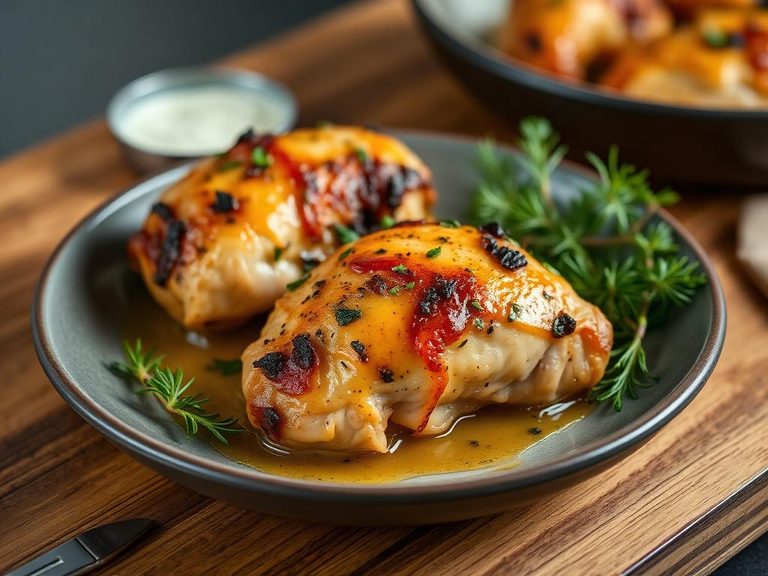
A baked chicken thigh, often with a flavorful coating or crispy skin, offers a juicy, tender bite with a rich, savory taste. The coating or skin provides a satisfying crunch, contrasting with the moist meat inside. It's a high-protein, moderate-fat option that delivers substantial energy and flavor.
Calorie split: 36% protein · 7% carbs · 57% fat
↓ Full nutrition💚 Why it's loved
People adore the irresistible combination of crispy, seasoned skin and succulent, flavorful meat that stays juicy after baking. It's a versatile centerpiece for weeknight dinners or casual gatherings, deeply embedded in comfort food traditions worldwide.
⚠️ Watch-outs & how to enjoy it better
The skin and coating significantly increase the fat and calorie content compared to skinless chicken. Those monitoring saturated fat intake or following strict low-fat diets should be cautious. Tip: Pair with a large portion of non-starchy vegetables (like roasted broccoli or a green salad) to add volume and fiber without excess calories. You can also remove the skin after cooking to reduce fat intake while still enjoying the seasoned meat.
Key benefits
- Excellent source of high-quality protein for muscle maintenance.
- Rich in iron and zinc, essential minerals for immune function.
- Contains B vitamins like niacin and B6 for energy metabolism.
- Provides healthy fats, including monounsaturated fats from the skin.
- More flavorful and moist than chicken breast for many palates.
🍽️ Popular dishes


🌍 Where it's eaten
💡 Did you know?
Chicken thighs contain more myoglobin than breast meat, which is why they are darker in color and have a richer, more 'meaty' flavor that holds up exceptionally well to high-heat cooking methods like baking.
Full nutrition (USDA data · scales with serving)
| Water | 59.1 g |
| Energy | 240 kcal |
| Protein | 21.0 g |
| Total lipid (fat) | 15.0 g |
| Carbohydrate, by difference | 4.0 g |
| Fiber, total dietary | 0.20 g |
| Total Sugars | 0.07 g |
| Calcium, Ca | 13.0 mg |
| Iron, Fe | 1.2 mg |
| Magnesium, Mg | 21.0 mg |
| Phosphorus, P | 196 mg |
| Potassium, K | 229 mg |
| Sodium, Na | 420 mg |
| Zinc, Zn | 1.6 mg |
| Copper, Cu | 0.06 mg |
| Selenium, Se | 23.1 ug |
| Vitamin C, total ascorbic acid | 0.00 mg |
| Thiamin | 0.13 mg |
| Riboflavin | 0.19 mg |
| Niacin | 5.4 mg |
| Vitamin B-6 | 0.37 mg |
| Folate, total | 12.0 ug |
| Folic acid | 7.0 ug |
| Folate, food | 5.0 ug |
| Folate, DFE | 16.0 ug |
| Choline, total | 61.3 mg |
| Vitamin B-12 | 0.39 ug |
| Vitamin B-12, added | 0.00 ug |
| Vitamin A, RAE | 15.0 ug |
| Retinol | 15.0 ug |
| Carotene, beta | 0.00 ug |
| Carotene, alpha | 0.00 ug |
| Cryptoxanthin, beta | 0.00 ug |
| Lycopene | 0.00 ug |
| Lutein + zeaxanthin | 18.0 ug |
| Vitamin E (alpha-tocopherol) | 0.55 mg |
| Vitamin E, added | 0.00 mg |
| Vitamin D (D2 + D3) | 0.20 ug |
| Vitamin K (phylloquinone) | 4.9 ug |
| Alcohol, ethyl | 0.00 g |
| Caffeine | 0.00 mg |
| Theobromine | 0.00 mg |
Fat & fatty acid profile (per 100g)
| Fatty acids, total saturated | 3.9 g |
| SFA 4:0 | 0.00 g |
| SFA 6:0 | 0.00 g |
| SFA 8:0 | 0.00 g |
| SFA 10:0 | 0.00 g |
| SFA 12:0 | 0.01 g |
| SFA 14:0 | 0.07 g |
| SFA 16:0 | 3.0 g |
| SFA 18:0 | 0.75 g |
| Fatty acids, total monounsaturated | 6.3 g |
| MUFA 16:1 | 0.80 g |
| MUFA 18:1 | 5.4 g |
| MUFA 20:1 | 0.08 g |
| MUFA 22:1 | 0.00 g |
| Fatty acids, total polyunsaturated | 3.4 g |
| PUFA 18:2 | 3.0 g |
| PUFA 18:3 | 0.20 g |
| PUFA 18:4 | 0.00 g |
| PUFA 20:4 | 0.09 g |
| PUFA 20:5 n-3 (EPA) | 0.01 g |
| PUFA 22:5 n-3 (DPA) | 0.01 g |
| PUFA 22:6 n-3 (DHA) | 0.00 g |
| Cholesterol | 118 mg |
Amino acid profile (per 100g)
Estimated from Chicken, broilers or fryers, dark meat, thigh, meat only, raw — USDA does not publish this profile for Chicken thigh.
| Tryptophan | 0.22 g |
| Threonine | 0.93 g |
| Isoleucine | 0.94 g |
| Leucine | 1.7 g |
| Lysine | 1.9 g |
| Methionine | 0.56 g |
| Cystine | 0.23 g |
| Phenylalanine | 0.79 g |
| Tyrosine | 0.74 g |
| Valine | 0.96 g |
| Arginine | 1.4 g |
| Histidine | 0.59 g |
| Alanine | 1.2 g |
| Aspartic acid | 1.9 g |
| Glutamic acid | 3.2 g |
| Glycine | 0.90 g |
| Proline | 0.79 g |
| Serine | 0.82 g |
FAQ
Why is baked chicken thigh often higher in calories than baked chicken breast?
The primary reason is the skin and the higher natural fat content of dark meat. The skin is rich in fat, and the thigh meat itself contains more intramuscular fat than the lean breast, leading to a higher calorie density per 100g.
How can I make baked chicken thighs healthier without sacrificing flavor?
You can remove the skin before eating, use a light coating of whole-grain breadcrumbs or crushed nuts instead of a heavy batter, and season generously with herbs, spices, and citrus zest to boost flavor without added fat or sodium.
Is the coating on baked chicken thighs typically a common allergen?
Yes, very often. Most coatings contain wheat flour (gluten) and sometimes eggs or dairy. Always check the ingredients if you have food allergies, and consider using gluten-free flour or crushed rice cereal for the coating.
Nutrient density (calculated · NRF9.3)
Nutrient Rich Foods index: beneficial nutrients (protein, fiber, vitamins, minerals) minus saturated fat, added sugar & sodium, per 100 kcal.
NRF9.3 index — Fulgoni, Keast & Drewnowski, 2009. Computed from USDA nutrients.
Weight-loss friendliness (composite index)
Energy density 2.40 kcal/g · 35% calories from protein · 0.2 g fiber · 0.1 g sugar per 100 g.
Composite of energy density (Rolls et al., 1999), protein & fiber satiety, minus sugar. A calculated heuristic — ranks satiety-per-calorie, not a clinical measure.
Dietary load (calculated from USDA values)
Potential renal acid load. Positive = acid-forming, negative = alkaline-forming.
Sodium-to-potassium ratio: 1.83 (lower is better — aim for ≤ 1)
Sodium:potassium per WHO potassium guidance. Computed from USDA nutrients.