

Chicken tenders or strips, NFS
Common food
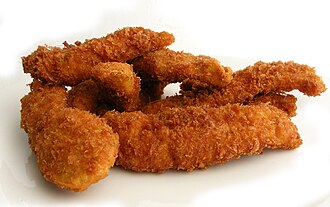
Photo: Wikipedia
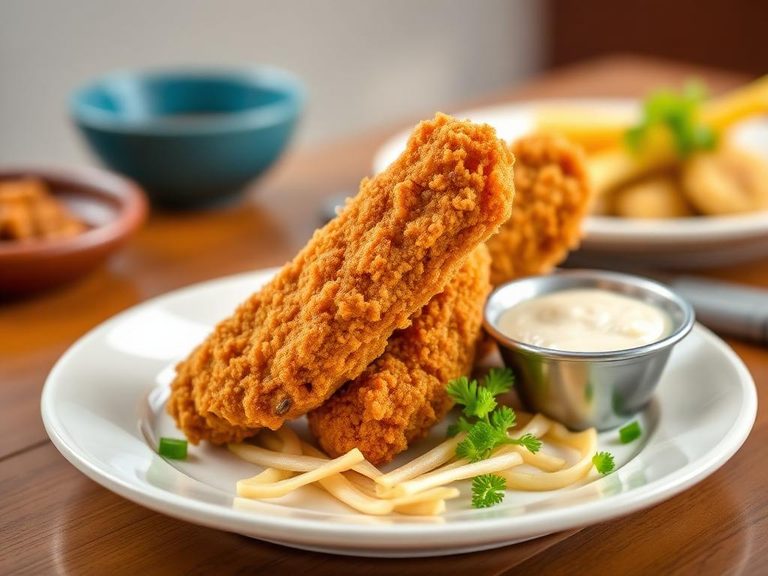
Chicken tenders, also known as strips or fingers, are the tender, inner pectoral muscles of a chicken breast, prized for their mild flavor and juicy, succulent texture when cooked. They are a lean protein powerhouse, offering nearly 20 grams of high-quality protein per 100 grams with a moderate amount of healthy fats. Typically breaded and fried to a golden crisp, they deliver a satisfying crunch that gives way to tender meat.
Calorie split: 28% protein · 25% carbs · 46% fat
↓ Full nutrition💚 Why it's loved
People adore chicken tenders for their universally appealing, mild taste and the irresistible contrast of a crispy, seasoned coating with juicy, tender meat inside. They are a beloved comfort food staple, especially for children and in casual dining, symbolizing simple, satisfying indulgence.
⚠️ Watch-outs & how to enjoy it better
The primary downside is that traditional deep-frying significantly increases calorie, fat, and sodium content, which can be a concern for heart health or blood sugar management. To counteract this, opt for baking, air-frying, or grilling the tenders, and pair them with fiber-rich vegetables or a salad to balance the meal and slow carbohydrate absorption.
Key benefits
- Excellent source of lean, complete protein for muscle maintenance and sati.
- Provides essential B vitamins like niacin and B6 for energy metabolism.
- Contains minerals such as selenium and phosphorus for immune and bone health.
- Versatile base for various flavor profiles and cooking methods.
🍽️ Popular dishes
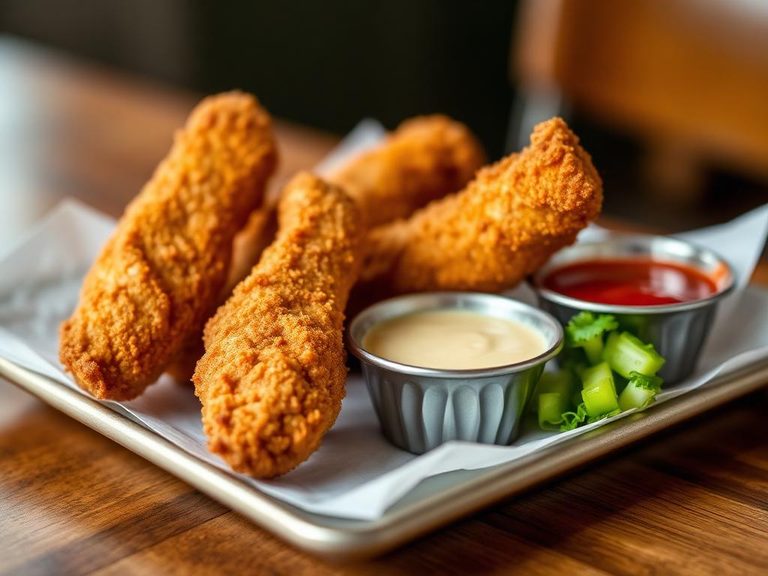
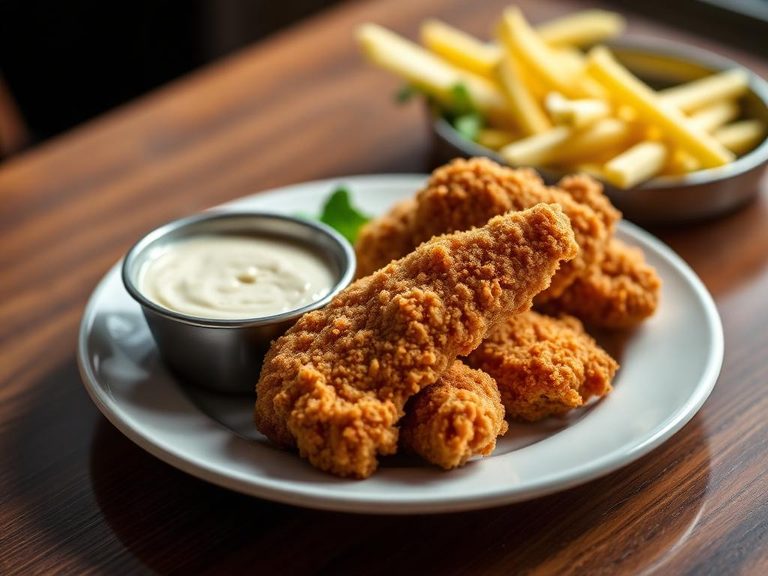

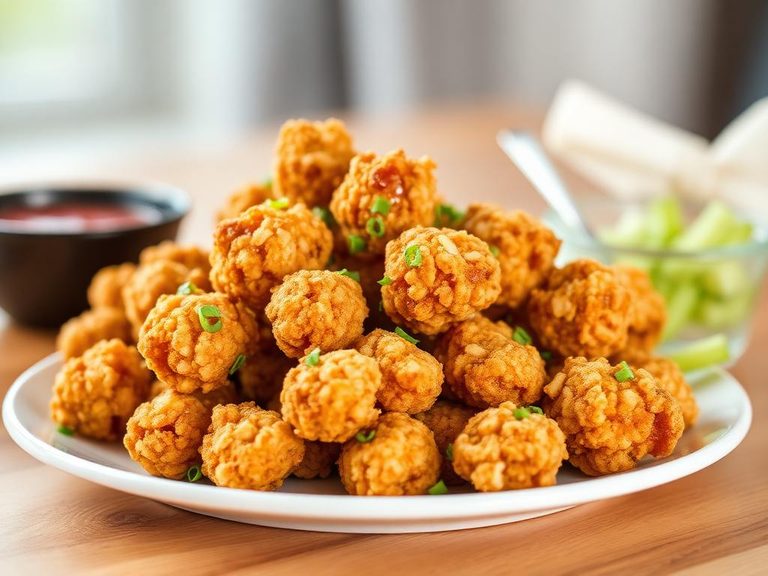
🌍 Where it's eaten
💡 Did you know?
The term 'chicken finger' is believed to have originated in the 1970s in the northeastern United States, with the first restaurant to trademark a specific recipe being The Puritan Backroom in Manchester, New Hampshire, in 1974.
Full nutrition (USDA data · scales with serving)
| Water | 46.6 g |
| Energy | 271 kcal |
| Protein | 19.2 g |
| Total lipid (fat) | 13.9 g |
| Carbohydrate, by difference | 17.3 g |
| Fiber, total dietary | 1.2 g |
| Total Sugars | 0.40 g |
| Calcium, Ca | 17.0 mg |
| Iron, Fe | 0.73 mg |
| Magnesium, Mg | 28.0 mg |
| Phosphorus, P | 282 mg |
| Potassium, K | 373 mg |
| Sodium, Na | 769 mg |
| Zinc, Zn | 0.71 mg |
| Copper, Cu | 0.07 mg |
| Selenium, Se | 17.5 ug |
| Vitamin C, total ascorbic acid | 1.1 mg |
| Thiamin | 0.11 mg |
| Riboflavin | 0.18 mg |
| Niacin | 8.2 mg |
| Vitamin B-6 | 0.43 mg |
| Folate, total | 19.0 ug |
| Folic acid | 6.0 ug |
| Folate, food | 13.0 ug |
| Folate, DFE | 23.0 ug |
| Choline, total | 43.7 mg |
| Vitamin B-12 | 0.16 ug |
| Vitamin B-12, added | 0.00 ug |
| Vitamin A, RAE | 3.0 ug |
| Retinol | 2.0 ug |
| Carotene, beta | 2.0 ug |
| Carotene, alpha | 0.00 ug |
| Cryptoxanthin, beta | 0.00 ug |
| Lycopene | 0.00 ug |
| Lutein + zeaxanthin | 83.0 ug |
| Vitamin E (alpha-tocopherol) | 3.2 mg |
| Vitamin E, added | 0.00 mg |
| Vitamin D (D2 + D3) | 0.20 ug |
| Vitamin K (phylloquinone) | 8.0 ug |
| Alcohol, ethyl | 0.00 g |
| Caffeine | 0.00 mg |
| Theobromine | 0.00 mg |
Fat & fatty acid profile (per 100g)
| Fatty acids, total saturated | 2.5 g |
| SFA 4:0 | 0.00 g |
| SFA 6:0 | 0.00 g |
| SFA 8:0 | 0.00 g |
| SFA 10:0 | 0.00 g |
| SFA 12:0 | 0.00 g |
| SFA 14:0 | 0.03 g |
| SFA 16:0 | 1.8 g |
| SFA 18:0 | 0.41 g |
| Fatty acids, total monounsaturated | 4.8 g |
| MUFA 16:1 | 0.05 g |
| MUFA 18:1 | 4.7 g |
| MUFA 20:1 | 0.11 g |
| MUFA 22:1 | 0.01 g |
| Fatty acids, total polyunsaturated | 5.8 g |
| PUFA 18:2 | 5.5 g |
| PUFA 18:3 | 0.23 g |
| PUFA 18:4 | 0.00 g |
| PUFA 20:4 | 0.04 g |
| PUFA 20:5 n-3 (EPA) | 0.00 g |
| PUFA 22:5 n-3 (DPA) | 0.00 g |
| PUFA 22:6 n-3 (DHA) | 0.00 g |
| Cholesterol | 48.0 mg |
Amino acid profile (per 100g)
Estimated from APPLEBEE'S, chicken tenders, from kids' menu — USDA does not publish this profile for Chicken tenders or strips.
| Tryptophan | 0.20 g |
| Threonine | 0.58 g |
| Isoleucine | 0.95 g |
| Leucine | 1.5 g |
| Lysine | 1.3 g |
| Methionine | 0.49 g |
| Cystine | 0.23 g |
| Phenylalanine | 0.76 g |
| Tyrosine | 0.51 g |
| Valine | 1.1 g |
| Arginine | 1.1 g |
| Histidine | 0.68 g |
| Alanine | 1.0 g |
| Aspartic acid | 1.7 g |
| Glutamic acid | 3.3 g |
| Glycine | 0.79 g |
| Proline | 1.2 g |
| Serine | 0.58 g |
| Hydroxyproline | 0.03 g |
FAQ
Are chicken tenders the same as chicken breast?
No. Chicken tenders (or tenderloins) are a specific, small strip of muscle located underneath the breast. They are naturally more tender than the breast meat but are often used interchangeably in recipes when cut into strips.
What's the healthiest way to cook chicken tenders?
Baking or air-frying are the healthiest methods. They achieve a crispy exterior with minimal added oil. Using whole-grain breadcrumbs or a light coating of spices instead of heavy batter also reduces refined carbs and calories.
Why are my chicken tenders always dry?
Chicken tenders are very lean and cook quickly, making them prone to drying out. Avoid overcooking by using a meat thermometer (aim for 165°F/74°C internal temp). Brining them in salt water for 30 minutes before cooking can also help lock in moisture.
Nutrient density (calculated · NRF9.3)
Nutrient Rich Foods index: beneficial nutrients (protein, fiber, vitamins, minerals) minus saturated fat, added sugar & sodium, per 100 kcal.
NRF9.3 index — Fulgoni, Keast & Drewnowski, 2009. Computed from USDA nutrients.
Weight-loss friendliness (composite index)
Energy density 2.71 kcal/g · 28% calories from protein · 1.2 g fiber · 0.4 g sugar per 100 g.
Composite of energy density (Rolls et al., 1999), protein & fiber satiety, minus sugar. A calculated heuristic — ranks satiety-per-calorie, not a clinical measure.
Dietary load (calculated from USDA values)
Potential renal acid load. Positive = acid-forming, negative = alkaline-forming.
Sodium-to-potassium ratio: 2.06 (lower is better — aim for ≤ 1)
Sodium:potassium per WHO potassium guidance. Computed from USDA nutrients.