

Chicken or turkey chow mein or chop suey, no noodles
Common food

Photo: Wikipedia
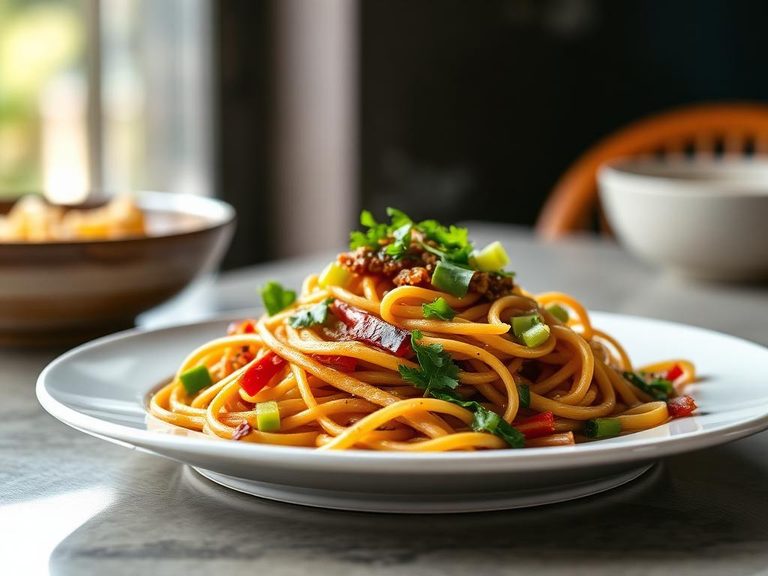
This is a classic Chinese-American stir-fry of tender chicken or turkey strips with a colorful medley of crisp vegetables like celery, bean sprouts, and onions, all coated in a savory, umami-rich brown sauce. The dish is defined by its satisfying contrast of textures—soft protein against crunchy vegetables—and a deep, savory flavor profile without the heaviness of noodles. Nutritionally, it's a lean, high-protein option that delivers significant flavor and satiety for very few calories.
Calorie split: 47% protein · 18% carbs · 35% fat
↓ Full nutrition💚 Why it's loved
People adore it for its perfect balance of savory, slightly sweet, and salty flavors, all carried by a glossy sauce that coats every bite. It's a beloved takeout staple that offers the comfort of a warm, hearty stir-fry without the carb-heavy noodles, making it a versatile and satisfying choice.
⚠️ Watch-outs & how to enjoy it better
The primary concern is the often high sodium content from soy sauce and other seasonings, which can be problematic for blood pressure management. To counteract this, you can request 'light sauce' when ordering, use low-sodium soy sauce if cooking at home, and pair it with a potassium-rich food like a side of steamed broccoli or a small banana to help balance sodium levels.
Key benefits
- Excellent source of lean protein for muscle maintenance
- Very low in calories, aiding in weight management
- Provides a variety of vegetables for micronutrients and fiber
- Quick to prepare, making it a convenient meal option
- Can be easily customized with preferred vegetables
🍽️ Popular dishes

🌍 Where it's eaten
💡 Did you know?
The term 'chop suey' is widely believed to be an Americanization of the Cantonese 'tsap seui,' which literally means 'miscellaneous leftovers,' reflecting its origins as a quick dish made from available odds and ends.
Full nutrition (USDA data · scales with serving)
| Water | 82.1 g |
| Energy | 83.0 kcal |
| Protein | 9.8 g |
| Total lipid (fat) | 3.2 g |
| Carbohydrate, by difference | 3.8 g |
| Fiber, total dietary | 0.80 g |
| Total Sugars | 1.8 g |
| Calcium, Ca | 21.0 mg |
| Iron, Fe | 0.52 mg |
| Magnesium, Mg | 14.0 mg |
| Phosphorus, P | 99.0 mg |
| Potassium, K | 183 mg |
| Sodium, Na | 344 mg |
| Zinc, Zn | 0.66 mg |
| Copper, Cu | 0.04 mg |
| Selenium, Se | 8.2 ug |
| Vitamin C, total ascorbic acid | 4.8 mg |
| Thiamin | 0.04 mg |
| Riboflavin | 0.13 mg |
| Niacin | 2.9 mg |
| Vitamin B-6 | 0.14 mg |
| Folate, total | 30.0 ug |
| Folic acid | 0.00 ug |
| Folate, food | 29.0 ug |
| Folate, DFE | 29.0 ug |
| Choline, total | 32.6 mg |
| Vitamin B-12 | 0.12 ug |
| Vitamin B-12, added | 0.00 ug |
| Vitamin A, RAE | 11.0 ug |
| Retinol | 3.0 ug |
| Carotene, beta | 99.0 ug |
| Carotene, alpha | 19.0 ug |
| Cryptoxanthin, beta | 0.00 ug |
| Lycopene | 0.00 ug |
| Lutein + zeaxanthin | 119 ug |
| Vitamin E (alpha-tocopherol) | 0.47 mg |
| Vitamin E, added | 0.00 mg |
| Vitamin D (D2 + D3) | 0.00 ug |
| Vitamin K (phylloquinone) | 12.6 ug |
| Alcohol, ethyl | 0.00 g |
| Caffeine | 0.00 mg |
| Theobromine | 0.00 mg |
Fat & fatty acid profile (per 100g)
| Fatty acids, total saturated | 0.72 g |
| SFA 4:0 | 0.00 g |
| SFA 6:0 | 0.00 g |
| SFA 8:0 | 0.00 g |
| SFA 10:0 | 0.00 g |
| SFA 12:0 | 0.00 g |
| SFA 14:0 | 0.01 g |
| SFA 16:0 | 0.55 g |
| SFA 18:0 | 0.15 g |
| Fatty acids, total monounsaturated | 1.2 g |
| MUFA 16:1 | 0.15 g |
| MUFA 18:1 | 1.0 g |
| MUFA 20:1 | 0.01 g |
| MUFA 22:1 | 0.00 g |
| Fatty acids, total polyunsaturated | 0.93 g |
| PUFA 18:2 | 0.81 g |
| PUFA 18:3 | 0.11 g |
| PUFA 18:4 | 0.00 g |
| PUFA 20:4 | 0.01 g |
| PUFA 20:5 n-3 (EPA) | 0.00 g |
| PUFA 22:5 n-3 (DPA) | 0.00 g |
| PUFA 22:6 n-3 (DHA) | 0.00 g |
| Cholesterol | 37.0 mg |
Amino acid profile (per 100g)
Estimated from Turnover, chicken- or turkey-, and vegetable-filled, reduced fat, frozen — USDA does not publish this profile for Chicken or turkey chow mein or chop suey.
| Tryptophan | 0.16 g |
| Threonine | 0.41 g |
| Isoleucine | 0.47 g |
| Leucine | 0.80 g |
| Lysine | 0.61 g |
| Methionine | 0.23 g |
| Cystine | 0.13 g |
| Phenylalanine | 0.47 g |
| Tyrosine | 0.37 g |
| Valine | 0.53 g |
| Arginine | 0.51 g |
| Histidine | 0.30 g |
| Alanine | 0.45 g |
| Aspartic acid | 0.80 g |
| Glutamic acid | 2.2 g |
| Glycine | 0.38 g |
| Proline | 0.87 g |
| Serine | 0.42 g |
| Hydroxyproline | 0.00 g |
FAQ
Is chicken or turkey chow mein without noodles the same as chop suey?
In most American Chinese restaurants, the terms are used interchangeably for a stir-fry of meat and vegetables in a brown sauce. Chow mein technically refers to a noodle dish, so specifying 'no noodles' makes it functionally identical to chop suey.
What vegetables are typically in it?
Common vegetables include celery, onions, bean sprouts, carrots, cabbage, and water chestnuts. The mix can vary by restaurant or home recipe, but the goal is a combination of crunchy textures.
How can I make it healthier at home?
Use low-sodium soy sauce, load up on non-starchy vegetables like broccoli and bell peppers, and control the portion of sauce. Using lean turkey breast and cooking with minimal oil also keeps it light.
Nutrient density (calculated · NRF9.3)
Nutrient Rich Foods index: beneficial nutrients (protein, fiber, vitamins, minerals) minus saturated fat, added sugar & sodium, per 100 kcal.
NRF9.3 index — Fulgoni, Keast & Drewnowski, 2009. Computed from USDA nutrients.
Weight-loss friendliness (composite index)
Energy density 0.83 kcal/g · 47% calories from protein · 0.8 g fiber · 1.8 g sugar per 100 g.
Composite of energy density (Rolls et al., 1999), protein & fiber satiety, minus sugar. A calculated heuristic — ranks satiety-per-calorie, not a clinical measure.
Dietary load (calculated from USDA values)
Potential renal acid load. Positive = acid-forming, negative = alkaline-forming.
Sodium-to-potassium ratio: 1.88 (lower is better — aim for ≤ 1)
Sodium:potassium per WHO potassium guidance. Computed from USDA nutrients.