

Chicken drumstick, sauteed, skin eaten
Common food

Photo: Wikipedia
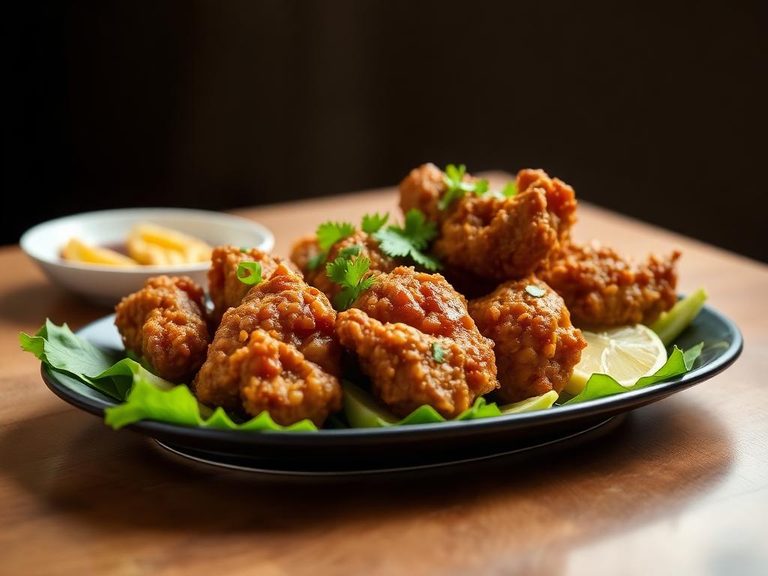
A single, sautéed chicken drumstick with the skin on is a savory, golden-brown delight, offering a satisfying contrast between the crispy, rendered skin and the juicy, tender dark meat beneath. With over 22g of protein per 100g and zero carbs, it's a powerfully lean and satiating meal component, delivering rich flavor without any dietary filler.
Calorie split: 46% protein · 0% carbs · 54% fat
↓ Full nutrition💚 Why it's loved
People adore it for the simple, primal satisfaction of eating juicy, flavorful dark meat, where the skin becomes a prized, crispy treat. Its versatility makes it a staple in home kitchens worldwide, easily adapted to countless marinades and seasonings.
⚠️ Watch-outs & how to enjoy it better
The skin and dark meat are higher in saturated fat than skinless breast, which may be a concern for some dietary plans. To enjoy it healthily, practice portion control (one drumstick is a typical serving), and pair it with high-fiber vegetables like roasted broccoli or a leafy salad to balance the meal.
Key benefits
- Excellent source of complete protein for muscle maintenance.
- Provides essential minerals like selenium and phosphorus.
- Skin adds flavor and helps retain moisture during cooking.
- Zero carbohydrates, suitable for ketogenic and low-carb diets.
🍽️ Popular dishes
🌍 Where it's eaten
💡 Did you know?
The drumstick's name comes from its resemblance to a musical drumstick, not from any specific cut or preparation method.
Full nutrition (USDA data · scales with serving)
| Water | 64.5 g |
| Energy | 204 kcal |
| Protein | 22.7 g |
| Total lipid (fat) | 11.8 g |
| Carbohydrate, by difference | 0.00 g |
| Fiber, total dietary | 0.00 g |
| Total Sugars | 0.00 g |
| Calcium, Ca | 11.0 mg |
| Iron, Fe | 1.1 mg |
| Magnesium, Mg | 21.0 mg |
| Phosphorus, P | 190 mg |
| Potassium, K | 240 mg |
| Sodium, Na | 427 mg |
| Zinc, Zn | 2.3 mg |
| Copper, Cu | 0.07 mg |
| Selenium, Se | 26.2 ug |
| Vitamin C, total ascorbic acid | 0.00 mg |
| Thiamin | 0.09 mg |
| Riboflavin | 0.20 mg |
| Niacin | 5.3 mg |
| Vitamin B-6 | 0.37 mg |
| Folate, total | 4.0 ug |
| Folic acid | 0.00 ug |
| Folate, food | 4.0 ug |
| Folate, DFE | 4.0 ug |
| Choline, total | 65.9 mg |
| Vitamin B-12 | 0.38 ug |
| Vitamin B-12, added | 0.00 ug |
| Vitamin A, RAE | 12.0 ug |
| Retinol | 12.0 ug |
| Carotene, beta | 0.00 ug |
| Carotene, alpha | 0.00 ug |
| Cryptoxanthin, beta | 0.00 ug |
| Lycopene | 0.00 ug |
| Lutein + zeaxanthin | 11.0 ug |
| Vitamin E (alpha-tocopherol) | 0.56 mg |
| Vitamin E, added | 0.00 mg |
| Vitamin D (D2 + D3) | 0.10 ug |
| Vitamin K (phylloquinone) | 5.1 ug |
| Alcohol, ethyl | 0.00 g |
| Caffeine | 0.00 mg |
| Theobromine | 0.00 mg |
Fat & fatty acid profile (per 100g)
| Fatty acids, total saturated | 2.9 g |
| SFA 4:0 | 0.00 g |
| SFA 6:0 | 0.00 g |
| SFA 8:0 | 0.00 g |
| SFA 10:0 | 0.00 g |
| SFA 12:0 | 0.01 g |
| SFA 14:0 | 0.05 g |
| SFA 16:0 | 2.2 g |
| SFA 18:0 | 0.59 g |
| Fatty acids, total monounsaturated | 4.9 g |
| MUFA 16:1 | 0.61 g |
| MUFA 18:1 | 4.2 g |
| MUFA 20:1 | 0.06 g |
| MUFA 22:1 | 0.00 g |
| Fatty acids, total polyunsaturated | 2.8 g |
| PUFA 18:2 | 2.4 g |
| PUFA 18:3 | 0.17 g |
| PUFA 18:4 | 0.00 g |
| PUFA 20:4 | 0.10 g |
| PUFA 20:5 n-3 (EPA) | 0.00 g |
| PUFA 22:5 n-3 (DPA) | 0.01 g |
| PUFA 22:6 n-3 (DHA) | 0.01 g |
| Cholesterol | 126 mg |
Amino acid profile (per 100g)
Estimated from Chicken, broilers or fryers, dark meat, drumstick, meat only, raw — USDA does not publish this profile for Chicken drumstick.
| Tryptophan | 0.22 g |
| Threonine | 0.92 g |
| Isoleucine | 0.93 g |
| Leucine | 1.7 g |
| Lysine | 1.8 g |
| Methionine | 0.56 g |
| Cystine | 0.23 g |
| Phenylalanine | 0.78 g |
| Tyrosine | 0.73 g |
| Valine | 0.94 g |
| Arginine | 1.4 g |
| Histidine | 0.58 g |
| Alanine | 1.2 g |
| Aspartic acid | 1.9 g |
| Glutamic acid | 3.2 g |
| Glycine | 0.89 g |
| Proline | 0.78 g |
| Serine | 0.81 g |
FAQ
Is the skin nutritious?
Chicken skin is primarily fat, which adds flavor and calories. It contains some protein and collagen, but for a lower-fat option, it's best removed before or after cooking.
How do I get the skin crispy?
Pat the drumstick completely dry with paper towels, season well, and cook in a hot skillet with a little oil, starting skin-side down without moving it until deeply golden and crisp.
Is dark meat less healthy than white meat?
Dark meat like drumsticks has slightly more fat and calories but also more iron and zinc. Both are excellent protein sources; the choice often comes down to personal taste and dietary goals.
Nutrient density (calculated · NRF9.3)
Nutrient Rich Foods index: beneficial nutrients (protein, fiber, vitamins, minerals) minus saturated fat, added sugar & sodium, per 100 kcal.
NRF9.3 index — Fulgoni, Keast & Drewnowski, 2009. Computed from USDA nutrients.
Weight-loss friendliness (composite index)
Energy density 2.04 kcal/g · 45% calories from protein · 0.0 g fiber · 0.0 g sugar per 100 g.
Composite of energy density (Rolls et al., 1999), protein & fiber satiety, minus sugar. A calculated heuristic — ranks satiety-per-calorie, not a clinical measure.
Dietary load (calculated from USDA values)
Potential renal acid load. Positive = acid-forming, negative = alkaline-forming.
Sodium-to-potassium ratio: 1.78 (lower is better — aim for ≤ 1)
Sodium:potassium per WHO potassium guidance. Computed from USDA nutrients.